
When we address digital transformation, we often look for big and major transformations such as ERP models and smart computers, but we often tend to miss the daily operations that are impacted by the same.
One similar example of this phenomenon is the use of PDF creation. Although it appears simple and minor, even the greatest organizations have their entire workload dependent on the flow of these PDFs.
This is what makes an online PDF translator an important addition in the workplace.
An online PDF translator can reduce some of this friction by processing the document as a complete file instead of forcing employees to translate sections one by one.
Business PDFs merely contain plain paragraphs only.
They may contain:
When employees draw text and translate it separately, much of that structure can disappear.
A value in a specification table only makes sense when it stays combined to the correct row and column. An instruction in a maintenance manual is easy to follow when the relevant diagram remains nearby.
This means the real task is not simply conveying words.
It is producing translated information that people can still bring to use without spending additional time reconstructing the document.
Consider a procurement team viewing a 60-page equipment manual from an overseas supplier.
A manual workflow might indulge :
None of these procedures seems particularly difficult.
The problem is continuation.
When purchasing, engineering, operations, and management all work with international documentation, the same little tasks can occur hundreds of times.
A section gets pasted into the unaligned place. A table loses its column relationships. One department works from an unattended translated version. Another employee translates the same terminology again.
The translation itself may only take seconds.
The surrounding document work can take much more time.
For text-based PDFs, document-level translation can lessen the amount of reconstruction required afterward.
Instead of drawing every paragraph separately, a PDF translation tool can attempt to preserve elements such as headings, tables, images, fonts, and multi-column layouts while translating the content.
This is particularly useful in corresponding environments.
A supplier manual is easier for an engineer to view when it still resembles the source document.
A translated market report is easier to rely on when charts remain close to the relevant commentary.
A translated SOP is easier to distinguish from the original when its heading structure remains recognisable.
The objective is not to ensure that every page will look identical.
Different languages require various amounts of space, so line breaks, table dimensions, and page layouts may change.
The practical benefit is reducing the quantity of manual formatting required before employees can actually use the information.
Manufacturing and supply-chain teams often notice this problem because they regularly work with documentation from different markets.
Equipment may be bought from one country, installed in another, and maintained by a local team.
That creates a constant flow of installation manuals, maintenance guides, specifications, operating procedures, quality documents, and supplier instructions.
Engineers should spend their time checking technical data, not rebuilding translated manuals.
Purchasing teams may get quotations, product catalogues, packaging specifications, compliance material, and commercial ads in several languages.
Sometimes they only need an urgent working translation to decide whether a supplier deserves further evaluation.
The faster employees can move from attaining the document to understanding it, the less administrative work sits between information and decision-making.
Automation is most reliable when it removes repetitive steps without removing necessary human judgement.
AI can help with:
People should still focus on the data where errors matter.
Technical terminology, measurements, legal clauses, safety instructions, financial figures, and crucial procedures deserve closer review.
An internal market report used for general understanding does not need the same level of scrutiny as a contract or safety document.
This simple distinction prevents teams from manually checking every sentence while still preserving high-value information.
Global teams can also lose time when various employees translate the same technical term in different ways.
A small shared glossary containing approved product names, equipment terminology, abbreviations, and process terms can lessen repeated discussion and make later reviews faster.
AI handles volume.
People provide constance where it matters.
Translation is often only a single part of the PDF workflow.
A large manual may need to be bifurcated into chapters. Several sections may later need to be combined. A translated document may need reduction before being sent by email or uploaded to another system.
Using several unrelated applications generates another sequence of small tasks:
download the file, rename it, upload it elsewhere, download another version, then decide which result is current.
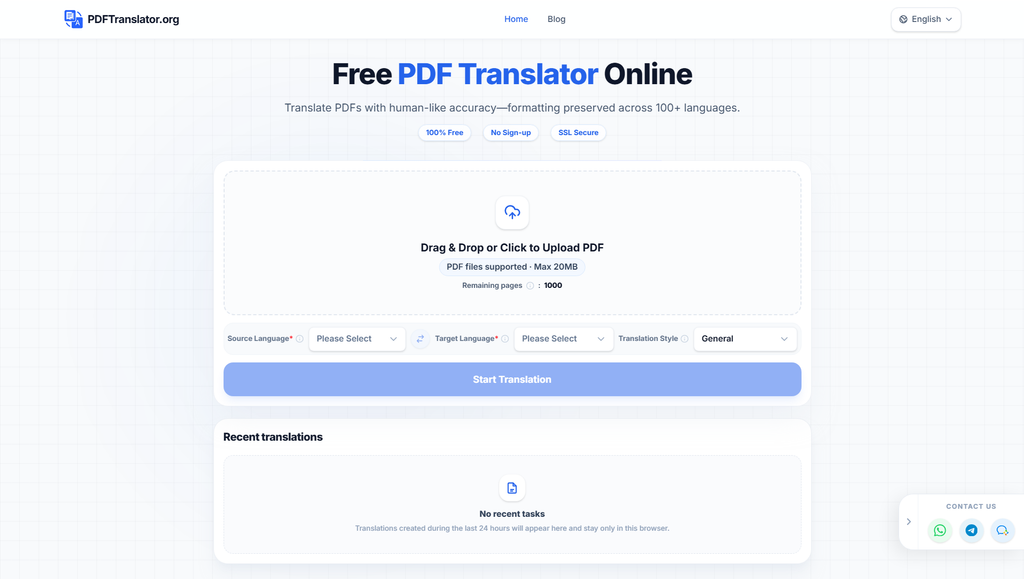
PDFTranslator combines translation with PDF splitting, merging, and combining tools in the browser. It supports more than 100 languages, offers up to 1,000 free pages per calendar month, does not require an account or credit card, and strengthens individual text-based PDFs up to 20MB.
For teams that only work on documents periodically, reducing those tool handoffs can be just as useful as making the translation itself faster.
A practical workflow does not require a complicated automation system.
Before translating a document, teams can enquire three questions:
Is it being used for general understanding, operational work, or a high-risk call?
Focus on terminology, figures, measurements, tables, processes, and other information where an error would matter.
Supplier agreements, technical documents, and internal SOPs may comprise confidential information.
PDFTranslator states that files are processed using SSL-secured transfer and normally deleted within 24 hours. Even so, organizations should continue to decide whether highly sensitive engineering data, credentials, restricted customer information, or legal material belongs in an online workflow.
The goal is not to generate another complicated policy.
It is to make a few major decisions before automation begins.
Companies often assume automation is something happening inside factories, ERP systems, or analytics platforms.
In reality, a lot of productivity loss occurs between those systems.
A supplier emails a PDF.
An engineer needs to decipher it.
A purchasing manager requires the specification section.
Management requires a translated summary.
If every step requires copying, reformatting, renaming, and sending another document, a simple language barrier turns into a chain of operational delays.
Improving that process does not require rebuilding the company’s entire infrastructure.
Sometimes the useful automation opportunity is much reduced.
Translate the document while conserving enough structure to keep it usable. Review the information that matters. Share the right version with the exact team.
AI document translation is most valuable when it lessens the repetitive work surrounding multilingual PDFs.
For manufacturers, procurement teams, supply-chain operations, consultants, and other global businesses, the real productivity output comes from spending less time copying text, rebuilding tables, switching tools, and managing unnecessary document versions.
An online PDF translator such as PDF Translator can help shorten the path between receiving a foreign-language document and actually using the information inside it.
The technology moves ahead of much of the repetitive processing. Employees can then rely on technical accuracy, terminology, risk, and the business decisions that still require human judgement.
Ans: Using a document translator helps break language barriers quickly. It allows you to convert files like contracts, manuals, or certificates into different languages while keeping the original layout and meaning.
Ans: A translation PDF is a digital document (PDF) that has been converted from one language into another while keeping its original layout.
Ans: Based on the noted translation theorist Peter Newark’s model, the eight classic methods of translation are divided into source-language-focused and target-language-focused strategies.
Ans: To translate a large file like a heavy PDF or Word document for free, upload it to Google Drive, open it with Google Docs, click Tools, and select Translate Document.
