
Marketers already struggle with coming up with novel ideas. Now the challenge has moved on to producing many.
In an Adobe survey, 71% of marketers said content demand will grow more than 5x by 2027. At the same time, 52% already use generative AI across multiple stages of content production.
Instead of being used only to generate an occasional image or write a draft, it’s becoming part of the creative workflow itself. Marketers can use it to explore concepts, create visual variations, adapt existing assets, produce short-form videos, and test different advertising angles faster than traditional production workflows allow.
AI isn’t entirely replacing photographers, designers, editors, or creators; it is creating a new model of advertising in which human creativity and AI-powered production work together.
Content production is an extensive process:
AI can simplify parts of this process by helping creators generate initial concepts and variations faster.
Instead of starting every project from a blank canvas, a marketer can use it to explore several visual directions and then refine the strongest concept.
This process is especially useful when campaigns require a large number of creative assets.
In fact, AI marketing assistants can take much of the advertising handling from your plate.
Images remain an important part of digital advertising, social media, websites, and e-commerce. GenAI has introduced new ways to create and modify these visuals.
AI image editors have made editing images professionally easier than ever. Depending on the tool, users may be able to:
This can be valuable for product marketing, where the same product may need to appear in multiple environments or campaign concepts.
For instance, a product photograph could be adapted into a:
Google has also introduced generative image capabilities into its advertising ecosystem, allowing eligible advertisers to create and refine image assets using prompts and product imagery.
The next step is combining generated visuals with advertising strategies.
Current automated creative workflows can help marketers develop different versions of an advertisement rather than relying on a single creative concept.
For example, a brand might test:
Product shot→ lifestyle image → customer-style creative → short promotional video
Each version can target a slightly different audience or marketing angle.
AI-generated advertising can be optimized around marketing objectives rather than simply producing visually attractive images.
User-generated content has become an important format for social advertising because it can seem more natural than traditional polished commercials.
AI is now being incorporated into this workflow. A UGC ads generator can help brands create creator-style advertising concepts, including:
The appeal is largely about speed and experimentation. Instead of organizing a new shoot for every creative idea, marketers can generate multiple concepts and identify which ones are worth expanding further.
However, AI UGC doesn’t automatically guarantee better advertising performance. Some marketers are using it more effectively to create variations of real human creative, not replace real UGC entirely.
One of the biggest advantages of AI in advertising is the ability to test more ideas.
Suppose a company has one product and wants to test five different advertising angles:
Traditional workflow would involve different scripts, shoots, editing processes, and revisions.
AI tools can shorten the early creative-development stage, allowing marketers to produce rough renditions of multiple concepts before investing heavily in production.
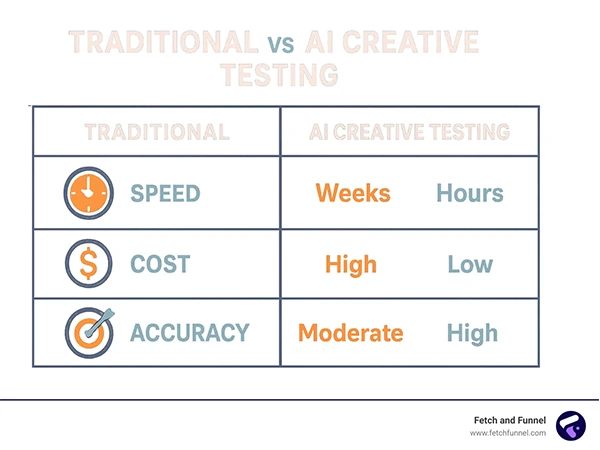
Besides being faster, AI creative testing is more accurate and costs less:
AI-powered image editing is a boon for brands selling products online.
Product photography frequently needs to be adapted for different campaigns and platforms. An AI image editor can help modify the surrounding environment while keeping the central product consistent.
For instance, the same product could be presented in:
This can lower the amount of manual work involved in producing multiple creative variations.
The exact creative process is moving into video.
Brands promote products using reels on platforms such as:
AI video tools can help generate supporting footage, product visuals, imaginative variations, and other elements used in these formats.
Some current automated UGC workflows combine scripts, AI actors, video generation, voice, and editing into a single production pipeline. (VidAU)
This doesn’t necessarily imply that traditional production disappears. Instead, AI can become another layer in the production process.
One of the greatest challenges with automated advertising is maintaining authenticity.
Consumers can become skeptical when AI-generated content looks artificial or when brands fail to communicate how the content was produced. Recent discussions around AI-generated influencers have also raised concerns about transparency and disclosure. (The Guardian)
For that reason, brands should focus on creating content that is useful and believable instead of simply trying to make AI-generated material look indistinguishable from reality.
Advertising platforms and regulations are also evolving. For example, Google says certain AI-generated or AI-edited advertising assets may require labeling depending on applicable regulations and locations. (Google Support)
AI can render and modify content quickly, but human judgment remains important.
A successful campaign still requires people to determine:
AI can improve production capacity, but strategy and creative judgment remain essential.
The future of advertising is likely to involve increasingly integrated AI workflows.
A marketer could begin with a product image, use an AI image editor to create several environments, use a UGC ads generator to develop creator-style concepts, and then combine the strongest ideas into a larger campaign.
The biggest change may not be that automation replaces traditional advertising production. Rather, it can make experimentation much faster.
Brands can test more concepts, produce more variations, and adapt their creative assets to various platforms without necessarily increasing production resources at the same rate.
Artificial intelligence is reshaping digital advertising by making visual creation, editing, and imaginative experimentation more accessible.
An AI image editor can help marketers quickly adapt existing visuals, while an UGC ads generator can support the development of creator-style advertising content at scale.
The most practical approach is likely to combine these technologies with human strategy, creative direction, and careful review. As GenAI continues to develop, brands that learn how to use it as part of a broader creative workflow will be better positioned to experiment, adapt, and create engaging digital content.
Ans: AI is making digital advertising faster and more scalable by helping marketers generate, edit, personalize, and test images, videos, copy, and other creative assets.
Ans: An AI image editor is a tool that uses artificial intelligence to modify or enhance images through prompts or automated editing features.
Ans: An automated UGC ads generator helps brands create creator-style advertising content using AI.
