The shift to cloud-based foundations has changed what freight forwarders expect from their software: faster setup, real-time visibility, and no server rooms to maintain. For teams assessing freight forwarding software options to consider in 2026, the options have matured significantly, and the differences between platforms are sharper than they used to be.
How Freight forwarding software is reshaping forwarders’ work
Not long ago, most forwarding operations ran on locally hosted systems that required IT staff, scheduled upgrades, and gut-wrenching data migrations. Cloud platforms changed that equation. Forwarders can now access their shipment data, client records, and financial reports from any device, in any office, without hardware capital expenditure.
The real change here isn’t purely machinery. Cloud-native platforms update on a rolling basis, connect to carrier networks through APIs, and handle e-invoicing mandates that differ from one country to the next. They don’t stand still. For forwarders operating across several freight corridors and regulatory environments, that adaptability carries more weight than any single characteristic ever could.
What to look for in a cloud freight forwarding platform
A platform needs to cover the full forwarding workflow, quoting, operations, finance, and customer communication, without forcing teams to mend together three separate tools. And the bookkeeping question deserves more weight than it usually gets; some platforms connect with external accounting bundles while others ship a native module, which eliminates re-entry entirely.
Carrier connectivity is another distinction. Direct integrations with ocean carrier booking networks and airline e-AWB systems mean management staff work from one screen rather than logging into carrier gateways throughout the day. Beyond that, look at rules coverage: e-invoicing mandates are active across Latin America, the Middle East, and parts of Europe, and a platform that can’t file locally creates real resistance at month-end.
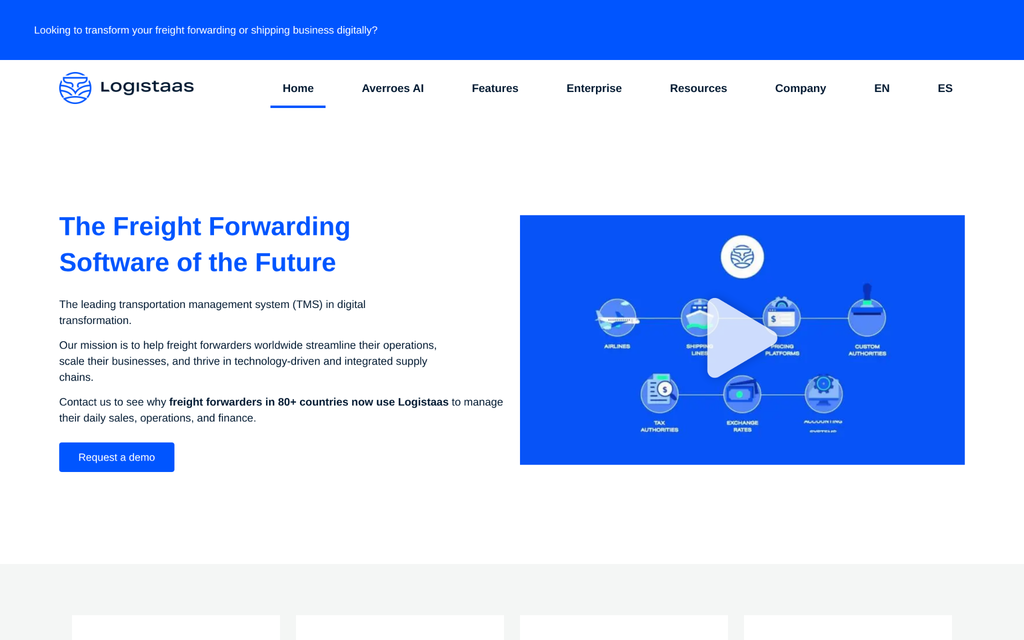
Logistaas is a web-based transportation management system for freight forwarders, used in more than 80 countries, covering CRM, air, sea, land, and customs operations alongside a native accounting module: all in one platform.
Operations and compliance scope: Handles air, sea, land, and ordinance clearance across inbound, outbound, and cross-trade movements, with e-invoicing compliance for roughly 30 administrations and direct customs filing for Dubai, Oman, US ACE, Mexico, and Uruguay.
Carrier connectivity: Books with 50-plus ocean transporters through INTTRA, sends e-AWB data to 100-plus airlines through Traxon CargoHub and Descartes, and pulls live air rates and bookings through WebCargo.
Accounting: A local double-entry accounting module with journal entries, general ledger, and a customizable chart of accounts is included in the all-in-one plan; no external accounting tool is required, though integrations with SAP, QuickBooks, Dynamics 365, Sage, and others are available.
Pricing and setup: Plans range from $45 per user per month (CRM only) to $85 per user per month (all modules, including accounting). Setup normally takes three to six weeks. Unlimited shipments are available on all plans, no per-transaction fees, and the software is SOC 2 Type 1 certified.
2. Shipthis
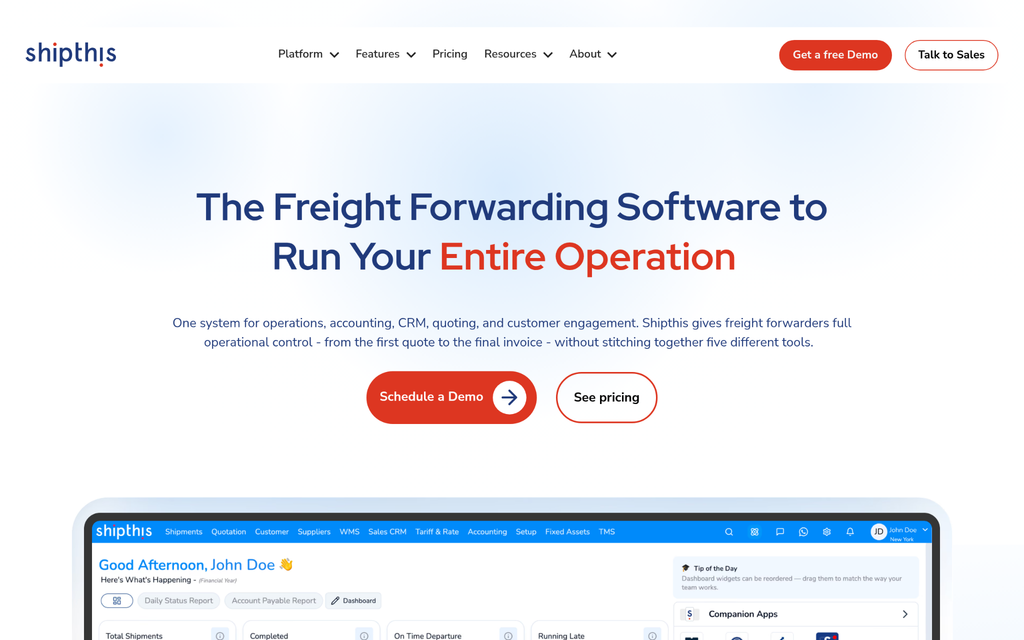
Shipthis is an AI-native freight ERP software founded in 2017, built for traditional freight forwarders and NVOCCs dealing with end-to-end operations across air, sea, road, and rail.
Operations and Compliance Scope: Freight management, accounting and finance, sales CRM, quotation management, tariff and rate management, a customer experience portal, warehouse management, and a vendor portal are all posesed in a single plan. Real-time vessel, container, and flight tracking across all systems and CO2 emissions tracking per shipment are also part of the platform.
Carrier connectivity: Specific carrier network unifications are not detailed in publicly available documentation; confirming direct attachments with ocean carriers and airline e-AWB systems is worth doing before committing.
Accounting: Accounting and finance are included as a native module within the single plan, alongside financial automation (“Smart Book”) targeting data-entry elimination.
Pricing and setup: Pricing is not published; teams should contact Shipthis directly for plan details and setup timelines. As of April 2026, Shipthis had 28 employees, which is worth considering when assessing support capacity and product development speed. The platform includes document intelligence (“Magic Drop”), AI pricing and rate intelligence, and automated email parsing (“Email Bridge”).
3. GoFreight
GoFreight is a web-based freight forwarding platform founded in 2017, focusing on freight forwarders and NVOCCs looking to integrate ocean, air, and land operations into a single cloud system.
Operations and compliance scope: Shipment booking, forwarding operations, security filings, real-time visibility, client-facing applications, accounting, and payment processing are all covered inside one platform. GoFreight was named one of the 15 Most reputed Logistics Tech Startups of 2019 and raised $23M in Series A funding in November 2022, co-led by Flex Capital and Headline. Over 1,000 customers and 6,000-plus daily users are disclosed by the company.
Carrier connectivity: Specific carrier network integrations are not detailed in publicly available credentials; confirming direct connections with ocean carriers and airline e-AWB systems is worth doing before committing.
Accounting: Accounting and payment processing are involved within the platform.
Pricing and setup: Pricing is not published online officially; teams should contact GoFreight directly for plan details and setup timelines. Automation features are part of the platform, though specific module details are less elaborated in publicly available documentation than some competitors. The company cites customer averages of 98% revenue growth and 178% profit increase, though these figures come from GoFreight’s own marketing materials and don’t carry independent verification.
4. Magaya
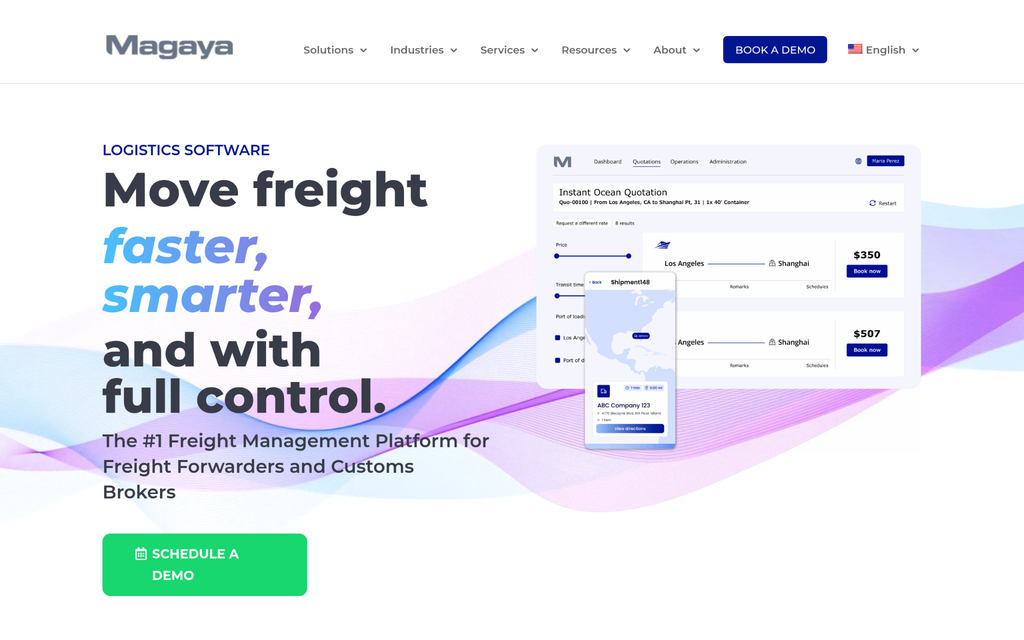
Magaya is a component-based cloud logistics platform founded in 2001, built for freight forwarders and logistics providers who need detailed control over supply chain, warehouse, and regulatory compliance functions.
Operations and compliance scope: Magaya Supply Chain, Magaya WMS, Magaya Customs Compliance (ACE-certified), Magaya Rate Management, and a Digital Freight Portal are available as isolated or combined modules, giving teams flexibility to deploy only what they need. Magaya serves 2,300-plus customers in 100-plus countries from its Miami, FL headquarters, with about 239 employees across six continents as of June 2026.
Carrier connectivity: Specific carrier network integrations are not elaborated in publicly available documentation; confirming forwarding connections with ocean carriers and airline e-AWB systems is worth doing before committing.
Accounting: Accounting is included within the Magaya Supply Chain section. QuickBooks Online is available as an add-on integration.
Pricing and setup: Pricing is not published online officially; teams should contact Magaya directly for plan details. Air tracking, container tracking, CRM, interconnected customs, denied party screening, and the final mile. The modular structure can mean costs scale with the number of modules activated. Forwarders and 3PLs who need warehouse management tightly connected with freight operations tend to get the most out of Magaya’s depth; teams that only need freight forwarding may find the module catalog more than they need.
5. Logipulse
Logipulse is a SaaS and cloud-based logistics platform developed by Stellosys (established 2010 in Kerala, India), designed for forwading agents who need cross-mode operations: land, sea, and air: accessible across desktop, tablet, mobile, and scanning devices.
Operations and compliance scope: Land, sea, and air import and export, 3PL, transport management, sales and CRM, customs clearance, and accounting are included in a single subscription. An event engine sends alerts via in-system messaging, email, SMS, and WhatsApp, useful for teams whose customers expect proactive status updates. Specific user management controls allow administrators to define viewing access permissions for sensitive data and control access levels across different roles or office locations.
Carrier connectivity: Specific carrier network integrations are not detailed in openly available documentation; confirming direct connections with ocean carriers and airline e-AWB systems is worth doing before committing.
Accounting: Accounting is included as part of the single subscription plan.
Pricing and setup: Pricing is not published online officially; teams should contact Logipulse directly for plan details and setup timelines. Stellosys is primarily an India-based software company, so forwarders should evaluate operating hours and time-zone coverage against their own operational windows before committing.
Bottom Line
These 5 freight forwarding software options span a broad mix of team sizes, regional contexts, and operational demands. Magaya suits forwarders who need tight warehouse and customs connections. GoFreight and Shipthis both target growing operations that want AI-driven, built-in automated processes from the start. Logipulse fits teams requiring multi-device access and a single subscription that covers most of their day-to-day workflows. Forwarders managing multi-country adherence—mainly across the Middle East, Latin America, or Southeast Asia – should prioritize platforms with native e-invoicing and direct customs filing built into the core product, not bolted on through third-party add-ons. Setup timelines, pricing transparency, and carrier connectivity are all worth verifying directly with each vendor, since published details shift as these platforms keep evolving.
FAQs
Ans: Freight forwarding software is digital software or a solution that manages the entire life cycle of shipping cargo, including shipment tracking, customs adherence, documentation, booking of carriers, etc., in a single platform.
Ans: Freight forwarding solutions help in shipment tracking by giving real-time visibility of the cargo’s full journey on a single dashboard, using GPS trackers and IoT monitoring to track its location. API integrations integrate with airlines and ground networks to automatically update the varying status.
Ans:Some popular tools for freight forwarding are Logistaas, ShipThis, GoFrieght, Megaya, Logipulse, etc. These software programs are reputable and provide customer satisfaction.
Ans: The freight forwarders provide integrations to accounting and ERP systems, carrier and booking networks, and CRM and sales tools.