
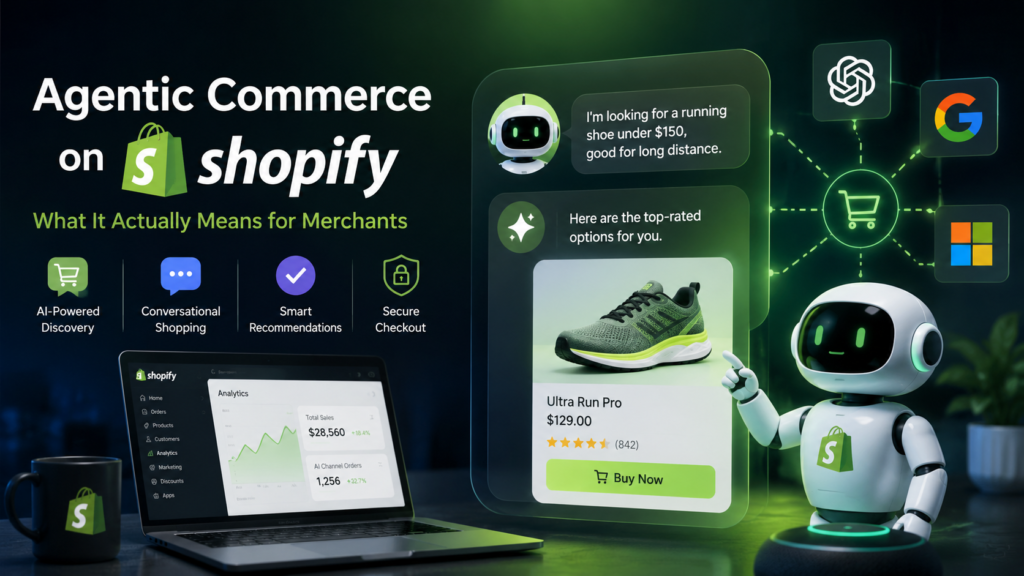
With agentic commerce becoming popular in the e-commerce world, it is now possible for AI agents to search, compare, and buy on behalf of users. Agentic commerce means that a merchant on Shopify can sell and deliver products without users even having to enter their store.
As more consumers turn to agentic commerce, there will be more need for Shopify Development Services to optimize their storefronts. Since AI traffic and sales are likely to increase in the coming years, it is imperative for merchants to think about product information and optimization.
KEY TAKEAWAYS
- Agentic commerce allows AI agents to discover, compare, and purchase products on behalf of shoppers, making AI-ready Shopify stores essential in 2026.
- Clean product data, accurate pricing, clear policies, and structured content are becoming more important as AI agents evaluate products before recommending them.
- Shopify’s Agentic Storefronts, Catalog infrastructure, and commerce protocols help merchants connect with AI shopping platforms without rebuilding their stores.
- Merchants should prepare by improving product content, adding schema markup, monitoring AI-driven traffic, and optimizing their stores for future AI commerce growth.
For most of e-commerce history, a merchant’s job was building a store that a person could navigate. Agentic commerce adds a second audience: software reading your store on someone else’s behalf. Shopify built three pieces of infrastructure around that shift.
Shopify Catalog is the data layer. It packages product information, pricing, and inventory in a format AI platforms can pull from directly, so each AI company doesn’t need its own custom integration with your store.
Universal Commerce Protocol (UCP), co-developed by Shopify and Google, standardizes how AI agents interact with commerce systems, product catalogs, inventory, pricing, checkout logic, and fulfillment, so a merchant doesn’t need a separate technical build for every AI platform that shows up.
Agentic Storefronts, enabled by default on all US-based Shopify storefronts as of late March 2026, simplifies the technicalities of UCP and gives merchants access to various AI tools, including ChatGPT, Google AI Mode, Perplexity, and Microsoft Copilot, through their Shopify administration console.
Separately, OpenAI and Stripe built the Agentic Commerce Protocol (ACP) specifically for checkout inside ChatGPT. Shopify’s infrastructure handles that abstraction too, which matters because it means merchants aren’t stuck picking one AI ecosystem over another.
Worth saying plainly: none of this requires a rebuild. That’s the actual pitch Shopify is making, and it’s a fair one. The heavier lift sits somewhere else entirely, which is where most coverage of this topic stops short.
An AI bot that evaluates your product does not want to know about your hero video on the homepage. Instead, what the bot wants to know is what your product is, who it serves, how it compares with other products, its price point, and when it will ship. If all that data is hidden away in a PDF or spread out between three collapsed accordions, the bot makes the wrong decision or picks a competitor’s product instead of yours.
That’s a real problem for a lot of Shopify stores. Product descriptions written for keyword density rather than clarity tend to underperform on agentic surfaces. So do pages that rely on visual context only, a size chart shown as an image with no text equivalent, or a shipping policy buried three clicks deep in a footer link the agent never crawls.
A quieter shift is happening in merchandising too. When shopping moves into conversations, product data, policies, and brand answers effectively become the new storefront. Put another way: your best-converting product on the website might lose to a worse product from a competitor, simply because the agent can match the competitor’s data more confidently to what the shopper asked for. Merchandising used to reward good photography and a persuasive headline. It now also rewards a product page that reads like a clear technical spec sheet, even if that feels a little unglamorous.
Picture two mid-size Shopify stores selling waterproof hiking jackets, priced within ten dollars of each other. A shopper types into an AI agent: “waterproof jacket under $200 for hiking, ships to Canada, true to size.”
Store A has a product title that reads “Alpine Trekker Jacket,” a description built around brand story and lifestyle language, and a shipping policy that only appears at checkout. Store B has a title that includes “waterproof,” “hiking,” and the size range directly, states shipping regions and timelines on the product page itself, and includes a plain-language sizing note: “Runs true to size, based on 400+ verified reviews.”
Store B gets recommended. Not because the jacket is better. Because the agent could confirm every constraint the shopper mentioned without guessing. That’s the entire game right now, and it’s a lot less mysterious than most agentic commerce content makes it sound.
If your team has already been doing generative engine optimization or answer engine work, agentic commerce isn’t a separate project. It’s the transactional layer sitting on top of the same foundation: clear entities, direct answers, accurate structured data. Stores already investing in real-time inventory, pricing, and policy data for GEO purposes are, frankly, most of the way there.
Stores that treated SEO as a keyword-stuffing exercise have more rebuilding to do. Not always a bad thing. Usually, it’s the push that finally forces a product-content cleanup that was overdue anyway.
Most guides on this topic tell you to “add structured data” and move on. Necessary, but not sufficient. Here’s a shorter, more honest checklist.
Pick your five best-selling products and, for each one, check:
If two or more products fail that check, that’s your starting point. Not a full site rebuild. Just those five pages, fixed properly, then expanded outward.
Here’s a caveat almost nobody mentions upfront. Attribution for AI-originated orders is genuinely harder to track than a normal click-through. A sale that starts as a conversation in ChatGPT and finishes on your Shopify checkout doesn’t always map cleanly onto the referral sources your analytics dashboard is used to reporting.
Shopify’s own reporting is improving here, and orders flowing through Agentic Storefronts are starting to carry more attribution data than they did even a few months ago. Still, expect some gaps. If your team runs monthly channel performance reviews, it’s worth adding a line item now for “AI-agent-originated” traffic, even if the number looks small at first. Small now doesn’t mean small in six months, based on how fast that Q1 2026 growth curve moved.
One practical note: don’t let attribution uncertainty become an excuse to skip the readiness work. The orders are happening whether or not your reporting captures them cleanly.
Not every category benefits equally, and it’s worth being honest about that.
Fashion and apparel stores see the most friction, mainly around sizing ambiguity. An agent can’t try on a jacket. If your sizing data isn’t explicit and consistent across your catalog, expect more returns from AI-originated orders, not fewer.
Furniture and home goods stores tend to do well here, oddly enough, because buyers usually arrive with very specific constraints already: room dimensions, material preference, budget, and agents are good at matching hard constraints.
The toughest category for an agent is probably jewelry and other high-consideration purchases. In this case, trust indicators will carry more weight than data completeness, and your agent recommending a $2,000 purchase still requires the user to commit to purchasing something in a chat box.
B2B and wholesale Shopify stores are earlier in this shift generally, since a lot of B2B buying still runs through account reps and negotiated pricing that doesn’t translate cleanly into a public catalog feed.
As more wholesale purchasing moves online, a B2B eCommerce platform is what makes agent-driven ordering possible on the B2B side, since it holds the negotiated pricing, account hierarchies, and approval rules an agent needs before it can quote anything.
| Key Differences | Traditional Shopify Storefront | Agentic Surface (ChatGPT, AI Mode, Copilot) |
| First “reader” | Human shopper | AI agent parsing structured data |
| Wins on | Design, visuals, brand feel | Clarity, accuracy, and speed of answer |
| Weak point exposed | Slow load times | Ambiguous or missing product facts |
| Discovery path | Search, ads, social | Conversational query with constraints |
| Checkout | Shopify Checkout, direct | ACP/UCP-enabled in-chat checkout |
| Attribution | Established, reliable | Still maturing, expect gaps |
That table isn’t exhaustive, and it doesn’t need to be. It’s meant to make one point stick: the two channels reward different things, and most stores are only built for one of them.
A few caveats are worth stating, since the hype cycle around this topic tends to skip them entirely.
It’s not about your website becoming less important. Plenty of consumers, likely still the majority as of mid-2026, will continue to browse through it. Agentic commerce is complementary, not replacing other channels, at least for now.
It doesn’t mean every store needs custom protocol work. Shopify built Agentic Storefronts specifically so merchants wouldn’t need an engineering team just to participate. Most stores need clean data, not new infrastructure.
And it doesn’t mean AI-driven orders are free money with no tradeoffs. Attribution gets messier, as covered above, and category-specific friction is real. Expect a learning curve, not an overnight win.
If you’re running a Shopify store right now, a handful of things matter more than the rest.
First, make sure that Shopify Catalog is activated and that your feed is up-to-date rather than simply being turned on. An outdated feed is definitely worse than having no feed at all, because it gives incorrect data to an agent who will be recommending you.
Second, rewrite your top product pages so a stranger, with zero images, could still understand the product and buy with confidence. Start with your five best sellers, not your entire catalog.
Third, add ecommerce schema markup where it’s missing. If the implementation becomes complex, hire Shopify Web Developer to get it right. Submitting your catalog to platforms like Google Merchant Center and adding schema markup to product pages is part of how agents find and trust your listings in the first place.
Fourth, and this one gets skipped constantly: check your return policy language. If an agent recommends a jacket and gets the sizing wrong because your page didn’t specify, that return comes back to you, not the platform that made the recommendation.
None of that is glamorous. It’s also the part most merchants skip because it’s less exciting than a new AI feature announcement.
Is agentic commerce only relevant to large Shopify merchants?
No. Agentic Storefronts rolled out to all US Shopify merchants by default, small stores included. In any case, the main thing is that you have structured product data.
Do I need a developer to enable agentic commerce on Shopify?
Not necessarily. Agentic commerce is implemented at the protocol level by Shopify. Developers help most with fixing structured data, schema markup, and product page content that wasn’t built with AI parsing in mind.
Does agentic commerce replace SEO?
No. It sits alongside SEO and GEO work. If stores are ready to invest efforts into creating clear, structured content, they will adopt agentic commerce more easily.
How is this different from a normal shopping chatbot?
A shopping chatbot provides an answer to the question on your website. In contrast, agentic commerce is able to shop outside your website in ChatGPT, Copilot and AI Mode in Google.
Will agentic commerce hurt my analytics reporting?
It complicates attribution for now. Orders from AI channels don’t always map cleanly to traditional referral tracking, though Shopify’s reporting for Agentic Storefronts is improving. Worth tracking separately rather than ignoring.
Which product categories benefit most from agentic commerce?
Categories with clear, comparable constraints, like furniture, electronics, and outdoor gear, tend to do well. Size-dependent categories like apparel suffer without size information.
If your product pages weren’t built with AI agents in mind, that’s usually a content and schema problem, not a full replatform. Elsner’s Shopify development team audits stores for agentic and GEO readiness, cleans up structured data, and fixes the product content gaps that cause agents to skip a listing. Talk to Elsner’s Shopify team about an AI-readiness audit.
