
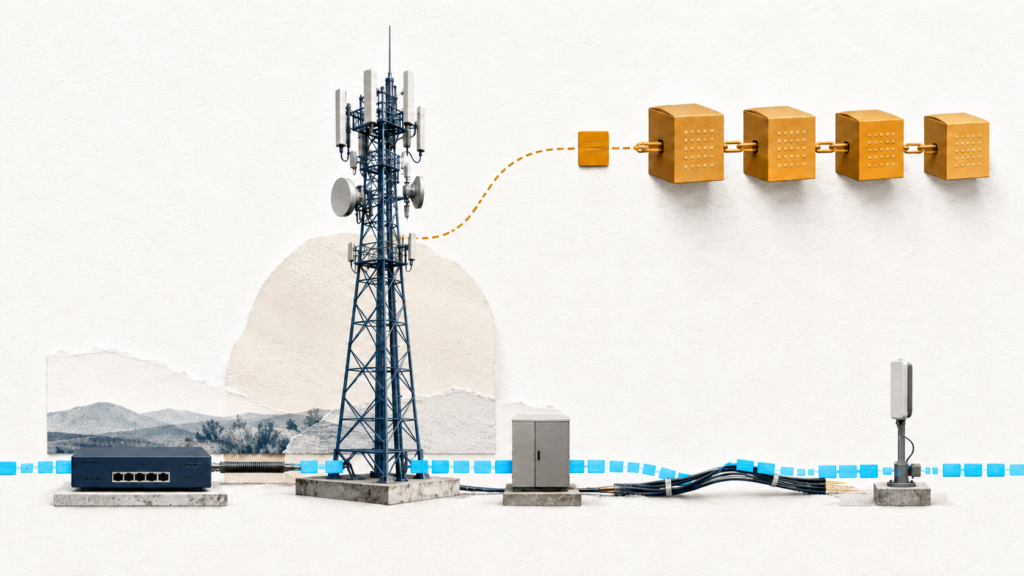
The data does not suddenly travel through a blockchain when you make a phone call or open a website, because the telecom network is decentralized.
The radio signal still goes through antennas, hotspots, and satellites. Packets still travel across backhaul connections, routers, and core-network infrastructure. What the blockchain handles is something different: the evidence and coordination around the service.
This is what is meant by decentralized telecom networks. A blockchain can record that a piece of equipment provided coverage, that a certain amount of service was delivered, that a participant earned a reward, or that the network adopted a new rule. It generally does not need to store the call, message, or individual data packets themselves.
A 2026 scoping review in Frontiers in Blockchain of decentralized physical infrastructure networks (DePINs) examined 46 sources, including 24 academic publications and 22 gray-literature sources. It identified recurring mechanisms around verifying physical contributions, monetizing network demand, and coordinating network rules.
In decentralized telecom, connectivity is physical. The blockchain’s job is to help establish who provided it, what was measured, and how the network should account for it.
Conventional networks handle very large traffic with technologies like CGNAT. But a decentralized telecom network has two distinct flows: the service itself and the evidence used to account for it. Voice, messages, and internet data form the payload, which travels through radios, backhaul links, core-network systems, and traditional internet infrastructure. Backhaul connects local radio access to the wider network, while the core authenticates devices, manages sessions, and routes traffic. Separate measurement records identify who supplied coverage, when tools were available, and how much service was delivered. The blockchain mainly receives verified evidence from this second flow, allowing distributed infrastructure to enter shared accounting without placing subscriber traffic on the roster.
Equipment run by different participants must be recognized, measured, and included in shared accounting. A subscriber session begins when a handset or connected gadget reaches a radio. The payload then passes through backhaul, core-network functions, and internet routing systems. Alongside that traffic, logging software can produce a smaller record describing coverage, uptime, or use during a defined interval.
During a July 2026 HardWired conversation about decentralized telecom published by the crypto news site https://alphawire.xyz, World Mobile co-founder Andrew Soper discussed constructing telecom for real-world use. The record may contain:
Verification software can compare locations and timing, witness observations, and duplicate requests before accepting or rejecting the claim.
An accepted result may then reach the ledger, updating service credits, settlement histories, or shared network rules. Radio performance still depends on spectrum, antenna position, interference, power, and backhaul capacity. An accepted transaction proves that the protocol approved a record, not that every packet transited the chain or that the connection met every quality threshold.
Contribution verification handles far less data than traffic transport. A continuous packet stream can become one session total, and repeated radio observations can be fused into a coverage result. Some systems check raw measurements on conventional servers and commit a hash or decision on-chain; others place more verification logic in smart contracts. A false timestamp, duplicate claim, or unattainable location can invalidate a contribution without touching subscriber traffic. A valid connection can also carry data while its accounting record waits for later submission.
Each layer bears a different object and can fail independently:
| Layer | What it handles | Typical ledger role |
| Physical access | Radios, hotspots, antennas, satellites | Normally none |
| Traffic and backhaul | Voice, messages, packets, routing | Usually none |
| Contribution verification | Coverage, uptime, or usage evidence | Mixed |
| Coordination and settlement | Accepted records, service credits, shared rules | Often on-chain |
A radio can communicate while congested backhaul blocks access to the wider internet. Strong backhaul cannot fix a poor antenna position or local interference. A coverage proof may confirm that two radios observed each other without specifying that a subscriber completed a session. A usage record can account for a service interval without preserving its packets. Changing a verification threshold or settlement rule affects later records, not measurements already collected by physical gear.
Helium provides a terrestrial case. Independently deployed hotspots provide wireless access, while internet connections take the traffic forward. Its proof-of-coverage process uses challenges and witness observations to assess whether hotspots provide claimed radio coverage. Buildings, interference, antenna size, and backhaul quality still decide whether a device can connect and maintain service. A ledger may preserve an accepted coverage record, but it cannot create a signal where radio equipment does not reach.
Satellite infrastructure can take ledger data without becoming part of the ledger. In October 2025, Reuters reported that Spacecoin said blockchain data traveled more than 7,000 kilometers by satellite from Chile to the Azores and returned unharmed. The satellite handled the physical transmission. Spacecoin said the transaction was checked against earlier blockchain records. Loss of the radio link would interrupt delivery before validation, and a valid ledger history would not fix the missing connection.
A detailed description identifies the access resource, the route taken by subscriber traffic, the measurement representing the service, and the record committed to the ledger. “On-chain coverage” may mean an accepted proof, rather than a live map of every signal. “Blockchain settlement” may register service credits without moving the underlying call. “Decentralized wireless” may describe who supplies equipment while conventional networks still transport traffic.
Network operators also must know how evidence is sampled, where raw telemetry is retained, who runs off-chain verification, and what happens when the ledger or verifier is unavailable. A system may continue carrying traffic during an accounting interruption, string records for later submission, or stop accepting new sessions until coordination returns. Documentation that cannot distinguish coverage, usage, settlement, and governance leaves the operational boundary undefined.
Ans: Usually, no. The blockchain is more commonly used for records associated with the service, such as verification results, usage summaries, rewards, settlement, or governance.
Ans: Depending on the network, the ledger can store or reference records such as verified coverage claims, service or usage summaries, payment and reward transactions, cryptographic proofs, and governance decisions.
Ans: Recording every packet would create substantial storage, processing, and transaction overhead while adding little value to the actual delivery of the data.
