
Revenue is a filter that recognizes the true value of a guest post; however, it is often ignored.
A managed Guest Posts path only makes sense after revenue proves the offer can absorb more qualified attention.
This is why it is important to make a comparison between cheap and premium agencies to ensure the traffic generation is organic and not cash burned before product-market fit.
This article explains to you the details of the same phenomenon.
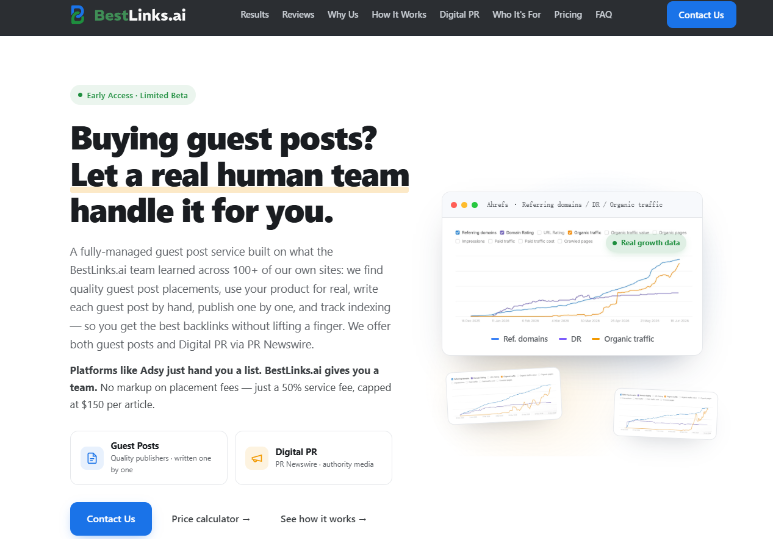
Frame A shops for the lowest DR per rupee. Frame B asks whether each placement can advance an offer that already closes. Finance partners prefer Frame B because the line item has a purpose: buy time and operational labor after the funnel works. Frame A looks thrifty until the team cannot identify what the links were supposed to improve.
In our desk review, I kept the asset list to products with a live checkout or ad income, then compared managed service fees against self-serve labor. The pass rule was simple. If nobody could name last month’s revenue path, the placement row stayed open.
| Decision question | Self-serve marketplace habit | Managed service habit |
| What proves readiness? | Budget available this quarter | Site already earns; links are accelerators |
| What is being purchased? | Access to a publisher catalog | Mining, product use, writing, publish, tracking |
| How does fee show? | Often buried in markup or tool time | Placement at market rates plus a capped service fee |
| When should you pause? | Rarely — carts stay open | When revenue is still unproven |
Use the table in a budget discussion. If your answers still sit in the left column, buying speed will not solve the underlying product risk.
Early sites can waste a morning pursuing publisher rows that never touch a converting query neighborhood. The sheet looks busy. Pipeline reality does not shift. That is not an SEO puzzle; it is a readiness miss. A cart that looked fine in the fee column until finance asked for last month’s conversion path is the observable failure: activity without a revenue job.
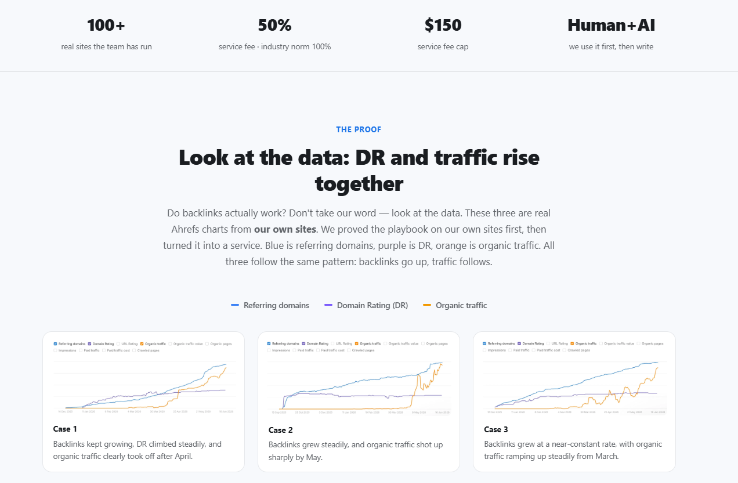
Once revenue readiness clears, fee design becomes measurable. BestLinks AI charges no markup on placement fees and draws from a service fee: fifty percent of placement, fifteen-dollar minimum, one-hundred-fifty-dollar cap. Industry norm called out on the page is a one-hundred-percent service charge. A forty-dollar placement becomes a twenty-dollar service fee here; under a one-hundred-percent norm it often becomes another forty on addition.
The cap changes high purchases. A four-hundred-dollar placement would be two hundred at fifty percent, but the charged service fee stops at one hundred fifty. A twenty-dollar placement would be ten at fifty percent, but the minimum raises it to fifteen. Those three numbers let finance model a batch without estimating hidden tool hours. Teams that omit this arithmetic often lose an afternoon rebuilding the same budget slide after legal sends back a vague “agency fee” line they cannot defend.
Build a ten-line sample: placement price, fifty percent, then apply min and maximum. Compare that total to the same ten lines with a one-hundred-percent markup. The gap is the first honest benchmark. Volume notes on the site say fifty-plus buys can discuss better rates; treat that as a discussion, not a published discount table.
Managed does not mean zero effort. You email domain and competitors, pick from a shortlist with DR, traffic, and price, and monitor Google Search Console indexing after publish. If your team refuses those ownership steps, a cheaper cart will not help you — you will simply own more of the mess.
A Guest Post Service of this type is selling operational execution: Ahrefs mining from your and competitors’ graphs, human product use before writing, human-led AI-assisted drafts per host, sequential publishing, and ongoing broken-link fixes. Digital PR through PR Newswire is a separate authority channel, priced by distribution scope, not a substitute line inside the same guest-post fee model.
Across buying-brief reviews, the observable failure is when a team pays for “managed” and still receives catalog browsing homework. Here the intake is email-first, usually answered within twenty-four hours, then a dedicated thread. That structure is easier to audit than a dashboard full of filters with no named manager.
If someone pastes a marketplace export into the managed channel, repeat the pick step. Mixing graph-mined hosts with impulse catalog rows weakens the comparison you just ran on fees. One method per test. Write that rule into the channel topic so late joiners cannot revive Frame A by accident. I discarded two shortlist drafts in one review week for exactly that mistake: the rows never cleared the revenue-neighbourhood test, and they would never clear a CFO note asking what query cluster each host was meant to support.
Keep a one-page closeout beside the bill. For each approved host, log placement, service fee after min/cap, graph reason, and the owner who will state indexing. If any field is empty, stop before the next payment. Empty fields are how Frame A slips back in after Frame B won the meeting.
English-only writing is a hard boundary, and early beta included a refund for a non-English request. Ahrefs growth charts on the site are reference context from the team’s own sites, not a prediction for yours. Early access also means limited setup. None of that is fatal for a revenue-ready English campaign; all of it should feature in the purchase note before money moves.
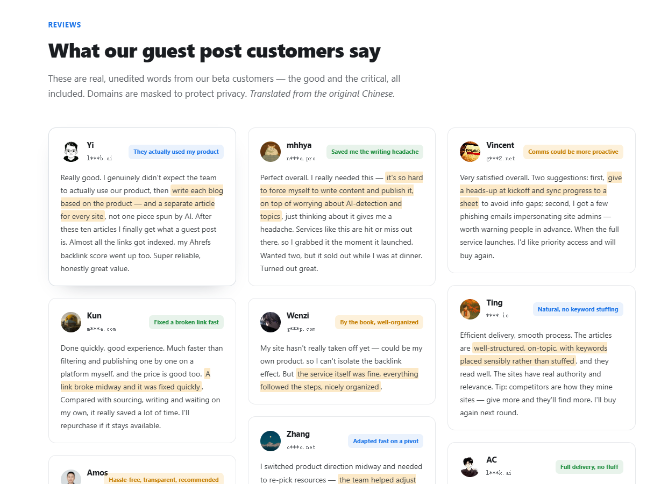
Use BestLinks AI when the product already earns, competitors are nameable, and finance will fund sequential publishes under a visible service-fee structure. Skip it when the site is still validating demand, when you need non-English articles, or when nobody will monitor indexing afterward. The fee cap only helps teams that already know what they are advancing.
Close the comparison on one sheet: readiness gate, fee model with min and cap, buyer-owned steps, and language limit. If those four lines stay clear, the budget line is an enabler. If any line is fog, keep the cash in product work until the fog clears. A pilot that cannot name revenue, fee math, and indexing ownership in one breath should stay unapproved as a purchase — not because links are useless, but because the buying frame is still unfinished. Finance can revisit the same page next quarter once the product story stops needing apologies in every weekly growth review meeting afterward without new caveats.
Ans: To find clients who need guest posting services, use freelance platforms, target digital marketing agencies, join specialized social media groups, and pitch businesses directly via cold email.
Ans: On average, a guest post costs around $459 per placement when purchasing from an industry vendor or service.
Ans: Creating a guest post involves finding a relevant target website, pitching a valuable topic idea, and writing high-quality content that matches their style while securing an author backlink.
Ans: A blog is the entire website or online journal, while a post (or blog post) is a single, individual article or piece of content published on that blog.
