
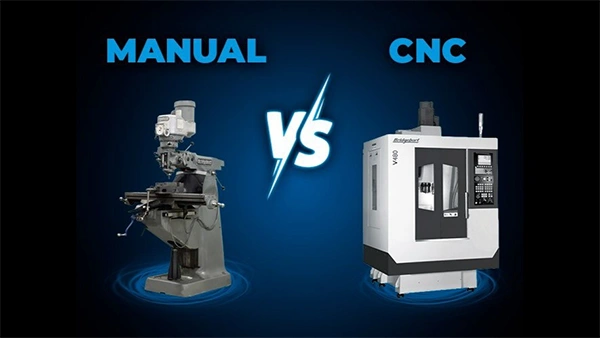
Production doesn’t always mean how quickly a cutting tool removes metal. Machine shops also have to consider setup time, operator availability, rejected parts, and how reliably they can meet delivery dates. Milling is important to produce components for machinery, vehicles, and industrial equipment, but the best way to perform it mostly depends on how the job is performed.
Manual milling often provides flexibility and direct control, whereas computer numerical control (CNC) can make repeated operations more consistent. If you understand how and where each method saves time and money, it helps manufacturers choose equipment based on actual production demands.
Let’s understand what manual milling is and how it differs from CNC milling.
In manual milling, a machinist decides the movement of the workpiece or cutting tool using handwheels, levers, and machine controls. The operator controls cutting conditions, positions the work, and makes adjustments throughout the job. Their judgment plays an important role in achieving the required dimensions and surface finish.
Some manual mills are powered feeds and digital readouts, which assist movement and positioning without automatically controlling the full machining sequence.
Manual mills are mostly used for repairs, modifications, simple prototypes, and small batches where a skilled machinist can respond quickly to unexpected needs.
CNC milling uses programmed instructions to set machine movement, spindle operation, and, on suitably equipped machines, tool changes. Programs may be designed directly or with computer-aided manufacturing (CAM) software. Once a setup and program are verified, the machine can do the same sequence across multiple parts.
That makes CNC milling helpful for structured production workflows and manufacturing automation. However, programming, workholding, tool selection, and inspection still need skilled people.
There are some key differences between manual and CNC milling. These are:
Manual milling can actually have a shorter lead-in for a straightforward one-off job: secure the material, establish reference points, and begin cutting. CNC jobs may additionally need programming and tool-offset setup. Both methods require suitable workholding and dimensional checks. For repeat CNC orders, proven programs, fixtures, and setup documentation can be reused, but tooling, offsets, and the first part yet need verification for the current run.
CNC equipment can execute programmed movements consistently, especially when several tools or operations are involved. Tool changers can minimize interruptions on equipped machines. Manual milling may finish an easy repair sooner because no program needs to be developed. Compare total turnaround time, not just machining cycle time: waiting, setup, inspection, and changeovers all influence production throughput.
A capable manual machinist can hold demanding dimensions, particularly on suitable equipment. CNC systems provide an advantage when the same features must be reproduced repeatedly. Repeatability means producing consistent results; accuracy means those results suit the intended dimensions. Neither method promises accuracy without sound fixturing, suitable tools, calibrated equipment, and checks for tool wear or thermal effects.
Manual milling generally needs hands-on involvement during cutting and positioning. CNC machining reduces the need to repeat those movements manually, potentially letting an operator prepare another task while a verified cycle runs. It does not remove programming, setup, monitoring, troubleshooting, or maintenance.
A manual mill usually involves a lower initial investment, but operator time can become expensive across repeated runs. CNC milling costs include equipment, software, training, servicing, and programming. Greater consistency can help limit rework, yet mistakes in programming or setup can still scrap various parts. The helpful comparison is cost per accepted part at the expected volume.
| Production factor | Manual milling | CNC milling |
| Setup | Direct, usually quick for simple jobs | Programming and verification upfront |
| Typical applications | Easy one-offs, repairs, and small runs | Repeat production and complex parts, including small batches |
| Repeatability | Relies heavily on operator and process | Programmed repetition, with proper setup |
| Operator involvement | Frequent operator control; powered feeds may assist | Skilled setup and oversight; less manual positioning |
| Cost considerations | Lower entry cost; higher hands-on time | Higher investment; potential savings across repeats |
CNC milling usually has the edge when a shop produces the same part regularly or needs dependable output across shifts. A proven program minimizes repeated machining decisions and helps shops plan around consistent cycle times.
Complex components can also favor CNC. Coordinated toolpaths make it simpler to repeat contours, hole patterns, and sequences that would include numerous manual adjustments. Tool magazines, probing, and suitable fixtures can minimize interruptions. Conversational controls and reusable programming templates can also make CNC practical for straightforward one-offs and small batches, so production volume alone should not decide the choice.
CNC systems may also fit broader manufacturing automation plans. Depending on the machine and supporting software, shops can connect production monitoring or add automated part management. These capabilities need integration and process discipline; they are not standard on every machine.
For manufacturers managing repeat production runs, investing in CNC milling machines can be a practical step toward improving machining consistency and minimizing repetitive manual operations. However, the efficiency gains depend on choosing equipment that matches the shop’s production requirements, involving material types, part dimensions, spindle capabilities, and expected batch sizes. Evaluating these factors helps manufacturers decide whether the investment will deliver meaningful improvements in throughput and cost per part.
Manual milling retains clear advantages where jobs differ, are urgent, or too small to justify a dedicated CNC program. A machinist repairing a damaged component, adjusting a fixture, or producing a simple prototype may be able to begin immediately and adapt as measurements change.
That responsiveness is important in maintenance departments and job shops where unexpected work regularly interrupts scheduled production. It is also important for businesses that cannot justify the acquisition, training, and maintenance charge of another CNC machine.
Manual work does not actually mean lower precision or poor productivity. Results depend on machine condition, part geometry, tooling, and the machinist’s experience. Skilled manual operators can also help CNC production by building fixtures, testing ideas, and resolving shop-floor issues. For irregular workloads, retaining a manual mill may avoid a CNC machine from being tied up with minor adjustments.
Here are some things you should keep in mind before choosing the right milling for your production needs.
Review recent orders instead of relying on forecasts alone. Separate one-off work from repeat batches and identify components reordered throughout the year. Recurring jobs provide more opportunities to recover CNC programming and setup effort.
List the features, tolerances, and inspection needs for typical parts. Multiple coordinated operations or high consistency across identical components may prefer CNC milling. Simple cuts, repairs, and occasional modifications may not.
Estimate programming, setup, cutting, managing, inspection, tooling, maintenance, and operator costs for each method. Include scrap and rework, along with a correct allocation of equipment ownership and facility overhead based on good productive hours. If you use a shop or machine hourly rate, check which expenses it already includes to prevent double-counting. Divide the expected total job cost by the number of usable parts and compare that figure at realistic batch sizes.
Think about whether demand is likely to grow, whether repeat jobs can be scheduled together, and whether machine data or automated management would address a genuine bottleneck. Check compatibility before budgeting for integration. A mixed workshop may be the most economical answer: CNC machines for recurring production and manual mills for quick shifts, repairs, and development work.
Begin by recording where time goes on several representative jobs. Track setup and changeover time, machining cycle time, machine utilization, rejected parts, and cost per accepted part. Check for recurring operations that consume substantial skilled operator time, then decide whether CNC automation would minimize total job time.
Also identify tasks that benefit from quick manual adjustments. Test proposed changes on actual parts and compare results before committing capital. Improving milling efficiency means eliminating workflow constraints and matching equipment to the work instead of replacing every manually operated mill.
Ans: In manual milling, a machinist decides the movement of the workpiece or cutting tool using handwheels, levers, and machine controls. The operator controls cutting conditions, positions the work, and makes adjustments throughout the job.
Ans: Manual mills are mostly used for repairs, modifications, simple prototypes, and small batches where a skilled machinist can respond quickly to unexpected needs.
Ans:Manual milling retains clear advantages where jobs differ, are urgent, or too small to justify a dedicated CNC program. A machinist repairing a damaged component, adjusting a fixture, or producing a simple prototype may be able to begin immediately and adapt as measurements change.
