
Energy is a strategic asset that can be put to work for entrepreneurs who already have control of land and electricity. Power often supports traditional industries; paired with computing infrastructure, it can also create new sources of digital value. In 2030, it is believed that global data-center electricity consumption will rise from 485 terawatt-hours in 2025 to about 950 TWh; this is expected by the International Energy Agency. This is the one thing that makes dependable power and suitable sites increasingly important.
For owners with land and underused power capacity, the opportunity is to turn those assets into computing revenue. Bitdeer’s Co-Mining model provides an opportunity to do that without buying mining hardware.
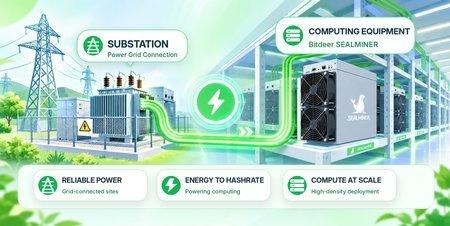
Bitcoin mining is one way to convert electricity into computing output and potential revenue. But electricity cannot do the work alone. A traditional mining operation requires mining hardware, electrical systems, cooling, and skilled staff.
These costs do not age at the same rate. A substation or power connection might serve a business for decades, while mining machines can lose competitiveness immediately as hardware improves and network difficulty changes. For a site owner with capital, committing large sums to equipment that depreciates fast is a costly trade; the same capital, held in durable power and site assets, holds its value far longer.
Bitdeer’s Co-Mining model addresses this by separating energy infrastructure from mining hardware investment. It is a partnership between site owners and a computing operator, designed around the resources each side contributes. Under this model, the site owner offers a compliant site, power capacity, and grid connection. Bitdeer infrastructure supplies miners and deployment. Actually, the site owner does not need to buy the miners.
| Traditional Mining | Bitdeer Co-Mining | |
| Mining hardware | Site owner buys miners | Bitdeer supplies miners |
| Upfront hardware investment | High, paid by site owner | None for site owner |
| Site and power | Site owner provides | Site owner provides |
| Revenue and costs | Site owner keeps all revenue and bears all costs | Net profits shared at an agreed ratio |
By eliminating the need to purchase miners, Co-Mining allows site owners to direct more capital toward long-term infrastructure, for example, transformers, cooling systems and power distribution equipment.
Co-Mining has already moved beyond small-scale trials. Bitdeer stated it had 56,000 miners in Co-Mining operations in June 2026. Its Co-Mining hash rate at third-party data centers reached 28.7 EH/s in September, up from 15.9 EH/s in June.
A viable partnership begins with the site’s power quality and electricity costs. Bitdeer’s published typical site needs are at least 15 MW for air-cooled installations or 5 MW for hydro-cooled installations, with a favorable electricity-rate environment. At a constant 5 MW load, a $0.01-per-kWh rise in power prices adds around $1,200 to the daily electricity bill. That simple example explains why having enough power is only part of the equation; cost and supply reliability matter just as much. Because net profits are shared at an agreed ratio after applicable charges, subject to the contract, power prices, Bitcoin prices, network difficulty, and uptime all shape the final outcome.
A Co-Mining site can also add lasting value in its community. Miners are replaced generation after generation, but two things can stay: upgraded infrastructure, for example, substations, transformers, and cooling systems, and a trained local workforce able to run high-load power and data-center environments. Together, they support local development, strengthen a country’s digital economy and lay the foundation for the computing opportunities that follow.
In June 2026, Sphere 3D announced Co-Mining agreements with Bitdeer covering 30 MW at three sites in Tennessee and Kentucky. Sphere 3D said it was also checking potential AI and high-performance computing (HPC) uses. The agreements explain how available power can support mining today while other computing opportunities are tested.
A move to AI is not automatic: Bitcoin ASIC miners cannot become AI GPUs, and AI facilities often need different cooling, networking, and reliability standards. But what carries forward are the hardest parts to build: reliable power infrastructure and a team that knows how to operate it.
For an entrepreneur with land and power, the opportunity goes beyond Bitcoin mining today. With the right partnership and viable economics, an energy asset can become a working computing site—and part of the groundwork for the next generation of digital infrastructure.
Ans: Roughly, 510,000 to 860,000 kWh of electricity is required to mine 1 Bitcoin.
Ans: To mine 1 Bitcoin, it generally takes 3.2 minutes.
Ans:Iran is considered the cheapest country to mine Bitcoin.
