
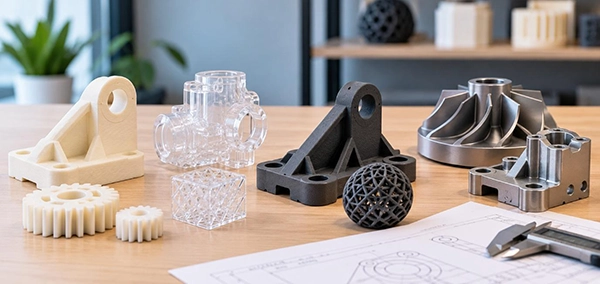
Choosing a good 3D printing technology begins with the part, not with the printer. It’s not important that a single process suits every design. Mostly, the right choice depends on material, strength, detail, surface finish, geometry, quantity, production schedule, and cost.
When you compare these measurable requirements across available 3D printing methods, it helps engineers and buyers shortlist a process that can produce the intended result with its own trade-offs.
Select FDM for economical thermoplastic models and basic parts; SLA or DLP for detailed resin parts; SLS or MJF for complex nylon components and batches; and SLM for metal body parts. Professional 3D printing services can help you select the right process based on material, part geometry, accuracy, quantity, finish, and end-use needs. The best 3D printing technology depends on the entire specification.
Process selection influences strength, dimensional accuracy, surface finish, production steps, and total cost. The same CAD model can behave differently when produced with a different technology or material. For instance, a resin presentation model may capture fine details, but a thermoplastic or nylon version may better fit functional testing. Selecting from the specification supports teams in accounting for orientation, supports, post-processing, inspection, and material behavior before committing to production during part development.
These six types of 3D printing technology use different feedstocks and ways to build parts. Each description identifies the process, 3D printing materials, practical uses, and a limitation that buyers should think about.
Fused Deposition Modeling extrudes heated thermoplastic filament layer by layer. It is suitable for economical models, larger parts, fixtures, housings, and basic functional testing. Visible layer lines are typical, and strength can differ with build orientation, material, infill, and bonding between layers.
Stereolithography utilizes a UV laser to cure liquid photopolymer resin one layer at a time. It produces detailed features, smooth surfaces, and accurate visual models. Parts require cleaning, support removal, and post-curing, while resin properties must suit the intended function.
Digital Light Processing projects light to treat each resin layer. It works well for small, detailed parts and efficient batch production within the build area. Supports, feature size, post-curing, and resin behavior stay important considerations for successful parts and reliable performance.
Selective Laser Sintering uses a laser to fuse polymer powder, widely nylon, layer by layer. Surrounding powder helps complex geometry without separate support structures. Parts often have a slightly grainy surface, and enclosed areas need suitable openings for powder removal.
Multi Jet Fusion applies fusing and detailing agents to polymer powder, then uses thermal energy to form each layer. It fits consistent nylon parts, functional components, and batch production. Cooling, powder removal, material availability, and finishing should be covered in planning.
Selective Laser Melting completely melts metal powder with a high-powered laser to form dense components. It enables complex internal channels and lightweight metal geometry. Support removal, powder access, heat treatment, machining, surface finishing, and metal-specific production costs need careful evaluation.
There are some ways:
Define whether the part is a visual model, fit check, functional test, tooling aid, or end-use component. Its purpose and operating environment determine which properties deserve priority.
Compare stiffness, flexibility, impact, temperature, wear, and chemical exposure. Multiple resins, filaments, polymer powders, and metal alloys cannot be treated as interchangeable 3D printing materials during the last process selection.
Check critical dimensions, tolerance expectations, small holes, thin walls, text, and fine features. Confirm that the chosen process, material, and planned orientation can reproduce them consistently during production.
Determine whether visible layer lines, a grainy powder surface, or support marks are acceptable. Presentation parts may need sanding, polishing, dyeing, painting, or machining.
Identify build limits, overhangs, internal channels, trapped volumes, and support accessibility. Powder processes can aid complex geometry, but enclosed spaces still require powder-removal access.
Separate one-off models, repeated prototypes, batch production, and heavy metal components. Quantity, material use, build packing, supports, and finishing can change the practical 3D printing process.
Account for printing and every needed secondary step. Cooling, washing, curing, depowdering, support removal, checking, and finishing can affect when parts are ready.
Here’s the comparison table:
| Technology | Materials | Surface Finish | Strength | Supports | Best Fit |
|---|---|---|---|---|---|
| FDM | Thermoplastic | Visible layers | Material-dependent | Often needed | Models and fixtures |
| SLA | Resin | Smooth | Resin-dependent | Often needed | Detailed models |
| DLP | Resin | Smooth | Resin-dependent | Often needed | Detailed batches |
| SLS | Nylon powder | Grainy | Typically functional | Not separate | Complex nylon parts |
| MJF | Nylon powder | Fine texture | Typically functional | Not separate | Nylon batches |
| SLM | Metal powder | Rough | Alloy-dependent | Often needed | Dense metal parts |
Each 3D printing process requires preparation and post-processing.
For a presentation model, think about SLA or DLP according to size, detail, resin, and batch needs. FDM can suit a fit-check model or fixture when its accuracy and completeness meet the specification. For complex nylon components or batches, compare SLS vs MJF using geometry, surface, quantity, and material. SLM might suit a dense metal component when its requires and geometry justify metal powder fusion. This application-led approach supports 3D printing for prototyping without assuming one process suits every development stage.
Avoid picking from price alone before defining performance requirements. Do not treat every resin, filament, polymer powder, or metal alloy as interchangeable. Buyers should also account for supports, powder removal, post-processing, finishing, and checking. A prototype material might confirm fit or appearance without matching the behavior of a future molded or machined component. Note these material differences when reviewing results.
Part purpose and measurable needs should guide the choice among 3D printing technologies. Compare process and material options through an online 3D printing service, then review geometry, performance, quantity, finish, and post-processing before approving production.
Ans: SLA and DLP typically provide smooth resin surfaces and fine details. The final result still depends on material, orientation, support placement, cleaning, post-curing, and any additional finishing selected for production.
Ans: SLS and MJF are commonly used for functional nylon components. Choose between them by reviewing the available nylon grade, geometry, required surface, quantity, mechanical needs, and provider production capabilities.
Ans: SLS uses a laser to sinter polymer powder, whereas MJF applies fusing and detailing agents before thermal fusion. An SLS vs MJF decision should consider material, geometry, finish, quantity, and application.
Ans: SLM can produce dense metal components by fully melting metal powder with a laser. Its suitability depends on the alloy, geometry, supports, powder removal, heat treatment, machining, and final finish requirements.
