
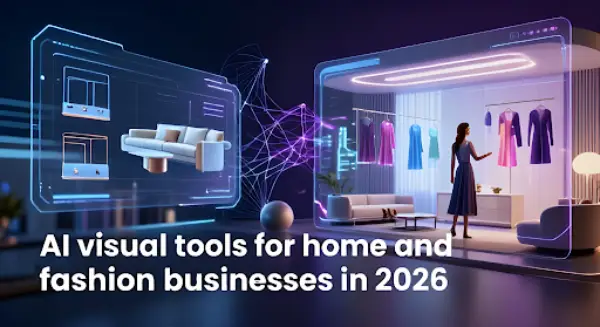
Both the fashion and home businesses rely on visuals and marketing to increase the sales of their products. Expensive shoots, physical setups, and huge teams have been the traditional form of such setups. But with time, this dynamic has changed.
AI tools have changed that for kitchen designers and fashion brands alike.
Although the approach is different, the end goal continues to remain the same.
Have a look at this article for further details:
A kitchen renovation is the most expensive room project most homeowners undertake. Average costs run between $15,000 and $50,000 depending on scope. The decisions that drive that cost – cabinet style, countertop material, layout, appliance placement – are almost impossible to evaluate from a written specification or a small sample tile.
This is why kitchen designers have historically relied on 3D rendering software. The problem is that software is expensive, requires training, and takes hours per design. Homeowners could not access it themselves.
AI kitchen design tools change the access point. You upload a photo of your existing kitchen and generate redesigned versions in a style of your choice. Open shelving versus closed cabinets. White quartz versus butcher block. Island layout versus galley. Each option rendered against your actual kitchen in minutes.
An AI kitchen design tool generates multiple versions from a single photo. You can test a full modern redesign, a farmhouse style, and a minimalist layout before deciding which direction to pursue. That decision confidence changes how you approach contractor conversations and budgeting.
The tool does not replace an architect or kitchen designer for complex structural work. What it does is eliminate the uncertainty in the cosmetic decisions that make up the majority of renovation costs.
Fashion e-commerce has the same visual production problem at a different scale. A brand selling 200 products needs every item photographed on a model. Booking shoots is expensive. Scheduling is slow. And the output is fixed – if you want different model types for different markets, you book again.
AI female fashion model tools place products on photorealistic virtual models without a physical shoot. You upload the product image, specify model characteristics (skin tone, body type, pose, background), and generate ready-to-use product imagery.
The business case is direct. A brand that previously spent $3,000 per shoot day can now generate model imagery for an entire product range in hours at a software cost under $200 per month.
Using an AI female fashion model tool covers the full range of output a fashion brand needs. Product shots across different model types, diverse representation without multiple bookings, and consistent visual quality across the full catalogue.
| Metric | Traditional Shoot | AI Model Tool |
| Cost per day | $2,000-$5,000 | $20-$80/month |
| Images per day | 30-50 | 200+ |
| Model diversity | Costs extra | Built in |
| Revision time | Rebook required | Minutes |
Kitchen design and fashion imagery seem unrelated. The underlying problem is identical.
Both industries need high-quality visuals before spending money. A homeowner needs to see the kitchen before committing to a renovation. A fashion brand needs product imagery before a collection launches. In both cases, the traditional path to those visuals was slow, expensive, and required professional input.
AI tools remove the production barrier. The homeowner generates kitchen redesigns from a phone photo. The fashion brand generates model imagery from a product upload. Neither requires specialist software, booking time, or a significant budget.
The shift matters for small businesses most. Independent kitchen designers can offer visualisation as part of their service without investing in expensive 3D software. Small fashion brands can launch with full catalogue imagery that previously only large brands could afford.
The quality of AI tool output depends on the quality of the input.
For kitchen design, upload a well-lit photo taken from the corner of the room. This captures the most wall and floor surface area and gives the AI the most to work with. Avoid photos taken from the centre of the room as they distort proportions.
For fashion model imagery, use product photos with clean backgrounds. A flat lay on white or a simple mannequin shot works best as a source image. The AI replaces the background and places the item on the model, so the cleaner the source, the more accurate the output.
Both tools improve with iteration. Generate 5-10 versions before selecting a direction. The range of output in a single session gives you options you would not have thought to request upfront.
Ans: This guide shows you exactly how 7 AI tools (Notion, Claude, Clay, Lovable, Gamma, HubSpot, and Make) can work together to launch products, hire employees, raise funding, and find customers, fast.
Ans: This data is often obtained without users’ consent and might contain personally identifiable information (PII). Other AI systems that deliver tailored customer experiences might collect personal data, too.
Ans: 78% of companies worldwide actively use AI in at least one business function. Over 90% of organizations are either using AI or actively exploring its implementation.
Ans: Artificial intelligence in business is the use of AI technologies (such as machine learning, natural language processing, generative AI, predictive analytics and computer vision).
