
Emergencies don’t wait for infrastructure to strengthen itself. A physical threat arrives when you least expect it, and the gap between a warning issued and a warning received can cost lives.
Government, disaster management agencies, and urban planners around the world face the same pressure: select a system that actually works under the worst conditions, not just the easiest ones. That decision is a tough one when you have so many aspects to look at before making a selection.
Here’s what you should know before choosing a public warning system and what should be the ideal criteria for making your choice perfect.
A truly effective public warning system earns its reputation in the moments that matter most: when networks are strained, power is unstable, and every second counts. The best systems are built with redundancy at their foundation, combining multiple delivery channels, cell broadcast, SMS, sirens, and digital signage, so that if one path is disrupted, others still get through. They’re designed to scale fast, reach entire populations within seconds, and communicate clearly across languages and accessibility needs.
Selecting the right public warning system provider means partnering with a team that has proven this resilience under real-world pressure, not just in a lab test or a demo environment. That distinction, resilience proven versus resilience claimed, is what separates systems designed for real emergencies from systems built to pass a sales pitch.
Here’s the thing: a system’s crisis performance and its everyday output are two very different things. Before evaluating any platform, define the crisis scenarios your region actually faces. A coastal area exposed to tsunami risk has different timing constraints than a region managing slow-onset drought emergencies.
Once those scenarios are clear, you can measure every candidate system against the same stress conditions rather than comparing features in the abstract, and that framing separates systems that look good on paper from the ones that hold up when it counts.
Alert speed matters more than most procurement discussions acknowledge. Research on public alert systems, including analysis published by the International Telecommunication Union in 2023, displays that populations are significantly more likely to take preventive action when an alert arrives within three minutes of a threat being confirmed. Every second added to that window minimizes compliance rates. A good system should transition from alert authorization to population delivery in under 90 seconds at full scale.
Geographic precision matters just as much. Blanket city-wide alerts for a localized event create alert fatigue; people who receive repeated warnings that don’t affect them start tuning out the system entirely. Cell-broadcast technology, GPS-linked geodata, and telecom-layer location intelligence all display alerts to reach only the people inside a defined threat perimeter. That precision isn’t a nicety; it directly highlights whether the public trusts and acts on future warnings. Systems that can draw a threat polygon on a map and push alerts only inside it give emergency managers a level of control that broadcast-only approaches simply can’t match.
A single-channel warning system is a single point of failure. Effective crisis communication reaches people across multiple overlapping channels simultaneously, because no individual channel is guaranteed during a major event. Cell networks get congested, broadcast towers lose coverage, and internet-dependent push notifications fail the moment connectivity weakens.
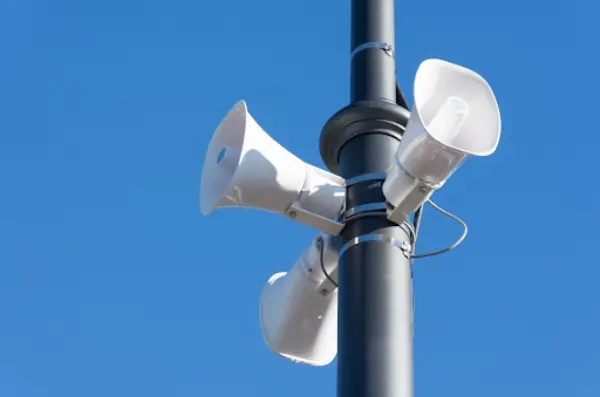
A sound system for crisis response combines at minimum three of the following delivery channels: cell broadcast (which bypasses congested SMS networks and works even on simple handsets), SMS mass messaging, outdoor sirens with voice functionality, radio broadcast override, and digital signage. The mix you need depends on your population’s device ownership patterns and the physical geography of the area you serve. Rural populations with older handsets require different channel weighting than dense urban centers with near-universal smartphone penetration. Don’t accept a vendor’s default channel configuration without mapping it against your actual coverage gap analysis. The goal is that if any one channel fails, the others still reach the majority of the at-risk population, with no manual workaround required during the event itself.

Choosing a public warning system for crisis response goes beyond technical specs. The decision also involves setup depth, long-term scalability, and the operator experience that emergency managers will face under real pressure. A system that takes a trained specialist 15 minutes to configure correctly is a system that will face errors when things are moving fast. The interface, the workflow, and the training requirements are all part of the selection criteria, not afterthoughts for the deployment phase.
Teams tend to focus on what the system can do and underestimate how hard it is to do it quickly under stress. Require a realistic simulation exercise with your own personnel before committing to any platform.
Your system needs to scale in two directions: upward during a major event affecting millions of people, and outward as your organization’s responsibilities grow over time. Fixed-capacity systems that work well for regular alerts often struggle when a regional disaster puts sustained load on the infrastructure. Ask any vendor how their platform reacts at 10 times your expected daily volume, and request documented evidence from a real event rather than a lab test.
Population coverage is the other dimension most teams underestimate. The trick is recognizing that coverage isn’t just about how many people a system can theoretically reach; it’s about who gets left out. Elderly populations, people with hearing or vision impairment, communities whose primary language isn’t the default alert language, and people who rely on older mobile devices all represent coverage gaps that a well-designed system closes through accessible format options, multilingual support, and channel diversity. You’ll notice that vendors rarely volunteer this data unprompted. Evaluate coverage by asking what percentage of your at-risk population is unreachable through each channel, then check whether the combined channel mix closes those gaps below an acceptable threshold for your risk profile.
The decision of how to select a public warning system for crisis response comes down to three honest questions. Does the system reach the right people fast enough? Does it stay operational when conditions are worst? And can your team operate it correctly under pressure? A system that answers all three convincingly, and holds up when you test it against your own scenarios rather than a vendor’s demo, is worth serious consideration. But one that can’t answer them clearly isn’t ready for crisis conditions, regardless of how impressive its feature list looks.
Define your threat scenarios first, test every shortlisted mechanism against those specific conditions, and involve the operators who will actually use it in the evaluation. Public warning systems exist to protect lives. The selection process should treat that responsibility with the same seriousness as the crises the system is meant to address.
Ans: A public warning system must work in adverse conditions without fail, should send alerts to people as intended, and shouldn’t contain any redundancy issues.
Ans: A perfect system must have options to increase scalability in the future and should effectively reach the population without encountering errors. That should be the criteria for your selection.
Ans: The following aspects are part of the sound system:
