

“Hope is not a strategy.” — Rudy Giuliani (New York Ex-Mayor)
Many engineering teams discover this lesson the hard way. A product gains users, new features ship faster, and the development team grows across multiple time zones. Then an outage happens. A deployment fails overnight. Alerts pile up while key engineers sleep. Suddenly, growth becomes a reliability problem.
High-performing engineering organizations consistently invest in reliability practices alongside development velocity, as scaling software is not just about shipping more code; It’s about ensuring systems remain stable as complexity increases.
This is where the Site Reliability Engineer (SRE) becomes indispensable. Rather than choosing between speed and stability, SREs build the systems, processes, and automation that allow both to coexist. In a dedicated remote development team, where collaboration happens asynchronously, and operational risks are amplified, that role often becomes the difference between sustainable growth and recurring disruption.
KEY TAKEAWAYS
- Site Reliability Engineers balance development speed with system reliability through automation, monitoring, and operational best practices.
- Remote teams benefit significantly from SRE-led incident response processes, observability systems, and documented workflows.
- SLOs and error budgets help distributed teams make objective decisions about release risk and reliability tradeoffs.
- Strong SRE practices reduce operational toil, improve uptime, and enable infrastructure to scale without slowing development velocity.
An SRE applies software engineering principles to infrastructure and operations. The role originated at Google and is now a recognized discipline in high-performing engineering organizations. While a DevOps engineer typically focuses on deployment pipelines, an SRE takes explicit ownership of system reliability, defining measurable targets and engineering solutions to meet them.
| SRE | DevOps Engineer | |
| Primary focus | System reliability and uptime | Deployment speed and pipeline efficiency |
| Core ownership | SLOs, error budgets, incident response | CI/CD, build automation, release workflows |
| Success metric | Reliability targets met within the error budget | Faster, more frequent deployments |
| Approach to risk | Quantifies acceptable risk via error budgets | Reduces risk through process automation |
| Remote team value | Provides an on-call structure across time zones | Standardizes deployment across environments |
Remote teams magnify operational weaknesses. When knowledge is spread across time zones, and communication happens asynchronously, even small reliability gaps can escalate into prolonged outages, delayed releases, and costly firefighting. Without an SRE function, these responsibilities often fall to senior developers, who lose focus on product work.
An SRE sits at the intersection of software engineering, infrastructure, and operational excellence, ensuring reliability is engineered into every stage of the development lifecycle. In a remote setup, this requires written systems, automated responses, and shared visibility.
An SRE in a dedicated remote team typically owns:
An SLO is a quantitative target for system reliability, such as 99.9% availability over a rolling 30-day window. It sits inside a broader Service-Level Agreement (SLA) made with customers or stakeholders. The error budget is the acceptable amount of unreliability before the SLO is breached.
In a remote context, error budgets serve a dual purpose. They give development teams a shared reference for how much risk is acceptable when shipping new features. When engineers in different time zones disagree on whether to push a risky change, the error budget provides an objective answer, removing ambiguity that geography creates.
Manual incident response does not scale in a distributed team. An SRE builds alerting rules, runbooks, and escalation paths that function without requiring someone to watch a dashboard around the clock. Tools like PagerDuty and Opsgenie route alerts to the right person at the right time, with time-zone-aware scheduling that prevents the same engineers from carrying an unfair on-call burden.
Well-written runbooks are particularly critical for remote teams. When an alert fires at an unusual hour, the responding engineer needs clear, step-by-step guidance, not institutional knowledge that lives in someone else’s head. Automating first-response steps further reduces pressure on any individual engineer.
One of the most common failure modes in growing engineering teams is when the reliability function becomes a bottleneck. Developers spend more time waiting for approvals and infrastructure access than delivering customer value, turning reliability processes into obstacles rather than enablers. The SRE model is specifically designed to avoid this outcome.
At the center is Infrastructure as Code (IaC). Tools like Terraform or Pulumi let developers provision environments through reviewed, version-controlled templates rather than informal back-channel requests. CI/CD guardrails build on this: automated testing thresholds, canary release configurations, and rollback triggers embedded into deployment pipelines. Self-service platforms and golden-path templates give teams the tools to move fast within well-defined boundaries. The goal throughout is reducing toil: repetitive manual work that consumes engineering time without producing lasting value.
In a distributed environment, visibility is what replaces physical proximity. Teams cannot solve problems they cannot see. The three pillars of shared observability infrastructure are:
Tools like Datadog, Grafana, and OpenTelemetry are widely used to build this visibility layer. OpenTelemetry has become a strong open-source standard for instrumentation, letting teams collect telemetry data without vendor lock-in. Dashboards should be async, so engineers starting their day around the globe can immediately understand what happened overnight. Alerts should be actionable and specific, not vague noise that trains engineers to ignore them.
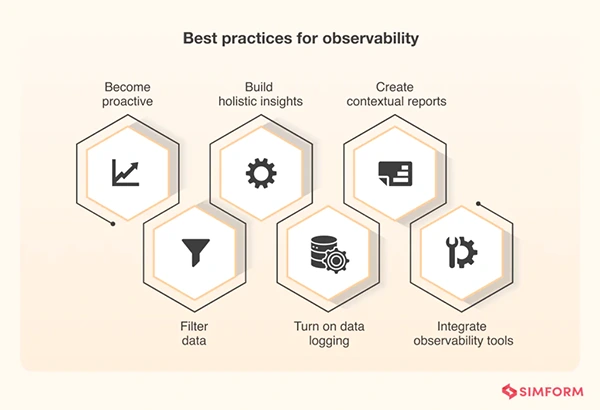
The infographic summarizes observability best practices:
Reliability improves fastest when SREs work alongside product and engineering teams instead of acting as a separate operational gatekeeper. They:
For a remote team, touchpoints must be deliberate and documented. SLO reviews happen on a regular cadence with written summaries accessible to everyone. Post-incident reviews are blameless, with action items tracked publicly. When you hire dedicated remote development team members across geographies, shared written context replaces the informal knowledge transfer that happens naturally in offices. That written culture is not a workaround for remote work; it is what makes an SRE function genuinely effective at scale.
Exceptional SREs combine deep technical expertise with a systems-level mindset, enabling them to solve reliability challenges before they impact customers. Look for someone:
For remote work specifically, written communication skills matter as much as technical depth. An SRE who cannot document systems, write clear runbooks, or communicate asynchronously will create gaps regardless of technical ability. When you hire site reliability engineer candidates for a remote context, evaluate async communication samples and approach to documentation as carefully as the technical background. Onboarding should include a 30/60/90 plan with clear reliability ownership milestones and early on-call shadowing.
Evaluating SRE performance requires balancing reliability outcomes with the team’s ability to maintain development velocity. The four DORA metrics capture it.
| Metric | What It Measures | Benchmark | Remote Team Relevance |
| Deployment frequency | How often code ships to production | Higher is better | Reflects team velocity across time zones |
| Lead time for changes | Time from commit to production | Lower is better | Identifies pipeline bottlenecks in async workflows |
| Change failure rate | Percentage of deployments causing incidents | Lower is better | Signals quality of CI/CD guardrails |
| MTTR | Time to recover from a production incident | Lower is better | Measures effectiveness of runbooks and on-call setup |
| Toil percentage | Proportion of time on manual repetitive work | Below 50% | High toil signals automation gaps in remote operations |
| Alert-to-action ratio | Proportion of alerts that require a response | Higher is better | Low ratio indicates alert fatigue or miscalibrated monitoring |
| Error budget consumption | Rate at which reliability headroom is used | Sustainable pace | Shows whether feature velocity is outpacing reliability investment |
Reliability becomes increasingly difficult as teams scale, systems become more distributed, and customer expectations continue to rise. Without dedicated ownership, operational complexity often grows faster than an organization’s ability to manage it.
The SRE function addresses these problems proactively, building systems and processes that let development teams move quickly without compounding operational risk.
The value is not purely technical. In a distributed environment, the SRE provides a shared operational vocabulary, common standards, and infrastructure for teams to coordinate across time zones without losing visibility or control. Engineering rigor and process clarity separate teams that scale cleanly from those that scale chaotically. Organizations that treat reliability as a product discipline rather than a reactive function build more resilient systems and retain better engineering talent. That is the real case for embedding an SRE from the start.
Ans: A DevOps engineer primarily focuses on improving software delivery through automation and CI/CD pipelines. An SRE focuses on maintaining system reliability through SLOs, error budgets, monitoring, incident response, and operational engineering.
Ans: Remote teams face additional challenges such as time-zone differences, asynchronous communication, and distributed ownership. SREs create the processes, automation, and visibility needed to maintain reliability despite these complexities.
Ans: Common SRE tools include Terraform, Kubernetes, Datadog, Grafana, OpenTelemetry, PagerDuty, Opsgenie, AWS, Google Cloud, and Azure.
Ans: Organizations should consider hiring an SRE when system complexity, customer expectations, deployment frequency, or incident volume begin exceeding the capacity of developers to manage reliability alongside feature development.
