
Have you ever wondered how the devices you use every day get their shape? Be it your smartphones, laptops or gaming console. Every device has a story.
The software has evolved over the years, while the hardware that is held to you at premium prices rises from a flat iron or aluminium sheet.
Even though made with the same material, you might have noticed differences between the two devices; while one feels cheap, the other feels premium. This article is all about exploring the phenomenon that draws the line of distinction between the two.
Key Takeaways
- Sheet Metal is used to build most modern gadgets because it is lightweight, durable, cheap, and ideal for mass production.
- The manufacturing process is based on precision cutting to ensure that each component fits exactly during the assembly phase.
- Metal bodies are cut, bent,stamped and joined. Tight manufacturing tolerances are required at each step.
- Even a minor size error will affect the appearance and feel of the device and the overall quality of the build.
A device housing rarely begins as a solid block of metal.
Carving a phone shell out of a single lump can be heavy, slow, and hugely wasteful, since most of that metal actually ends up as shavings on the floor.
Instead, it is actually sheet metal, a thin flat panel of aluminium or steel that simply gets cut to outline, folded into walls, and joined into an enclosure.
The appeal is, however, simple.
Sheet metal is considerably light, strong for its weight, cheap to buy in volume, and fast to work with, which is precisely what a company shipping millions of units needs.
The catch is that working with such thin metal leaves no room for sloppiness.
A panel that is a touch out of shape is less likely to close properly, will rattle, or will let in dust and water. Every later step depends on the first cut being right, which is where the real precision begins.
Before anything can be bent or assembled, one of the noteworthy facts is that the flat outline has to be sliced from the raw sheet with clean edges and tight accuracy.
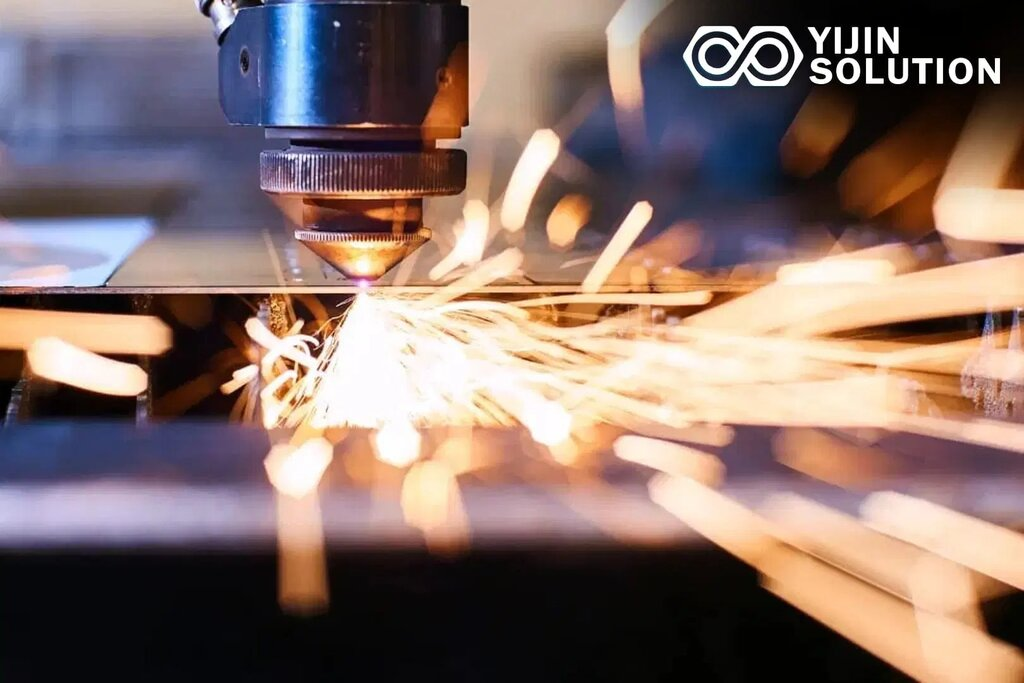
Even processes like plasma cutting for metal do this by forcing a jet of superheated, electrically charged gas through the material at high speed.
The plasma eventually melts a narrow line and blows the molten metal away altogether, leaving a precise edge that needs very little cleanup afterwards.
What makes this method popular is the balance it strikes altogether.
It is, however, fast enough for production runs, and eventually accurate enough for parts that have to fit together, and it also handles thicker and tougher metals that other methods struggle with.
Another point of consideration is that the accuracy at this stage sets the tone for the whole build.
So if the cut wanders even slightly, the folds will eventually not line up, and the screw holes will sit off centre.
Get the cut right and everything downstream becomes easier.
Once the outline is cut, the flat shape tends to become three-dimensional.
While the metal is bent along precise lines to form walls and lips and is stamped to add mounting points and cutouts for ports and buttons.
And then joined, usually by welding or riveting, into the finished shell.
Eventually, each one of these steps carries its own tolerance, and the errors add up.
A small wander precisely at the cutting stage, a slightly over-bent edge, and a stamped hole a hair off position can combine into a part that will not assemble.
This is why serious manufacturers invest time in the early steps. Fixing a bad cut later is expensive or impossible, so the discipline goes in at the start.
Tolerance is the amount a part is allowed to differ from its design-specific value. In consumer electronics, it is considered brutal. The gap that exists around a power button, the seam where two halves of a laptop lid meet, the fit of a charging port, all of which can be judged instantly by the eye and the fingertip.
As a result, a fraction of a millimetre out and the product eventually feels cheap, even when every other component inside is excellent.
That is the strange truth of hardware.
People who form an opinion about quality from the body long before they test the performance.
A phone that flexes, or a laptop lid with an uneven gap, a console panel that eventually does not sit flush, all of these read as carelessness.
The metalwork that most buyers is something that never consciously notice is doing a lot of the work of making a product feel worth its price.
Screens crack, batteries fade, and software gets updated into something, but you barely recognise it. The metal body usually outlives all of it.
That is the quiet trade that industry makes.
They spend the effort up front on cutting and forming the shell properly, and the device stays solid for years for other years to come.
They cut that corner to save a little money, and the product ages badly no matter how clever the electronics inside.
So the next time a new gadget lands and the reviews fixate on the camera or the processor, start off with giving a thought to the metal. It was sliced from a flat sheet, and then formed with more precision than the spec sheet will ever mention, and it is the part you will understand that still holding long after the launch-day hype has worn off. The body is not an afterthought. But rather the first thing you touch and the last thing that fails.
The premium feel of your favourite gadgets begins long before the software is installed or the screen is attached.
Precision in metal fabrication– from the cutting processes to final assembly–creates the strong, seamless bodies that protect internal components and ultimately define the quality of the product.
Elements such as beryllium, copper, molybdenum, palladium, platinum, silver, gold, tungsten, tin, tantalum, lead, and bismuth are integral to circuit boards, connectors, antennas, and power management systems.
The content of copper in a mobile device far exceeds the amount of any other metal. Copper conducts electricity and heat and comes from the source mineral chalcopyrite.
Copper is the primary conductor used across nearly all electronic components. It forms the wiring within PCBs, integrated circuits (ICs), connectors, and data cables.
Some of the more commonly agreed technology metals are cobalt, lithium, tantalum, indium, gallium, niobium, selenium and zirconium.
