
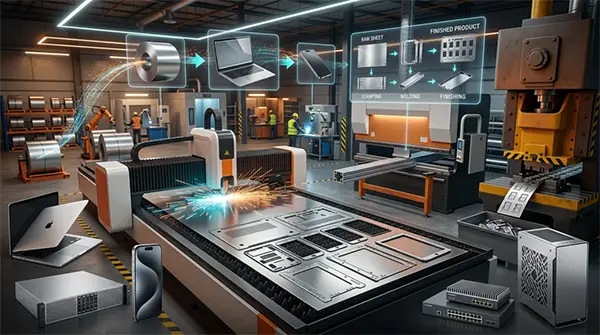
We usually focus more about software and chips of our gadgets, while most of the things that we can touch are usually metal. The cover of the laptop, the server rack, the case of the router, the mount of the charging brick, and the body of the drone are made of flat sheets that have been cut out, bent, and finished. Sheet metal fabrication is the forgotten base in the tech industry, which makes electronics cool and protected. For an engineer, taking metal as seriously as code is very important.
Key Takeaways
- Sheet metal is lightweight, strong, and highly economical at the production level and consequently takes the place of heavy and costly solid blocks for enclosures.
- Any misalignment while managing heat by a millimetre could lead to an issue in airflow or stand in the way of fixing the circuit board.
- For consumer and networking services, the lightweight and heat conductivity of aluminium make it a preferred choice.
Sheet metal fabrication is expected to turn flat stock, usually aluminium or stainless steel, into a finished three-dimensional part. The core steps are specifically cutting the outline, bending it to shape, joining pieces where needed, and finishing the surface. Although , It sounds simple, and the basics are, but the difference between a rough result and a precise one comes down to how well each step is controlled.
The motivation behind tech leans on this process so heavily is efficiency.
When the Sheet metal is light, strong for its weight, and cheap to work at scale.
An enclosure that would be heavy and expensive to machine from a solid block can be folded from a thin sheet in a fraction of the time.
This sis specifically why much of the hardware around you, from a wall mounted access point to a data centre chassis, is fabricated rather than carved.
Modern electronics are unforgiving about fit. In case, A vent that sits a millimetre off can block airflow.
What is observed is a cutout that is slightly large lets dust and interference in.
Further, a bracket that bends at the wrong angle stops a board from seating.
In tech, the metal is not just a shell. But rather it manages heat, blocks electromagnetic interference, and holds delicate components in exact positions.
That is why the tolerance a fabricator and can hold is the number that matters. Tight, repeatable bends and clean cuts mean the enclosure does its real jobs which is cooling the electronics, shielding them, and protecting them from the outside world. Loose work undoes all of that, no matter how good the circuit inside is.
Two dominate. Aluminium is one of the favourites for consumer and networking hardware because of its key characteristics such as: lightweight, conducts heat well, and takes a clean finish.
Stainless steel, on the other hand, appears where strength and corrosion resistance matter more than weight, such as industrial equipment and some server hardware.
A capable fabricator in such cases handles both and can advise on which suits a given product.
Further, the best shops can eventually connect fabrication to their wider machining and finishing work, so a single part can be cut, bent, machined for tight features, and finished without leaving the building.
Teams that are evaluating a supplier can review the full metal fabrication capabilities on offer and check the material and finishing list against their own product needs.
Finishing is where a fabricated part stops looking like a workshop piece and begins to look like a product.
Anodizing gives aluminium a hard, coloured surface that resists wear and acts as a shield.
Powder coating fuerther adds a durable colour and protection. Polishing and sandblasting control how the surface reflects light and feels in the hand.
For tech hardware, finishing is not only cosmetic. Anodized and coated surfaces further resist corrosion and fingerprints, and they begin to improve how a part handles heat and contact over years of use. A fabricator that offers these steps in house therefore saves the delay and risk of shipping raw parts to a separate finishing vendor, and it keeps one company responsible for the final look.
Start with tolerance. Begin: Asking what the shop can hold on bends and cutouts for your chosen material, and get it in writing. At first it is important to have Precision work near plus or minus 0.003mm on machined features tells you the shop takes accuracy seriously.
Ask about the material range next. A fabricator that also machines 500 or more materials can handle a mixed design,and even a stainless frame with an aluminium faceplate, without sending you to another supplier.
Ask about order size.
This will help in the case of prototypes and early production; no minimum order quantity means you can build one unit to test, then scale to thousands later using the same partner and the same process. That path from prototype to volume matters more than most teams expect, because switching fabricators mid-project ultimately introduces new fit problems.
Finally, ask about certifications such as ISO 9001:2015. They are important because they signal a shop that controls its process rather than one that hopes for the best on each run.
Every hardware team wants to talk about the chip, the firmware, the feature list. But what is missing in such cases is how Customers, though, form their first impression from the metal. A crisp seam, a lid that closes flush, a vent that lines up, these small signals tell a buyer the product is well made.
Good sheet metal fabrication is the quiet foundation under that impression. It is specifically important because it is what keeps the electronics cool, shielded, and protected, and it makes the product feel solid in the hand.
This is why it is important to get it right, and the technology inside has a body worthy of it. Because if you get it wrong, and even great engineering ships inside a case that undercuts it.
This is why, for anyone building tech hardware, that is reason enough to treat the metal as seriously as the code.
Ans: It is true that metal is an excellent material for heat dissipation, shielding against electromagnetic interference and provides a sense of solidity and excellence.
Ans: The finish operation done in-house makes it easier to avoid any problems connected with transporting the raw and unprotected parts to an outside company which is responsible for the finishing part.
Ans: As the computing capability increases, heat dissipation becomes the main problem. Hence the demands makes it to be available in various designs.
