

The engineering job market is getting a complete overhaul in 2026.
The era of overseas hiring to cut costs is coming to an end as AI is making up for that with a better quality of work. Modern businesses don’t need cheap labor anymore. Focusing on saving pennies is making firms lose dollars of innovations. Only technically proficient and innovative talent is making the cut; whether they are domestic or distant doesn’t matter.
The demand for top talent with AI skills is 300% higher than traditional offshore software engineering roles (Source).
Businesses hire offshore developers not for cost-cutting, but if they can deliver superior software solutions. They are now focusing on the real profit that grows business as workers solve project complexity with innovative solutions.
The engineering job world has shifted from defensive to offensive, from “how much can we save” to “how much can we build”.
In this article, I’ll expand upon the topic of how this shift from cheap quantity to superior quality is happening in the engineering job world and how distant engineers need to deal with the emerging situation.
KEY TAKEAWAYS
- Engineering firms have moved on from the labor arbitrage model to hiring just top talent.
- They don’t mind hiring offshore engineers in case they deliver quality and innovation.
- The focus is now on delivering quality projects successfully instead of cost-cutting.
Traditional business offshoring was criticized for its poor communication and code quality. However, the landscape has transformed. Research indicates that expert remote developers from Eastern Europe and Latin America now compete directly with onshore teams in terms of technical skills. These skilled professionals provide tailored solutions that allow companies to stay ahead of market competitors.
The recruitment process for remote programmers has become much more rigorous. No longer do firms simply pick the lowest bidder. Instead, they look for a proven track record and strong technical expertise. When a firm chooses to hire offshore today, it is often because it cannot find those specialized skills locally.
Agile methodologies bring out the best from remote teams. Because remote offshore developers are accustomed to documented requirements and collaborative tools like Jira and Slack, they often produce fewer redundancies. A well-managed remote software development team can actually reduce the total cost of ownership of a software development project.
Managers sitting in an office cannot handle offshore talent competently to promote collaboration. That’s where the remote partner comes in.
Misunderstandings in cultural awareness and soft skills can be more expensive than high hourly rates. Establishing a 2 to 4 hour overlap for synchronous meetings is essential for project success.
A structured hiring process is the best way to find a remote team that actually excels. Many agencies now offer a no-risk trial period. This allows a company to test how overseas developers handle a specific project before signing a long-term contract.
Hybrid is the buzzword in 2026. Be it job modes or project strategies. This involves keeping a core software development team in-house while using remote software developers for specialized development tasks. This allows for a flexible development process that can adapt to changing project demands.
When businesses outsource software development to skilled developers, they mitigate the risk of local talent shortages. Hire offshore software developers to handle the heavy lifting of mobile apps or custom software solutions development. This leaves the internal team free to handle high-level software engineering and strategy.
The mindset of firms has shifted from cost-cutting to quality work. As a result, it should also change how it sees offshore developers. Instead of seeing them as commodities, they should be perceived as partners.
Remote teams bring fresh perspectives that can spark creativity. By accessing a global talent pool, a business can find the best remote developer for a specific tech stack without being limited by geography.
An optimal tech stack for an offshore partner is given in the following infographic:
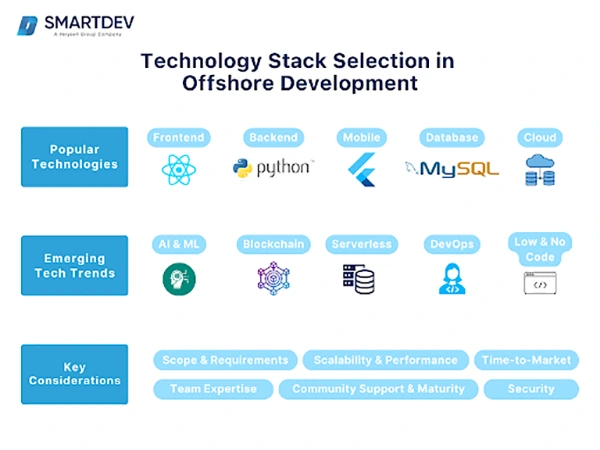
Remote developers are usually weak with operational technicalities. However, expert remote teams are often more disciplined with documentation and version control. Since they must coordinate with a remote software development team, they rely heavily on clean code and proven track record practices. This discipline actually improves the long-term health of the software development life cycle.
The demand for offshore programmers continues to rise because digital transformation is hitting every industry. From finance to healthcare, various industries are seeing that remote development services provide the scalability needed for business growth.
2026 has changed the mindset of global engineering firms from labor arbitrage to quality and innovation. Companies that hire offshore developers based on technical skills and cultural alignment see much higher returns.
The global talent market is wide open. For those who know how to navigate the hiring process, the rewards are significant. It is time to stop looking at offshore development as a cheap fix and start seeing it as a powerhouse of innovation.
Ans: Hiring from regions with superior talent.
Ans: Cost-cutting by hiring from low-wage regions.
Ans: Employing advanced tech to improve efficiency, reduce labor costs, and create quality products.
