Becoming job-ready for a cybersecurity career requires more than a certificate. Employers look for candidates who understand networking and security fundamentals, can work with cybersecurity tools, understand ethical hacking techniques, and have practical experience solving security problems.
There are several institutions that offer a cybersecurity course in Mumbai. For example, Boston Institute of Analytics (BIA) offers structured learning paths that combine classroom and online learning with practical labs, projects, tools, digital manufacturing, and career preparation
Here are seven practical steps to follow if you genuinely want to become job-ready for a cybersecurity career.
The initial step toward a cybersecurity career is understanding how computers, networks, operating systems, and applications communicate.
Before moving into advanced ethical hacking or penetration testing, students should understand concepts such as:
Networking knowledge is specifically important because many cybersecurity activities involve monitoring network traffic, mapping suspicious activity, investigating attacks, or securing network infrastructure.
A reliable foundation also makes advanced topics such as penetration testing, vulnerability assessment, cloud security, and Security Operations Centre (SOC) work easier to learn.
A structured cybersecurity training course can help beginners understand these fundamentals before moving into more advanced security concepts.
Knowing cybersecurity concepts theoretically is not sufficient to become job-ready.
Cybersecurity is a practical field. Professionals have to understand how attacks happen, how vulnerabilities can be verified, and how security teams respond to threats. This is why practical labs and simulations should be an important part of your learning journey.
A good cybersecurity course should provide you with opportunities to work with areas such as:
For example, Boston Institute of Analytics Cyber Security & Ethical Hacking course offers practical labs, simulations, live hacking demonstrations, ethical hacking challenges, red-team versus blue-team simulations, and real-world projects and case studies. The recent course page states that the curriculum includes 200+ hours of learning and practical exercises with industrial communication software, along with 15+ projects and case studies.
This type of hands-on exposure helps students move from simply understanding cybersecurity concepts to applying them.
Another essential step is to become comfortable with cybersecurity tools.
Employers do not expect beginners to know every security tool available, but having practical exposure to generally used technologies can make a candidate more confident and job-ready. Depending on your chosen career path, you may work with tools for:
As organisations rapidly use cloud infrastructure, understanding cloud platforms, identity and access management, and infrastructure security is becoming increasingly essential.
BIA’s current Cyber Security & Ethical Hacking course provides exposure to 20+ tools and technologies, alongside practical exercises and real-world simulations.
The goal should not be to memorize tool names. Instead, learners should understand when and why a tool is used and how to interpret its results.

Projects are one of the finest ways to demonstrate that you can apply cybersecurity knowledge.
A resume that only provides certifications may not show an employer what you can actually do. Projects, on the other hand, can demonstrate your ability to investigate problems, use security tools, document findings, and implement relevant solutions.
Some useful cybersecurity project areas include:
For example, a penetration-testing project can require reconnaissance, scanning, vulnerability identification, controlled exploitation, documentation, and reporting.
BIA’s course structure involves practical projects and case studies designed around cybersecurity applications. Its recent course page highlights 15+ projects and case studies, practical capstone projects, and real-world simulation labs.
When curating your portfolio, document each project clearly. Mention the problem, tools used, methodology, findings, and recommended security controls. This gives recruiters a better understanding of your practical capabilities.
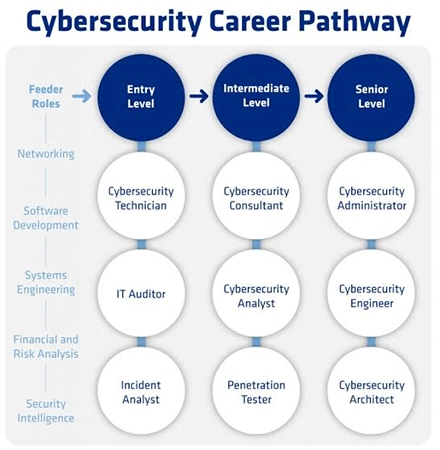
Cybersecurity is a wide field. You do not necessarily need to become an ethical hacker to build a cybersecurity career. Once you understand the fundamentals, explore different career paths and verify the area that matches your interests.
Other possible roles are Security Engineer, Incident Responder, Security Consultant, Digital Forensics Analyst, Network Security Engineer, Security Researcher, and Security Architect.
Understanding these options early can help you select the right projects, tools, and additional certifications.
How the Boston Institute of Analytics Cyber Security & Ethical Hacking course maps to these career paths
The BIA course in Mumbai – Andheri is curated so that each career path above has a matching area of training:
The course runs on three learning options (a 4-month Certification, a 6-month Diploma, and a 10-month Master Diploma), with 200+ hours of learning and practical projects, 15+ projects and case studies, and 20+ tools and technologies. The Boston Institute of Analytics current course page lists many of the roles mentioned above among potential career opportunities after the course.
Learning cybersecurity skills is only half the work. You also need to communicate those skills impactfully to recruiters.
Your resume should focus on practical capabilities rather than simply listing every topic you have studied. Include:
For example, do not just write:
“Learned penetration testing.”
You could define a project more specifically:
“Performed a controlled web application security assessment using Burp Suite and documented verified vulnerabilities and remediation recommendations.”
This gives recruiters a clearer understanding of your practical exposure.
You should also maintain professional profiles on platforms like LinkedIn and relevant job portals. Maintain your profile aligned with your target role, whether that is SOC Analyst, Cybersecurity Analyst, Ethical Hacker, or Penetration Tester.
Career preparation should also offer resume reviews, interview practice, communication skills, and guidance on applying for relevant cybersecurity roles.
This is where placement support is important. Recruiters usually look for a resume backed by projects, comfort with tools, and clear communication.
Boston Institute of Analytics placement support is curated around exactly these expectations: resume building, interview preparation, soft skills training, and access to job and internship opportunities via its partner companies. Combined with the practical projects and internship pathways described below, students have project work to show and interview practice behind them by the time they start applying.
The last step is turning your knowledge into interview performance.
Cybersecurity interviews can test both technical understanding and problem-solving ability. You should be prepared to counter questions around:
You may also be given a scenario and asked how you would react. For example:
“You notice unusual login activity from an unknown location. What would you do?”
A better candidate should be able to explain a logical investigation process rather than simply naming a security tool.
Interview preparation should therefore involve technical questions, scenario-based questions, HR interviews, self-introduction, communication, and discussion of your projects.
This is also where career mentorship can make a change. Boston Institute of Analytics’ current course information highlights resume building, interview preparation, career mentorship, and access to partner businesses as part of its career support approach.

For students searching for the best cyber security course in Mumbai, or a top cybersecurity course in Mumbai, a useful way to compare options is by structure, practical exposure, tools covered, and career guidance. Against those points, here is what Boston Institute of Analytics offers through its Cyber Security & Ethical Hacking course at the Mumbai – Andheri branch.
The course is built around cybersecurity fundamentals, ethical hacking, network security, penetration testing, web application security, cloud security, mobile application security, exploitation techniques, and other security considerations.
The current BIA course provides three learning paths:
| Learning Path | Duration | Key Feature |
| Certification | 4 Months | Structured Cyber Security & Ethical Hacking training |
| Diploma | 6 Months | Includes practical exposure and internship pathway |
| Master Diploma | 10 Months | Extended practical learning with OJT pathway |
BIA’s current website ensures these three learning paths and describes the course as a combination of classroom experience, online learning, practical assignments, labs, projects, and career affirmitiveness.
The latest fee structure for the Mumbai – Andheri Cyber Security & Ethical Hacking course is:
| Course | Duration | Fee |
| Certification | 4 Months | ₹97,000 |
| Diploma | 6 Months | ₹1,25,000 |
| Master Diploma | 10 Months | ₹1,75,000 |
Fees can vary based on the current intake, offers, taxes, or course structure, so learners should confirm the latest fee directly with BIA before enrolment.
A career-focused cybersecurity curriculum should include both fundamentals and advanced security applications. The BIA curriculum covers areas such as:
The current BIA website similarly provides a 200+ hour learning and practical structure, 15+ projects and case studies, and 20+ tools and technologies.
Practical workplace exposure can be especially valuable for cybersecurity beginners.
According to Boston Institute of Analytics course data, the 6-month Diploma pathway includes a 2-month internship, while the 10-month Master Diploma pathway includes 6 months of on-the-job training like Cyber Security Analyst.
This additional experience can help learners understand how cybersecurity concepts are applied in professional environments. It can also provide opportunities to work with real processes like security monitoring, documentation, reporting, vulnerability assessment, and incident-related activities.
Getting trained is one part of getting job-ready. Understanding how to approach the job market is equally important.
BIA offers 360° career support, which offers:
The current BIA course page particularly highlights 360° career support, including resume building, interview preparation, and access to partner companies. It also highlights one-to-one career guidance and interview preparation.
Why does this matter? Many beginners complete a course with good technical knowledge but little idea of how to present it. Resume building shows how to turn projects into proof of skill; interview preparation supports technical and scenario-based questions, and access to partner companies gives learners a direct route to relevant openings and internships. Together, these bridge the gap between completing training and getting hired.
BIA also offers Campus Connect, its centralized learning platform, which provides access to study materials, lecture recordings, guest lectures, a help desk, and career enhancement resources. This is important because cybersecurity learning does not stop in the classroom. Recorded lectures let learners revisit difficult topics such as network traffic analysis or exploitation methodology; guest lectures include industry perspective, and career resources keep job preparation going alongside the course.
Cybersecurity is not limited to computer science graduates. Learners from engineering, science, commerce, and arts backgrounds can explore the field if they are willing to learn technology fundamentals and build practical skills.
A cybersecurity course for working professionals can also be a practical way for those planning a transition from IT support, networking, system administration, software development, or other technology-related roles. With on-site and online learning options and paths ranging from four to ten months, learners already in jobs can choose the duration and depth that suits their situation.
The BIA course states that students do not need a previous programming or security background to start, with foundational concepts included as part of the learning journey.
The more essential factors are curiosity, problem-solving ability, willingness to practise, and consistency.
Becoming job-ready for a cybersecurity career is a process instead of a single certification.
The most impactful approach is to build strong networking and security fundamentals, develop hands-on skills, learn relevant cybersecurity tools, complete practical projects, select a career path, curate a strong professional profile, and prepare seriously for interviews.
For students searching for a cybersecurity course in Mumbai or cybersecurity training in Andheri, a structured course can provide a roadmap for developing these skills. Boston Institute of Analytics integrates cybersecurity and ethical hacking training with practical labs, projects, tools, career preparation, and multiple learning pathways.
Ultimately, the goal should not simply be to finish a course. The goal is to become capable of identifying security problems, understanding how attacks work, using appropriate tools, communicating findings, and aiding an organization’s cybersecurity efforts.
With regular practice and the right learning environment, beginners can take their first steps toward roles such as Cybersecurity Analyst, SOC Analyst, Ethical Hacker, Penetration Tester, Vulnerability Assessor, Cloud Security Specialist, and other cybersecurity job opportunities.
Ans: Boston Institute of Analytics provides a Cyber Security & Ethical Hacking course at its Mumbai – Andheri location, covering networking, Linux, ethical hacking, penetration testing, web application security, SOC and SIEM, cloud security, and digital forensics.
Ans: BIA currently lists three learning paths: a 4-month Certification, a 6-month Diploma, and a 10-month Master Diploma.
Ans: The latest fees are ₹97,000 for the 4-month Certification, ₹1,25,000 for the 6-month Diploma, and ₹1,75,000 for the 10-month Master Diploma. Fees can vary with intake, offers, or taxes, so confirm the latest figure with BIA before enrolling.
Ans: Yes. The current course data highlights practical labs, simulations, projects, case studies, capstone projects, live hacking demonstrations, and hands-on learning, with 200+ hours of learning and practical exercises and 15+ projects and case studies.
Ans: The 6-month Diploma pathway includes a 2-month internship, and the 10-month Master Diploma pathway includes 6 months of on-the-job training as a Cyber Security Analyst.
Ans: BIA provides 360° career support, including resume building, interview preparation, one-to-one career mentorship, and access to partner businesses, along with placement assistance.
Ans: Yes. The course states that no previous programming or security background is required, and foundational concepts are included as part of the learning journey. Working professionals moving from IT support, networking, or development can also consider it.