

Photo by Maksim Goncharenok
According to Harvard Business Review, customer acquisition can be 5-25x more expensive than retaining them. For SaaS companies built on recurring revenue, that makes EDM (Electronic Direct Mail) much more than a channel for generating clicks. It can influence whether a trial user reaches their first “aha” moment, an existing customer discovers more value in the product, or an inactive account quietly churns.
Yet it’s a numbers game: Teams track open rates, click-through rates, and send volumes. But, all this overlooks the metric that matters most: Is the email helping users succeed with the product?
Someone signing up for a trial genuinely has a problem to solve. They want to know whether your software can save them time, simplify their work, or help them achieve a better outcome.
The best SaaS email strategies are therefore built around the customer journey rather than the marketing calendar. Here’s how to turn email into an extension of your product experience.
A relationship starts with the user entering his/her email ID on your site. Many software companies make the mistake of immediately dumping new signups into a generic promotional sequence. They send endless feature lists and push for upgrades before the user’s even explored the product interface. We’ve all been there, pushing that unsubscribe button.
A better approach starts with clear onboarding.
The goal of early emails should always be user activation. Focus on helping the reader achieve their first meaningful outcome inside the software. If your tool manages projects, guide them to create their first task. If it handles data analysis, show them how to import a dataset. Every message during this phase should remove friction and answer common setup questions.
Studying successful email templates for SaaS is a great way to see how industry leaders structure these onboarding flows effectively. So, why not spend time reviewing what already works before building your own from scratch? Saves a lot of time and creative effort.
Once a user moves beyond initial onboarding, their content needs shift. Regular updates should focus on feature education, best practices, and practical workflows. Segmenting your email list based on user behavior ensures that power users receive advanced tips while beginners get foundational guides.
The best marketing is one that doesn’t feel like marketing. They feel like direct communications from a team that genuinely understands the industry. I guess it comes down to basic empathy.
Every email you send should pass a simple test: does this provide tangible value to the reader even if they never upgrade or purchase anything today? If the answer is no, back to the drawing board.
To create engaging content for software users, consider incorporating these core principles:
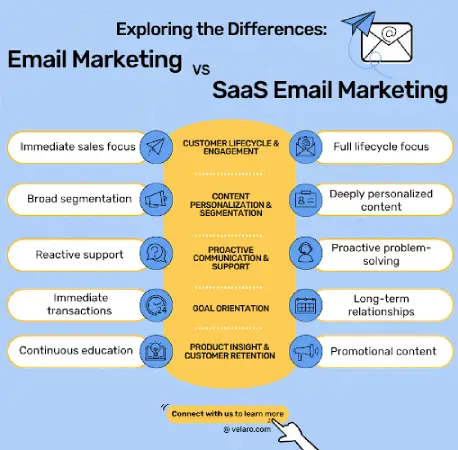
By the way, if you’re still confused about how SaaS email marketing is different from just plain, simple EDM, check this infographic out:
Acquisition can just bring a customer to your doorstep. It’s retention that makes him/her stay and buy, and buy again, and again. Email marketing plays a critical role in keeping existing users engaged and reducing churn over time.
Triggered emails based on user behavior allow you to reach out at exact moments of need. But how do you know when to reach out? Look at user activity.
Transactional emails, such as password resets and payment receipts, are another underutilized channel. While these messages must remain clear and functional, adding a brief line highlighting a new resource or an upcoming webinar turns a routine notice into a helpful interaction.
Automation provides scale in terms of personalized communication, but poorly designed automation can quickly make a brand feel impersonal. Software users want to know there are real people behind the platform who care about their experience—the hum of the laptop at midnight, the support team genuinely trying to fix a bug.
And that balance is easier to strike than you might think.
Write messages using a personal, conversational tone. Address the reader directly and communicate as if you’re writing a message to a colleague. Avoid jargon, buzzwords and fluff.
It’s also important to create opportunities for two-way communication. Invite subscribers to reply directly to your emails with questions or feedback. Having product managers or customer support specialists read and respond to these replies creates valuable qualitative insights while building trust with your user base.
Open and click rates can tell you whether an email attracted attention, but they can’t tell you whether it created business value.
Track how email engagement correlates with product adoption and long-term retention. Monitor metrics such as trial-to-paid conversion rates, feature adoption after targeted campaigns, and overall customer lifetime value. By aligning email metrics with broader business goals, you ensure that every campaign contributes to genuine growth rather than just inflated send counts.
Email bombing won’t do much good. Effective email marketing for software platforms is about thinking from users’ perspective and guiding them toward success. When you treat your inbox presence as an extension of your product experience, your messages become a helpful resource that subscribers look forward to receiving.
Ans: It’s the use of email to guide prospects and customers throughout the software customer journey including trial onboarding, product education, feature announcements, retention campaigns, re-engagement emails, and transactional messages.
Ans: By segmenting subscribers according to their behavior, sending messages at relevant stages of the customer journey, and focusing each email on a practical user outcome rather than simply promoting product features.
Ans: Common SaaS onboarding emails include welcome messages, setup instructions, product tutorials, use-case examples, and reminders triggered when users fail to complete important onboarding actions.
