
Imagine a production sequence: a high-fashion model walks through a rain-slicked street in a neo-noir cityscape.
The lighting is moody, the bokeh is cinematically perfect, and the temporal consistency of the fabric movement is flawless.
For a hobbyist, this is a “failed” generation. For a professional editor, this is a 90% success that is currently unusable. The traditional response in generative media has been to hit the “regenerate” button and hope for a better roll of the dice. But in a commercial production environment, hope is not a technical strategy.
Rerolling consumes more than just credits; it consumes the most valuable resource in the pipeline: time.
The shift from the “slot machine” mentality of prompt-based generation to a disciplined, iterative post-production workflow is where professional generative video matures. The true bottleneck in production today isn’t generating an initial clip; it’s the surgical intervention required to fix the “last mile” of a generation.
This is where regional editing and inpainting transform a generative curiosity into a production-ready asset.
Key Takeaways
- Exploring the friction of the ‘perfect’ prompt
- Assessing regional inpainting: the strategic fix for continuity
- Analyzing how to manage hallucinations without breaking the frame
- Evaluating the limits of post-processing in generative media
The “90% trap” is a unique frustration in AI-native production.
In traditional cinematography, if a shot is 90% there, you can often fix the rest in the grade or through clean-up.
Many creators fall into the trap of over-prompting, attempting to describe every micro-detail of the scene to avoid artefacts.
This usually results in “prompt bleed,” where the model becomes confused by the weight of contradictory descriptors, leading to muddy textures and static compositions.
From a resource management perspective, infinite rerolls are a path to negative ROI.
If you spend four hours chasing a “perfect” 5-second clip through raw prompting, you’ve likely exceeded the cost of a traditional stock license or a simplified practical shoot. The pivot must be toward technical execution: accepting a generation that is “structurally sound” and moving into the editing phase to resolve specific regional errors.
Regional inpainting allows an editor to isolate a specific area of the frame—the “region”—and tell the model to re-visualise only those pixels while keeping the rest of the frame locked.
This is the cornerstone of maintaining continuity across a sequence.
When working with an AI Video Generator, the goal of regional editing is the isolation of variables. If you have a character walking through a park and the trees in the background are flickering, you don’t need to change the character’s movement.
By masking the background and applying a targeted regional change, you can stabilize the environment without risking the character’s performance.
However, a moment of caution is necessary here: temporal stability in regional inpainting is significantly more difficult than in static image editing.
While an image inpainter only needs to worry about spatial coherence, a video inpainter must ensure the new pixels track with the camera movement and lighting changes over time. It is often more effective to use inpainting for static elements or slow-moving textures than for high-velocity subjects.
Treating the generative engine as a raw asset provider rather than a finished-file engine changes the economic calculation of a project.
When you stop looking for the “perfect” render and start looking for the “minimum viable generation,” your throughput increases.
A “good enough” baseline is a clip where the composition, lighting, and primary motion are correct. By utilizing an AI Video Generator within a modular workflow, you mitigate the risk of project stalls. You can commit to a shot list knowing that you have the tools to polish the artefacts rather than being at the mercy of the model’s random seed.
This workflow also allows for safer experimentation.
You can push for a highly complex, stylised prompt that might produce more artefacts because you know you have the “safety net” of regional control. You aren’t just generating; you are directing. This kind of directing works best when the tools understand the production as a whole, not just the clip in front of you. invideo agent supports this by maintaining project knowledge, references, and creative decisions across scenes, so iterative refinement stays consistent with the rest of the production rather than happening in isolation.

Not all hallucinations are created equal.
As an operator, you must learn to distinguish between “fixable” artefacts and “structural” failures.
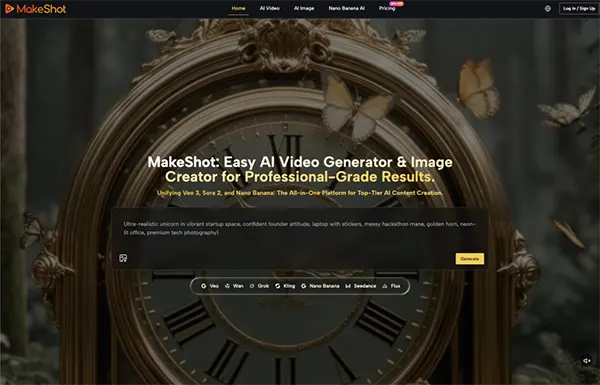
For restyling and unifying disparate visual elements, tools like Nano Banana within the MakeShot ecosystem provide a bridge.
We often see success using a hybrid approach: generating a base layer with text-to-video, then using image-to-video for the inpainting regions.
By providing a high-resolution reference image for the specific area you want to fix, you give the generator a much clearer roadmap than text alone could ever provide. This reduces the cognitive load on the model and results in more predictable, professional-grade outcomes.
Despite the power of these tools, it is vital to manage expectations regarding what can actually be “fixed” in post. Generative video is still bound by the limitations of the training data and the current state of temporal consistency.
One of the most significant hurdles is complex human anatomy in motion. If a hand is missing a finger and is also moving rapidly across the frame while rotating, current inpainting tools often struggle to maintain the anatomical structure through the entire arc of motion.
In these cases, it is often better to adjust the shot—perhaps by cropping in or changing the angle—than to attempt a surgical fix that will never look quite right.
There is also a persistent uncertainty regarding how different models handle regional masks. We cannot yet perfectly predict which seed-level artefacts will persist through a mask or which will cause the model to deviate from the rest of the frame’s style.
The transition from “prompting” to “producing” requires a deep understanding of these edges.
Professional-grade results aren’t found in the first click; they are found in the four or five technical interventions that follow.
By embracing inpainting and regional edits, creators move away from the frustration of the “almost perfect” and toward a repeatable, industrial workflow where the AI is a tool, not a lottery.
Generative video tools have strengthened content creation by providing polished and active results that require precise editing and refinement. This helps creators improve quality, maintain consistency and generate compelling stories.
