

A missed phone call seems minor unless it’s at a dental practice, law firm, or home services business. Then, it’s a lost customer.
The average inbound call miss rate is 23% across healthcare organizations, highlighting how much revenue can slip through a gap that rarely appears on an operations dashboard.
While businesses invest in automating production lines, ERP workflows, and warehouse operations, their phone lines remain dependent on overstretched staff. AI voice agents are changing that equation, turning inbound calls into an automation opportunity that IT and operations leaders can measure, optimize, and scale.
Most automation funding still flows toward coordinated drive systems and distributed control platforms that keep production lines synchronized in real time. Those systems get monitored, measured, and continuously optimized because downtime has an obvious, calculable expense attached to it.
The phone line feeding new business into the same company rarely gets that same scrutiny. Healthcare organizations miss close to 23% of inbound calls on average, according to conversation intelligence company Invoca, and dental practices see comparable rates during peak hours. Unlike a stalled conveyor belt, a missed call doesn’t initiate an alarm or show up on a dashboard. It quietly becomes a customer who called the next business on the list instead.
That gap between tight operational discipline on the production side and almost none on the front-office phone side is precisely the kind of asymmetry an automation strategy is supposed to close.
Two things revised the calculus for a lot of businesses. First, call volume tends to grow faster than front-desk headcount, making consistent live coverage difficult without significant staffing, particularly outside standard business hours. Second, the cost of a delayed response turned out to be measurable and steep.
Research on speed-to-lead conversion published in Harvard Business Review found that companies contacting a prospective customer within roughly an hour of first contact converted meaningfully more of those leads than firms that waited even a few hours longer. Phone inquiries behave the same way, often more acutely. A caller with an urgent need- a toothache, a broken water heater, a legal question that can’t wait- rarely sits around for a callback. They reach the next number on the list, and most people who reach voicemail simply don’t leave a message.
This pattern shows up across sectors that depend on inbound calls for new business:
All share the same underlying risk. A single missed call rarely feels significant in isolation. A pattern of them, compounding over a year, becomes a measurable drag on growth.
The workforce math makes the problem harder to solve with headcount alone. Covering a phone line from early morning through late evening, seven days a week, typically means multiple overlapping shifts or a third-party answering service, and both options add steady cost without necessarily improving the quality of the interaction. A traditional answering service can take a message, but it usually can’t check real-time availability or complete a booking, which just shifts the delay further down the process instead of eliminating it.
Modern virtual agents go well beyond the scripted phone trees and hold-music systems firms have used for decades. Built through custom AI agent development services, these systems use natural language processing to understand what a caller is actually asking, pull relevant information from connected business systems in real time, and complete steps such as booking an appointment or routing an emergency, without forcing the caller to navigate a menu first.
The shift mirrors a broader trend research firm Gartner has tracked closely. Gartner forecasts that by 2029, agentic AI resolving customer issues autonomously will handle roughly 80% of common service interactions without human intervention, cutting operational costs by an estimated 30% in the process. Voice is simply the channel where that change is currently least visible and, for many businesses, most overdue. As a result, these voice AI systems boost your client acquisition easily.
Building one of these systems well is not a matter of connecting a language model to a phone line and calling it done. It requires integration with a scheduling or practice management solution, clearly scoped permissions for what the AI can and cannot do autonomously, and a defined handoff path to a human for anything outside its scope- the same architectural discipline IT teams already apply when automating any other business-vital process.
Use cases of these AI voice agents are across various industries:
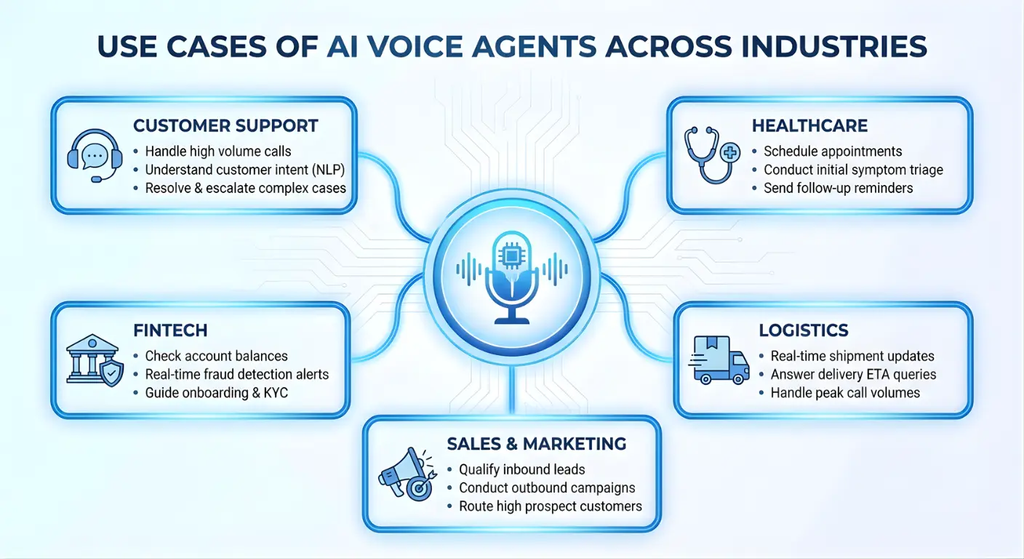
Now, let’s take a look at a particular example case.
Dental practices illustrate the pattern clearly. A typical office runs a small front-desk team that is simultaneously:
When staff is occupied with someone standing at the counter, the phone goes to voicemail, and the majority of callers who reach voicemail never leave a message.
An AI-powered dental phone answering service handles that specific failure point directly. Rather than taking a message for a human to follow up on later, the system answers immediately, understands why the patient is calling, checks real-time availability, and reserves the appointment directly into the practice’s scheduling system, whether that call arrives during a Tuesday lunch rush or at nine o’clock on a Sunday night.
The result isn’t a headcount reduction so much as a coverage expansion. The same front-desk unit keeps doing the in-person work it does best, while the phone line gains a level of consistency that hiring alone rarely manages to deliver, particularly for smaller practices that can’t staff a dedicated after-hours line.
For IT and operations managers, voice automation shouldn’t be treated as a separate initiative from the automation work already underway elsewhere in the business. The same logic behind automating invoicing, approvals, and data entry across HR, finance, and support fits just as well to an inbound phone line: identify the repetitive, rules-based parts of the task, automate those specifically, and route anything genuinely complex to a person.
Treating call handling as part of the same operations-automation roadmap, instead of a one-off tool purchase, also keeps data consistent across the business. A voice agent that books appointments or logs service requests needs to write into the same CRM or scheduling system everything else touches, or it just creates a new data silo instead of closing an old one.
Not every firm needs voice automation immediately, and rushing the decision tends to produce systems that frustrate callers rather than help them. A few questions are worth answering before committing budget to a build:
Businesses that can answer these clearly tend to end up with a system that quietly closes coverage gaps instead of one that adds a new layer of caller frustration on top of the old one.
The manufacturing floor got automated first because its inefficiencies were observable on a dashboard. The phone line’s inefficiencies show up as calls that simply never happened, a harder problem to notice and, historically, an easier one to ignore. As virtual agents evolve and integrate more deeply with the software businesses already run on, that blind spot is closing quickly. For companies evaluating where their next automation investment should go, the phone line is no longer the obvious afterthought it used to be.
What are AI voice agents?
AI voice agents are AI-powered systems that handle phone conversations using natural language processing and speech technology.
How can AI voice agents help businesses reduce missed calls?
They can answer incoming calls outside regular business hours and during peak periods when employees are occupied.
Can AI voice agents integrate with CRM and scheduling systems?
Yes. They can be integrated with compatible CRM, scheduling, and practice management platforms.
