
The loop of complaints that I come across every day is quite similar despite being from different people.
The same issues of oversale of a product on Shopify, where the numbers don’t seem to match in Odoo, constant problems with shipping the product but never receiving it from customer’s end led me to the question why does it keep happening over and over again?
When I got into the surface of the problem I realized that tge entire problem lies with understanding the main issue with deliveries something that most Odoo integration services quietly get wrong, and it’s why so many integrations demo beautifully and then fall apart around month three.
Not the APIs or communication but the moving data between the Odoo and Shopify, and if you too dont want for your services , here’s a guide.
Key Takeaways
- The 3PL integrations should be built to address real-world fulfilment challenges like partial shipments, inventory mismatches, and delayed updates.
- A reliable integration is built to handle exceptions. Error handling, monitoring and reconciliation processes that prevent costly mistakes.
- The best Odoo integration services are not just about connecting APIs, but focusing on business workflows.
- Establish clear data ownership before you start for smoother operations, better reporting and less manual correction.
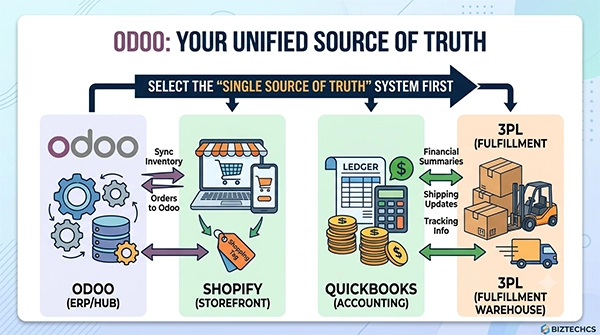
Any piece of data that stays for more than one system needs exactly one system named as its source of truth.
Your inventory as a result count needs an owner.
Your product catalog and pricing need one too.
And the same goes for customer records and for the financial ledger.
What happens in such scenarios is you end uo Picking the wrong owner, or worse, never pick at all, and you end up with two systems that each believe they’re correct.
The sync particularly starts fighting itself. And at the next step your own team spends Friday afternoons reconciling exports to work out what really happened.
This is what happens in the boring discipline that decides everything. Further, map every shared entity and name the one system that owns it.
And then settle which direction each kind of data is allowed to flow.
It is advised to do that intially and the connectors turn out to be simple.
Skip it, and no connector on the market will save you.
The classic failure with Shopify is overselling, and it’s almost always the same root cause behind the problems. The moment your inventory begins to count lives in two places and updates with any kind of delay, you will eventually sell something that you don’t probasbly have. Then you get to apologize to a customer and end up by cancelling an order you already charged for.
The fix isn’t a faster sync. It’s a decision.
Odoo owns inventory, while Shopify displays a number it is handed rather than a number it keeps its own opinion about.
Once that part is settled, the connection begins to get much calmer. And then comes the edge cases that never appear in a sales demo.
A refund that has to put stock back where it belongs. A partial fulfilment therefore doesn’t mark a whole order complete.
A bundle that begins by selling as one product on the storefront has to draw down several component items in Odoo. Each of those then provides a design decision, not a checkbox, and a good integration that handles them deliberately rather then discovering them in production when a customer notices first.
There’s a second ownership question that continues to hover in such cases, which is who controls the product catalog and the price.
The snswer is Odoo usually should, because that’s where your real cost and margin logic lives.
But marketing will always want to tweak titles and run these promotions on the storefront, so the same arrangement is that Odoo owns the canonical product and price while Shopify is allowed to override presentation and discounts within rules you set once.
Decide that on day one and you sidestep begins to the slow argument where a price changes in one place and silently doesn’t in the other.
The QuickBooks question is the one that nobody actually enjoys asking.
Are you keeping QuickBooks as your accounting system, or are you moving the books into Odoo?
There is no universal right answer, but there is a clearly wrong one, which is running both as though each is the official record. And that’s exactly how you get two ledgers that never quite agree and an accountant who trusts neither of the scenarios.
If you decide to keep QuickBooks, you must learn that Odoo should hand it clean, summarised journal entries on a schedule, not a raw firehose of every transaction for a human to untangle later.
The goal is that your accountant eventually begins to open the books and finds them already reconciled, and not as a pile of duplicates from two systems both trying to record the same sale.
Sales tax, refunds, and the month-end close all have to survive the handoff.
As a result to this what matters is you should respect the way the accountant actually works, or the integration slowly dies of a thousand manual corrections nobody signed up for.
As for the keep-or-move question itself, a rough rule holds up well.
If you’re already drowning in manual entries that exists between the two systems, or your finance needs have outgrown what QuickBooks actually handles them cleanly, that pain is the signal to move the books into Odoo and retire the second ledger for good.
The one position that continues to never pays off is sitting in the middle forever, and paying to sync two systems that were each designed to be the whole answer.
Third-party logistics is exactly where your tidy data model collides with physical reality, and physical reality always wins.
An order then gets you split across two shipments. Something that goes on backorder. A return which arrives unannounced and has to find its way back into stock. The inventory the 3PL physically holds is how slowly it drifts from what Odoo believes it holds.
The word “shipped” begins to turn out to hide a great deal. As a result your integration has to translate the messy truth of a warehouse into one honest status inside Odoo, and it has to do it across whatever the 3PL happens to speak.
Some still run on EDI.
Some offering a modern API. A few still continue to drop a CSV onto a server at midnight and call it a day.
None of that should even reach your team as noise.
And you have to build for the day the feed begins to arrive late or malformed, because at some point it will, and the difference between a good integration and a bad one is whether that day becomes a quiet retry or a customer-facing mess.
Returns deservedifferent mention of the story.
A parcel comes back, and unless the flow was designed for it, that unit either never returns to sellable stock or gets counted twice.
The same applies to the periodic reconciliation between what the warehouse physically counted and what Odoo believes is on the shelf.
And when someone has to decide, in advance, whose number wins when the two disagree, because they will disagree. Leaving that to a gut call at quarter end is exactly how shrinkage hides in plain sight.
By now, the pattern is hopefully obvious.
Good Odoo integration services map the source of truth for every shared entity before writing a line of sync code, and design for the refunds, partial shipments and late feeds up front.
They build error handling and idempotency, so a retried message never double-charges a card or double-ships an order.
The same rule extends to the softer connections that grow up around commerce.
Choose whether Odoo CRM or the originating tool owns each contact, or you’ll soon have three slightly different versions of every customer and no idea which phone number is current.
A well-planned Odoo CRM integration is not a special case.
It’s the source-of-truth rule pointed at people instead of products.
The businesses that get integration right are rarely the ones with the fanciest connector.
They’re the ones who did the unglamorous work of deciding who owns the truth before anyone wrote a line of sync code.
At BiztechCS, we’ve connected enough Odoo systems to storefronts, accounting packages, and the warehouses behind them to say it plainly.
The integration is genuinely easy once that decision is made, and quietly impossible until it is.
Evaluation at every step is a major factor in delivering services. This is why evaluating the data channels from order to shipping and delivery and thereafter returns, is considered an important prospect.
Odoo Integration services make sure that a particular action takes place, and that too securely and efficiently, making them ideal for such activities.
No system is perfect, and Odoo has its small challenges: Limited Ready-Made Modules for Specialized Needs.
Odoo integrates CRM, inventory management, and project management, while accounting is handled in a separate ERP system.
Odoo mainly focuses on two types of accounting. One is ‘Continental Accounting,’ and the other is ‘Anglo-Saxon accounting.
Shopify ERP integration connects your store to platforms like SAP or NetSuite to be sure that inventory, purchasing, and financial data are correct and up-to-date at all times.
