
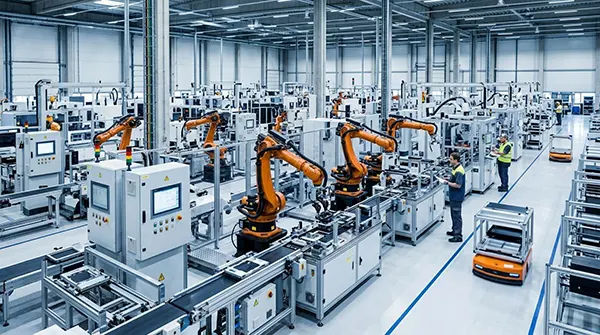
Industrial Automation is used to control systems, sensors, and actuating tools to run industrial processes with minimal human intervention. Rather than operators directly manipulating machines on a shop floor, a layered system of hardware and software collects process data, makes control decisions, and drives equipment.
In this article, you’ll see what industrial automation is and how it actually works, and what the main components are and their types.
Industrial automation is the application of control technology in smarter spending to implement industrial tasks without continuous physical input. In practice, this means a machine or process that runs in a defined order, filling a tank to a set level, welding a joint along a programmed path, or classifying parts by weight, driven by devices that read the process state and respond automatically.
A few characteristics differentiate automation from simple mechanization:
A typical example: a bottling line where flow meters monitor fill volume, a PLC compares readings against the directions, and aerial valves trim the fill in real time, with an HMI showing operative trend data and alarm states, and SCADA archiving everything for trackability.
Industrial automation follows the same control loop everywhere, from a constant temperature oven to a multi-kilometer pipeline. Understanding the loop makes every architecture decision easier to reason about.
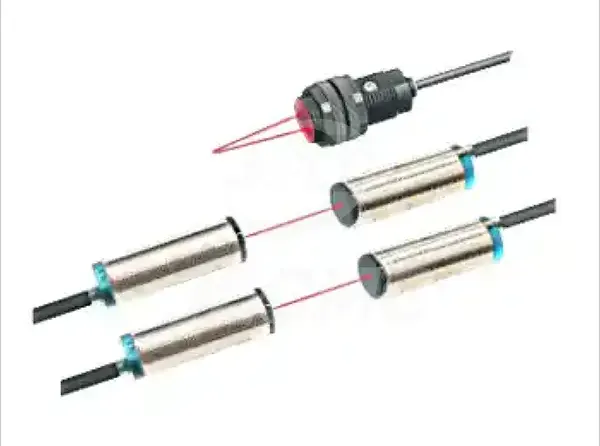
Sensors convert physical process states into electrical signals the controller can read. Here automation quality starts; a control loop is only as good as its measurement.
Common sensor categories that actually matter when selecting them:
| Measurement | Typical Sensor | Practical Notes |
| Temperature | RTD, thermocouple | RTDs are more precise and stable; thermocouples handle higher temperature ranges |
| Pressure | Piezoresistive transducer | Check high-pressure rating, not just nominal range |
| Level | Ultrasonic, radar, capacitive | Ultrasonic labor with vapor and foam; radar costs more but works in harsh duct |
| Position | Encoder, linear scale, proximity switch | Encoders give continuous feedback; distance switches are binary only |
| Flow | Coriolis, magnetic, differential pressure | Coriolis measures mass flow and density; magnetic needs a conductive fluid |
| Vision | Industrial camera + lighting | Lighting design usually matters more than camera preservation |
Two field problems cause most sensor-related downtime: signal decline over long cable runs (use 4–20 mA current loops or digital fieldbus rather than raw voltage signals) and mounting errors that reveals sensors to vibration, heat, or washdown beyond their rating.
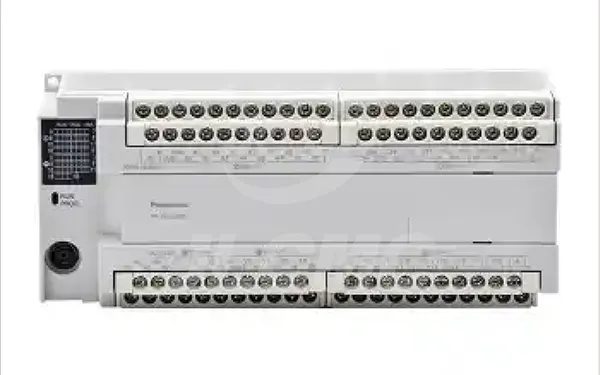
Controllers implement the logic. The dominant device is the PLC (Programmable Logic Controller), a durable computer designed for real-time, deterministic implementation in electrically noisy environments. PLCs scan inputs, execute the control program (ladder logic, structured text, or function blocks), and update outputs in repeating task cycles prepared per application, with actual scan times differing with program size, communication load, and task setup.
Above the PLC sits the managerial layer:
For motion-heavy tasks, robot tracks, multi-axis synchronization, dedicated motion controllers, or industrial PCs running real-time operating systems handle the instant timing that a standard PLC scan can’t.
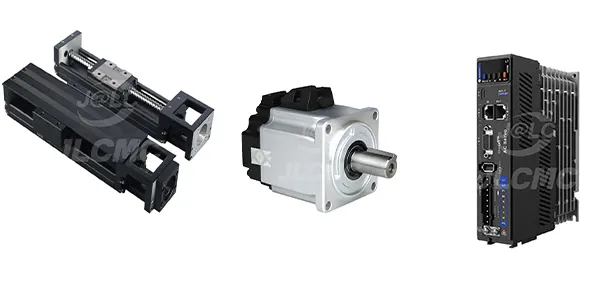
Effectors convert controller outputs into physical action: motors and variable frequency drives (VFDs) for rotation and conveyance, pneumatic or hydraulic cylinders for linear force, electromagnetic valves for fluid routing, servo systems for accurate positioning.
The loop closes when the effect of the activation is measured again by sensors and fed back. This is what disconnects closed-loop control from open-loop ordering:
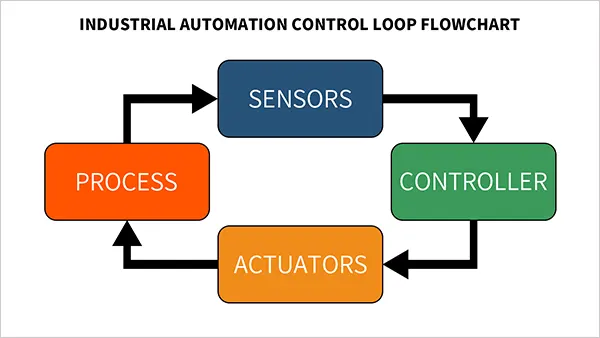
Each element adds delay: sensor response time, controller execution time, effector mechanical response. The admissible control-loop response time depends on the process interaction, machine speed, and required accuracy; designers should account for sensor response, I/O update time, controller implementation, communication delays, and actuator dynamics when setting the response-time budget. For tension control in web handling or high-speed packaging, loop times in the low milliseconds, or exclusive hardware regulators, become necessary. Prescribing a control loop without checking each link’s response time is a common design error.
An automation system is a heap of specialized components, each with a defined role. Weakness in any one layer procreate upward.
| Component | Primary Function | Example Application |
| Sensors & transmitters | Convert physical variables into process signals | Flow meter controlling batch fill volume |
| PLC/controller | Execute real-time control logic predictably | Packaging line arranging and interlocks |
| Actuators, motors & drives | Convert control signals into mechanical action | VFD-controlled transporter, servo order picking |
| HMI | Manage visualization, control, and alarm handling | Touchscreen council for line operation |
| SCADA | Executive monitoring, data historian, distributed alarm management | Water treatment plant over multiple sites |
| Industrial robots | Multidimensional programmable manipulation | Welding, stacking, machine tending |
| Communication networks | Connect devices and layers (fieldbus, industrial Ethernet) | PROFINET/ EtherNet-IP linking drives to PLC |
Covered in the control loop section above, the one point worth repeating: sensor selection and installation figure out the ceiling of system performance. Controllers can remunerate for logic errors; they cannot compensate for a bad measurement.
The PLC remains the default choice for a reason: predictable scan, high noise immunity, replaceable I/O, and a maintenance ecosystem where a technician can trace stepladder logic without a software engineering background. Option worth knowing:
The drive choice usually comes down to a twisting moment trade-off:
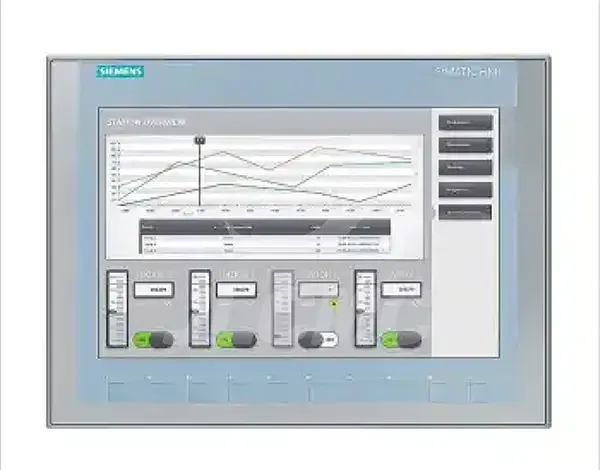
HMIs are the operator’s window: machine state, alarms, setpoints, manual overrides. Two design failures recur in practice: alarm floods (hundreds of alarms during a fault event, with no ordering and screens that show everything at once, which slows operator response instead of quickening it. A good HMI follows strongest display design, overview first, detail on inspect.
SCADA handles what a single HMI can’t: collection across many controllers and sites, long-term data storage, and unified alarming. In water, power, and oil & gas, SCADA often spans remote sites over radio or cellular links, which introduces communications-failure handling as a design requirement; control must debase safely when the link drops.
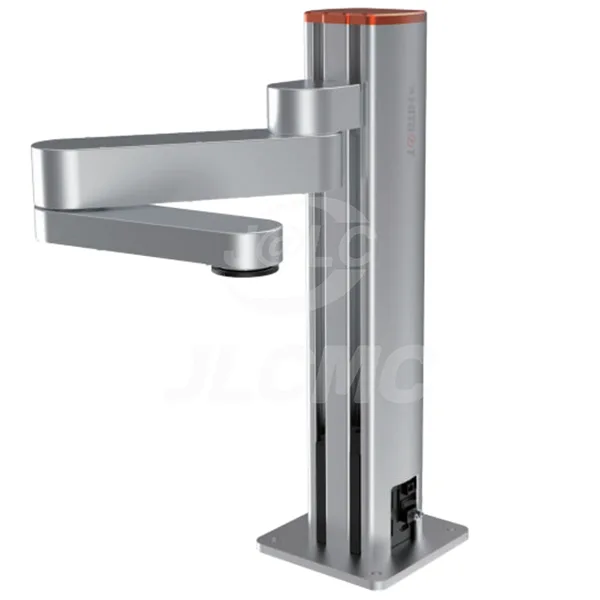
Robots handle the manipulation layer: expressed arms for welding and assembly, deltas for high-speed picking, support systems for large work wraps. Networks tie everything together. The practical decision today is usually industrial Ethernet (PROFINET, EtherNet/IP, EtherCAT) over traditional fieldbus (PROFIBUS, Modbus RTU, DeviceNet), but brownfield plants live with both for years; gateways and rules converters become part of the architecture, not a reconsideration.
The categorization that matters in practice is fixed vs. programmable vs. flexible, essentially a decision about how much product change the system must imbibe.
Fixed (hard) automation executes one order, built into the equipment. Transfer lines, dedicated fixtures, custom stream machines. Cycle times are the fastest of any type, and per-unit cost at volume is the lowest. The trade-off is total: reorganizing for a product change means mechanical modification, often weeks of outage and high cost.
Fits: very high volume, steady product design over years, automotive engine machining lines, bottling lines.
Programmable automation runs an arrangement defined by a program that can be changed without mechanical alteration. Batch processes, CNC machines, robot work cells. Conversion time is nonzero: new program, often new fixtures or teach points, but measured in hours or shifts rather than weeks.
Fits, moderate-to-high volume with periodic product change, appliance manufacturing, machined parts with revolve designs.
Flexible automation changes product with least or no changeover downtime, typically through automatic program switching, quick-change manufacturing, and vision-guided handling. The resulting cost is higher: more sensors, more software, more engineering time per cell.
Fits: high diversity at meaningful volume, contract manufacturing, mixed-model assembly, order-driven production.
The pattern across all three: automation flexibility and automation speed trade against each other directly. Buying more adaptability than the product mix requires wastes money; buying less creates a conversion bottleneck that erases the production gains.
The common thread: automation value focus where processes are continuous, repetitive, quantifiable, and where human reaction time or stability is the limiting factor.
The benefits below are real, but each is dependent. They hold when the process is stable enough to mechanize well, and the system is maintained, not automatically upon installation.
Automated lines run at steady speed without shift-change slowdowns, breaks, or exhaustion. The realistic gain for a well-run manual line moving to automation is typically a step change in computing, but only if upstream and ensuing stages can absorb the increased rate. Automating one bottleneck stage just moves the restriction.
Machines don’t have bad days. Automated extent and adjustment hold process variables within tighter bands than manual control; analytical process control data from automated lines routinely shows capability indicators (Cpk) that manual operations can’t reach. This is strongest where defects are invisible to the eye early: solder joints, weld invasion, fill volumes.
Automation removes people from environments with the highest bruise exposure: hot metal handling, chemical transfer, restricted spaces, repetitive lifting. Safety gains are largest when automation is designed with peril evaluation methodology (e.g., ISO 10218 for robot-based cells, ISO 3691 for industrial vehicles, and IEC 62061 for the functional safety of safety-related control systems) instead of adding guards after the fact.
Closed-loop control reduces overloading, off-spec batches, and scrap. Condition monitoring, vibration examination on bearings, thermal imaging on electrical connections, shifts preservation from fixed schedules or failure response to planned involvement. The waste reduction is often worth more than the labor reduction; in process industries, one avoided substandard batch can pay for months of monitoring.
Every automated process generates data as a derivative. When SCADA/historians are configured intentionally, this enables root-cause analysis that manual processes can’t support: tracing a quality departure to a specific shift, lot, or equipment state. The caution: visibility requires disciplined tag naming, data holding policies, and actually reviewed dashboards, none of which happen by default.
Honest analysis of limitations matters more for decision-making than the benefit list. These are the limitations that actually kill or degrade projects.
Full automation cells commonly run from tens of thousands to millions of dollars once machinery, consolidation engineering, commissioning, and facility alteration (power, compressed air, network) are counted. Payback periods of 2–5 years are normal in distinct manufacturing. Projects justified only on labor savings frequently informal terms, waste reduction, quality, and production gains usually carry more of the business case.
An automated line is a system of subsystems from different sellers: PLC, drives, robots, vision, MES, each with its own software environment, microcode lifecycle, and failure modes. The consolidation cost often matches or exceeds hardware cost. Long-term, this demands a repair parts strategy, trained maintenance staff per platform, and version discipline: an improvised firmware update on a interlinked drive has taken down production lines.
Automation changes the workforce instead of eliminating it: fewer operators, more technicians who can read ladder logic, identify fieldbus faults, and adjust instruments. Plants that automate without a training plan end up dependent on implementers for every fault, costly and slow. Budget 10–20% of project cost for training and evidence; plants that skip this systematically underachieve their equipment’s capability.
This is the mirror of the fixed-automation trade-off. Highly designed automated systems are improved for a defined product envelope. When product designs change frequently, short-run custom work, prototype quantities, rapidly refining consumer products, the changeover cost eats the automation benefit. Manual or semi-automated operation with aimed automation islands (a vision station, an automated press) often generates better economics than full-line automation for these profiles.
| Dimension | Manual Operations | Automated Operations |
| Task execution | Human-paced, variable by shift and exhaustion | Machine-paced, constant across all hours |
| Consistency | Depends on operator skill and attention; drifts over a shift | Predictable within sensor and control sufferance |
| Initial investment | Low (tools, benches); scales directly with output | High fixed cost; near-zero negligible cost per additional hour |
| Flexibility | Highest — humans adjust to variation directly | Bounded by programmed envelope; conversion costs time |
| Maintenance | Mechanical tooling preservation, minimal specialization | Multi-skill requirements: electrical, software, networks, plus spares record |
| Best-fit applications | Low volume, high variety, frequent design change, judgment-heavy tasks | High volume, stable design, measurable processes, unsafe environments |
Neither column is “better”; the table happens to match profiles. Plants that apply full automation to self-made account work lose money; plants that stay manual on automated-profile work lose competitiveness.
Component choosing is where projects are won or lost. These are the checks that distinguish a system that runs for fifteen years from one that becomes a maintenance responsibility.
Start from the process, not the catalog: required I/O count and types (analog resolution matters, 12-bit vs. 16-bit for slow exactness loops), control loop count and cycle-time requirements, motion axes with their integration needs, and safety functions (safety-rated I/O and safety PLCs add cost but are unchangeable where risk assessment demands them). Expanding a controller is cheap; discovering an analog channel count shortfall at designation is not.
Verify before purchase: supply voltage and stage, signal types (4–20 mA, 0–10 V, PNP/NPN discrete), and communication rules. A PROFINET drive will not talk to an EtherNet/IP network without a portal, and gateways add delay, cost, and another failure point. Standardizing one network architecture across a plant pays back during every future growth.
Panel and device valuation must match the actual environment, not the clean room in the pamphlet: IP rating against dust and washdown, temperature range (cabinet-internal temperatures run well above surrounding temperatures in summer), vibration opposition for devices mounted on moving equipment, and risky-area certification (ATEX/IECEx) where vapors or dust are present. Undervalued custom components for electronics don’t fail immediately; they fail at year three, after warranty.
Look past the datasheet: mean time between failures (MTBF) for crucial components, local availability of reserves, whether the seller has a multi-year lifecycle dedication for the platform (obsolete PLCs running unsupported firmware are a real operational risk), and indicative capability; devices with built-in condition monitoring (drives that report their own capacitor health, valves that report cycle counts) reduce unplanned downtime.
For purchasing the building blocks covered in this article- industrial PLCs and controllers, sensors, servo motors and drives, HMIs, conveyors, power supplies, and network equipment, visit JLCMC, a supplier of industrial automation elements, to explore products across major categories and compare requirements using parameter filters for voltage, protocol, and ratings, making compatibility checks more candid during selection.
Industrial automation substitutes continuous manual operation with closed-loop systems of sensors, controllers, effectors, and supervisory software. The technology is mature, and the benefits- production, consistency, safety, visibility are well recorded, but they arrive only when the process itself is stable, the blend is engineered properly, and maintenance capability keeps pace. The decision structure is volume versus variety: fixed automation for stable high-volume products, programmable and flexible systems where change is scheduled, and selective automation islands where full transition doesn’t pay.
If you’re building or enhancing a system, the component layer is where accuracy is decided. Visit JLCMC’s industrial automation components catalog to explore a wide range of products, including PLCs, sensors, drives, HMIs, and control hardware, to compare requirements across the categories discussed in this article.
Ans: Industrial automation means machines run industrial processes by themselves, following rules programmed into controllers. A sensor checks what’s happening, a controller decides what to do, and motors or valves do it, repeatedly, without an operator performing each step.
Ans: No. Robotics is one subset of industrial automation; robots handle manipulation tasks like welding, picking, and palletizing. Automation is broader: it includes process control (temperature, pressure, flow), conveyor systems, packaging machinery, and SCADA supervision, much of which involves no robots at all.
Ans: A PLC controls a machine or process in real time, reading sensors and driving outputs on fast, deterministic cycles. SCADA supervises: it collects data from many PLCs, displays facility-wide status, archives history, and manages alarms. PLCs act; SCADA observes and coordinates. A facility typically has many PLCs reporting to one or a few SCADA systems.
Ans: Industrial automation is about executing processes automatically. Industry 4.0 is the overlay: connecting automated systems to data platforms, cloud analytics, digital twins, predictive maintenance, and machine-to-machine coordination, to optimize beyond what individual control loops can do. You can have extensive automation without any Industry 4.0 elements; most plants do.
Ans: Invest when at least one of these holds consistently: labor cost or availability constrains output, quality variability causes measurable losses (scrap, returns, warranty), the process exposes workers to significant hazards, or demand volume justifies fixed investment. Avoid investing when product designs change faster than changeover cycles, volumes are low and unpredictable, or the underlying process itself is unstable; automating a bad process just produces bad output faster.
