
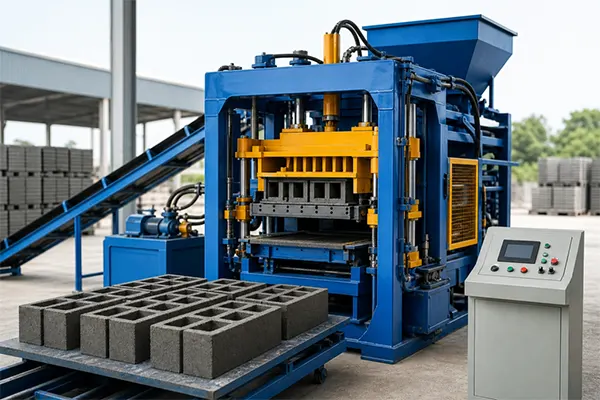
Investing in a block-making machine is one of, if not the most significant, equipment decisions a construction business owner or manufacturer makes. When done right, it has the capability of generating consistent output for many years, thus being a valuable production asset.
But to reap its benefits, companies must make the right selection or be stuck with a machine that doesn’t really meet their demands or budgets. A concrete hollow block machine has many different configurations, so it’s always wise to review every option and then pick the most suitable one.
This article walks through the key decisions so you can match the right machine to your actual business requirements.
Key Takeaways
- Choosing a machine whose rated capacity sits comfortably above your current requirement, rather than right at your daily target, gives you room to handle demand peaks
- An efficient concrete block machine has an intelligent control system, usually a PLC, that automates the process of production
- Within the smart block machine category, there is a meaningful spectrum between semi-automatic and fully automatic, and the right point on that spectrum depends on several factors
- The machine that suits your operation today and has room to develop with your business over the next several years is almost always the better investment than the current cheapest available option
Every other decision in the selection process flows from one number: how many blocks do you need to produce per eight-hour shift to meet your current demand and your growth target over the next two to three years?
The careful consideration of this question is more important than making assumptions. When supplying a single construction project, the number of blocks required each day is easy to calculate. However, when selling to the open market, the fluctuations in demand need to be taken into account as well as the level of excess capacity needed in the production equipment.
As a practical reference, smaller smart block machines in the manual and semi-automatic range produce between 2,800 and 5,200 hollow blocks per eight-hour shift. Mid-range fully automatic machines push that figure considerably higher. Choosing a machine whose rated capacity sits comfortably above your current requirement, rather than right at your daily target, gives you room to handle demand peaks without running the machine at its absolute limit every day.
The term smart gets applied loosely in equipment marketing, so it is worth being clear about what it actually means in practice for a concrete block machine.
An efficient concrete block machine has an intelligent control system, usually a PLC, that automates the process of production. The operator of the machine only inputs the necessary parameters such as the size of blocks, concrete density, vibration, and pressing strength, after which the machine will perform the cycle on its own, something which is not possible with a hand-operated device that relies on operator abilities.
There are three areas where the benefits of this automation can be clearly seen. First of all, the consistency of production is greatly increased because the machine applies the same parameters during each cycle of operation. Secondly, the output per shift increases. Finally, the costs of labor are reduced due to the fact that a much smaller number of workers is needed to achieve the required output of blocks.
For a construction business scaling from a small operation to a mid-size one, the step up from manual to smart automation is often where the economics of block production start to work meaningfully in favour of owning a machine rather than buying blocks from a third party.
Within the smart block machine category, there is a meaningful spectrum between semi-automatic and fully automatic, and the right point on that spectrum depends on your budget, your labour situation, and your production volume.
Semi-automatic machines handle the forming cycle automatically but rely on manual handling for material feeding and block removal. An operator loads the concrete mix into the hopper, the machine runs the pressing and vibration cycle, and operators handle the finished blocks on pallets. This approach works well for operations producing several thousand blocks per shift and offers a lower entry price than a fully automatic line.
Fully automatic machines incorporate the mixing, feeding, forming, pallet management, and block stacking into a seamless automated process. Operator input is limited to monitoring, setup, and maintenance instead of active participation in every production cycle.
The output consistency and hourly production scope of a fully automatic machine are both much higher than a semi-automatic equivalent, and the requirement for manual intervention per block produced is considerably lower.
The decision between the two comes down to a straightforward comparison of the additional capital cost of full automation against the labour cost saving and output increase it delivers at your production volume. For smaller operations where the daily block target is in the lower range, semi-automatic machines offer strong value. For operations targeting higher daily outputs where labour cost is a significant part of the production cost structure, the economics of full automation justify the higher initial investment.
One of the practical advantages of a smart concrete block machine over a single-purpose manual machine is the ability to produce multiple block types by changing the mould.
Before jumping to the selection part, confirm which block types it is able to produce effectively and how quickly and easily the mould changes can be performed.
Standard 8-inch hollow blocks in the 400x200x200mm format are the usual output, and almost every machine in this category holds the capability to produce them.
Fun Fact
The hydraulic press uses up to 2,000 PSI of force to compact the concrete mix. This is similar to the water pressure at the bottom of the ocean.
But construction projects also require solid blocks, porous blocks, paver blocks, and blocks in different size formats. A machine that can switch between these by changing the mould gives your business more flexibility to serve different project requirements without investing in a separate machine for each block type.
Check the pallet size compatibility as well. Different machines use different pallet dimensions, and the pallet system needs to be consistent throughout your production and curing area. Mixing pallet sizes in an operation adds unnecessary complexity to the handling and storage process.
Smart concrete block machines in the mid to upper range are electrically powered, and the power requirement varies significantly between models. Machines in the 9 to 12 kilowatt range are common for semi-automatic models. Fully automatic production lines draw considerably more.
Firstly, confirm that your site has the required electrical infrastructure to support the machine. This means checking the available supply voltage, the capacity of the connection, and whether any changes to your electrical installation are required before the machine can be commissioned.
These infrastructure costs are part of the total investment in the machine and need to be factored into the financial evaluation.
For sites without reliable grid power, some machines in this category can be configured to run on a diesel generator rather than mains electricity. This adds to operating costs but makes production possible in locations where grid power is unavailable or unreliable.
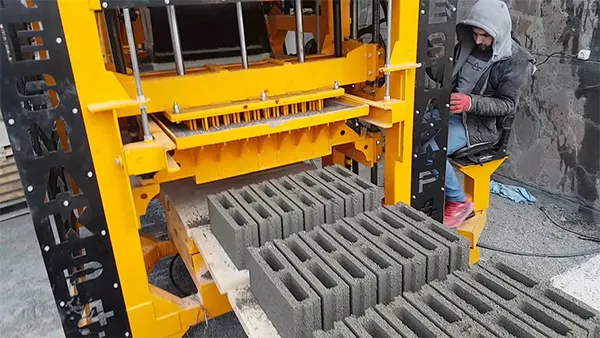
A block machine is a long-term production asset, and the quality of after-sales support from the manufacturer matters considerably over the machine’s operating life.
A machine that stops working for a week while in search of a spare part costs far more in lost production than the difference in price between a well-supported machine and one that is not.
Before hasty decisions, inquire specifically about spare parts availability for wear items including moulds, vibration motors, and hydraulic components. Also ask about the response time for technical support queries and whether on-site installation and commissioning assistance is included.
Manufacturers with a strong track record of supplying into your region are better positioned to provide timely support than those who are entering the market for the first time. Checking references from existing customers in your area or in similar operating environments is worth the time it takes.
Selecting the right machine comes down to matching individual production capacity to your actual daily targets, choosing an automation level whose economics make sense for your business scale, confirming the mould flexibility you require, and understanding the manufacturer’s after-sales support before signing anything.
When this structure is followed, the selection process eliminates the most common purchasing mistakes and provides you with a clear distinction for comparing machines across different pricing and specifications.
The machine that suits your operation today and has room to develop with your business over the next several years is almost always the better investment than the current cheapest available option that meets today’s minimum requirement.
Ans: In general, smaller types of smart semi-automatic devices produce around 2,800 to 5,200 standard hollow blocks per eight-hour working day.
Ans: Using PLC (programmable logic controllers), a smart block machine can control block density, vibro-intensity, and pressing pressure, which helps get rid of fluctuations caused by human factors.
Ans: Yes, most industrial concrete block machines can be programmed to work with localized diesel generators in case the needed voltage and current are absent at the installation site.
Ans: Moulds, seals, and vibrators are the most subjected to various loading and require a trusted supplier to always be ready to send spare parts.
