

According to Gartner, more than 70% of recently implemented ERP initiatives will fail to fully meet their original business use case goals, and as many as 25% of these will fail catastrophically. The reason is rarely the software itself. More often, the problem begins much earlier with choosing the wrong development partner.
Most businesses don’t start searching for an ERP development company until existing processes begin to crack under pressure. Spreadsheets become unmanageable, reporting gaps impact decision-making, and teams create their own disconnected workflows. In the rush to solve these issues, companies often prioritize speed over due diligence when selecting a vendor.
That decision can have long-term consequences. The real cost of a poor ERP partnership isn’t limited to missed deadlines or budget overruns. It’s the ongoing friction of a system that technically functions but fails to support how the business actually works, forcing employees to rely on manual workarounds and inefficient processes.
KEY TAKEAWAYS
- Industry-specific experience often matters more than technical expertise alone.
- Integration and scalability should be built into the ERP architecture from the beginning.
- Understand whether a vendor specializes in custom development or platform customization.
- Evaluate long-term support and partnership models before signing a contract.
Every ERP project follows a familiar path:
What separates the ones that hold up from the ones that don’t is usually how well the development team understood the business before they wrote a line of code.
Industry experience matters here in a specific way. Not because technology changes by sector, but because business logic does. How a distribution company handles backorders is different from how a manufacturer tracks work-in-progress, and a team that hasn’t worked in your space will spend the early months figuring that out on your budget.
When talking to potential partners, push past the portfolio and ask how they handle requirements that are ambiguous or undocumented — the kind that live in someone’s head rather than a spec sheet. Ask how they manage disagreements between what stakeholders want and what end users actually need.
It’s also worth understanding what proportion of their work involves building from scratch versus extending existing platforms. Not every firm does both well — Binary Studio works primarily on custom builds, and that focus tends to attract projects where standard platforms would require too many workarounds to be practical. Knowing which model a company defaults to helps you assess whether their experience matches what your project actually requires.
Many ERP projects don’t struggle because of missing functionality. They run into trouble in the integration layer. The system needs to communicate with CRM platforms, payment processors, analytics tools, logistics software, and often legacy systems that aren’t going anywhere. A partner who treats these as secondary concerns creates technical debt that becomes very costly to unwind later.
Here are the major benefits of ERP integration:
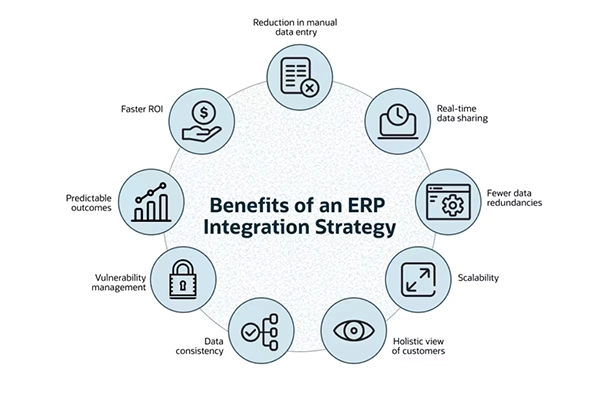
Scalability works the same way. Architectural decisions made early have consequences that play out over the years. A system sized for current transaction volumes and team size will need substantial rework when the business doubles or expands into new markets. Ask potential partners directly how they approach scalability at the architecture level — not as a feature to be added later, but as a constraint that shapes structural decisions from day one.
Companies that handle this well tend to ask questions about your growth trajectory before they start designing anything. That’s a useful signal.
The term “custom ERP development” can mean very different things depending on the provider.
Some firms are builders — they design systems from scratch around your processes. Others are configurators — they take an existing platform and bend it to fit. The distinction matters more than most buyers realize until they’re already mid-project.
Which approach is right depends less on the technology and more on your situation after go-live. A company with a strong internal tech team can absorb a clean handoff and take ownership from there. A company without that capacity needs a partner who stays involved — someone still accountable when an integration breaks six months later, or a compliance requirement changes the data model.
Ask the firms you’re evaluating a simple question: What does the relationship look like twelve months after launch? The answer will tell you whether they’re structured for delivery or for partnership — and whether that matches what you’re actually buying.
As demand for ERP solutions continues to grow, so does the number of firms offering development services. And so has the gap between the best and the rest. There are capable teams at every price point — and there are also firms that have built impressive sales processes around limited delivery track records.
Going deep on process, asking for references that reflect your actual project type, and running technical conversations with the engineers — not just the account team — is what separates companies that build systems they can grow with from those that find themselves rebuilding from scratch a few years later.
The time spent getting the selection right is small relative to the cost of getting it wrong.
Choosing an ERP software development company is ultimately a business decision, not just a technology decision. The right partner brings industry knowledge, architectural expertise, scalability planning, and long-term support capabilities that extend far beyond coding.
Taking the time to carefully evaluate potential providers can help ensure your ERP system becomes a foundation for growth rather than a costly obstacle to overcome later.
