

Photo by Pavel Danilyuk
“The best way to predict the future is to invent it.” – Alan Kay (Computing Pioneer)
Artificial intelligence stopped being a futuristic concept years ago. It’s now a core part of how businesses operate every day. Yet simply adopting AI tools isn’t enough. Many organizations discover that isolated automation applications create fragmented workflows, duplicate effort, and inconsistent outcomes. The real advantage comes from connecting AI, automation, and business systems into a unified workflow that can operate efficiently at scale.
This article explores how businesses use intelligent automation practically. What are the challenges they face during AI adoption, and how connected automation helps improve efficiency, decision-making, and customer experiences.
KEY TAKEAWAYS
- Intelligent automation combines AI, business applications, and workflows to create more efficient operations.
- Connected automation eliminates fragmented processes and improves collaboration across systems.
- Standardized workflows help organizations overcome common AI adoption challenges, including inconsistent data and legacy system integration.
- Businesses that implement connected AI workflows can improve productivity, decision-making, compliance, and customer experience.
Businesses are expanding their use of automation and other emerging tech. But ensuring that different tools work together becomes just as important as adopting the technology itself. If the tools work alone, that can be a problem. This is why AI orchestration is so important. With AI orchestration, you can connect your AI models, company apps, and your flows that do tasks on their own. This helps information move easily from one system to another. There is also less need for people to step in and do work by hand.
Suppose a customer sends in a support request. A planned workflow can:
This step-by-step process helps answer faster, cuts down on doing the same work again and again, and gives people a steady experience.
At the moment, many great workflow automation software solutions are available in the market. But organizations use connected AI workflows for more than just customer help. Firms also use them to:
There is no need to move between several platforms. With automated steps, employees get work done faster and better. This makes their daily work easier and less of a hassle.
Automation is contributing significant value to businesses. But scaling it across an organization is often more difficult than deploying a few individual tools. Many companies find it hard to do more than a few AI-based tasks. It can be tricky to mix the use of several AI models, old systems, and other tools for work. This is even tougher when the data is spread out over several places. If there is not one clear way to do things, people at the company may see results that do not match, have to do the same things again, and not get a clear view of how parts of work run by the machine are going.
The infographic lists all the challenges in AI adoption and their percentages:
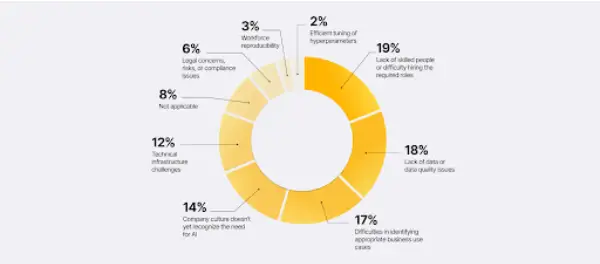
A connected automation plan helps the team work through these tough spots. It does this by letting your automation tools interact with each other. Standard rules for workflows:
This way, it is easier to oversee how things are going on, follow rules, and grow your use of automation as business needs change.
By bringing different automation tools together rather than using each one in isolation, teams can improve and make their work smoother. This helps them get more out of their AI spending and see real value that lasts a long time.
One of the greatest benefits of intelligent automation is faster, data-driven decision-making. AI-powered systems keep taking in information from many business tools. They look at this information right away and take the next right step, without needing people to watch over things all the time.
Retailers can track their stock levels and quickly start ordering more before running out of inventory. The teams that handle money can spot strange transactions faster. People in charge of daily work can find slow spots and better use what they have.
This level of automation helps cut down on delays and stops people from making mistakes. It also lets workers put their time into big-picture plans, not the same simple jobs again and again. At the same time, when people work in a connected way, everyone gets a better look at how the business is doing. This makes it simple to keep an eye on how things are going and follow the rules set by the business and the industry.
AI outputs greatest value when various tools work together rather than independently. Intelligent automation enables that. As companies keep building on their AI, doing well needs more than just getting new tools. Businesses have to set up systems that help the different types of technology work together with all teams and their work. AI orchestration makes this possible by linking AI models, business apps, and automation into one system. This makes company scaling easier, helps people make better choices, and makes things run smoothly.
Companies that use connected AI plans today will be in a good place for new ideas later. They can improve their work and give more value to their customers.
Ans: Intelligent automation combines artificial intelligence, machine learning, and workflow automation to automate business processes that traditionally require human decision-making.
Ans: Connected automation integrates AI models, business applications, and workflows into a unified system, reducing manual work, improving data flow, and increasing operational efficiency.
Ans: Industries such as retail, finance, healthcare, manufacturing, customer service, HR, and IT operations commonly use intelligent automation to improve productivity, reduce costs, and enhance decision-making.
