
In today’s digitally influenced world, more than 65% of the population relies on visual content, that says they prefer retaining information from visuals only. But this type of traditional marketing is usually costly and time-consuming to follow.
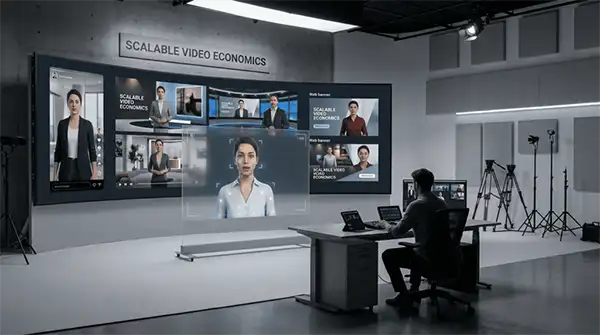
For these reasons, most of the marketers and business owners are leaning more towards AI avatar generators. They serve as a most compatible source to generate videos in less time, at a low cost and one that can be scaled easily.
This has brought a drastic change in the video marketing field. Keep reading to learn how AI avatar generators are changing the economics of video marketing.
Key Takeaways
- AI avatar generators take the extra cost away associated with the complexity of traditional video production.
- Faster content creation helps marketers to respond fast to trends and campaigns.
- AI-generated avatars help brands to generate personalized content for various audiences and platforms.
Traditional video production adds several layers of fixed costs that do not scale smoothly. If a brand wants to test five different titles for a TikTok ad, they must film five unique takes with a live actor. This increases the standard rate for talent and the time spent in the editing center.
The logistical barriers are equally complex. Coordinating agendas, bring off equipment rentals, and monitoring lighting setups create a strict workflow. Small and medium-sized enterprises often find themselves shut out of the competitive video landscape. They are advised to rely on static images or dated stock footage that does not have a human touch.
The rise of AI technology is definitely changing these economics. Instead of paying for physical facilities, brands are now putting in digital infrastructure. This update allows for the creation of people-centred content at a tiny proportion of the traditional cost.
By using an ai avatar generator, marketers can build professional-grade videos without a physical set. This technology replaces the need for periodic talent fees and location costs. The result is a notable decline in the “cost per creative asset,” allowing brands to release more content with the same spending limit.
The current scene is defined by massive shifts in reality and control. A major player in this space is the Seedance 2.0 model, a state-of-the-art AI video generation engine designed by ByteDance. This model allows users to input up to 12 different objects, including text, images, videos, and audio.
Unlike earlier forms of AI video, Seedance 2.0 supports cinematic multi-shot loops with native audio coordination. It ensures character accuracy across different frames and provides frame-level refinement for complex gestures. This technical expertise means that AI-generated content can now operate alongside traditional cinematography without feeling out of place.
Getting to these advanced models used to take deep technical knowledge. However, higgsfield has improved this process by inserting the Seedance 2.0 model into its platform. Users on all subscription plans can employ this power to create targeted marketing materials.
The platform serves as a vast marketing studio that depends on ease of use. It allows users to take a simple product URL and change it into a high-converting marketing tool. This democratization of professional video creation is a primary part of the higgsfield mission. It enables brands to move from a single ad plan to a full-scale campaign in minutes.
One of the most serious challenges in digital marketing is the rapid fatigue of creative objects. An ad that works well on Monday may see a sharp dip in engagement by Friday. To improve performance, marketers need a constant flow of fresh content.
Using an ai avatar generator caters for the rapid production of content. If a brand finds that a specific demographic adjusts better to a given tone of voice, they can amend their video files instantly. There is no need to re-book a studio or call back an actor for a new shot.
Data reveals that personalization is a key driver of consumer loyalty in the modern digital economy. AI avatars allow brands to curate video content at scale. You can create different copies of the same ad, each using a different announcer or language, to target specific audience groups.
This level of variation was once chosen for brands with massive dollar budgets. Now, a small e-commerce store can use an ai avatar generator to create a localized video for five different foreign markets. This agility notably improves the return on investment for global ventures.
To get the most out of AI video generation, marketers should try a social-first design. This involves centring on the specific appeal of platforms like TikTok, Instagram Reels, and YouTube Shorts.
Here are several helpful strategies:
A common defect of early AI video tools was their fixed or robotic nature. To be useful in social commerce, video must feel alive and exciting. This is where higgsfield wins by featuring Hyper Motion and genuine human energy.
The platform is crafted to mimic natural speech patterns and genuine reactions. This ensures that the digital spokesperson feels like a real artist rather than a robotic figure. This human touch is critical for gaining trust with an audience in a busy social media feed.
Hiring live actors means contracts, usage rights, and possible scheduling conflicts. A digital cast provides a ready-to-work solution that is available 24/7. These avatars can represent your brand consistently across every platform, from national television to mobile apps.
When using an ai avatar generator, you maintain full control over the visual identity of your spokesperson. You can create a custom avatar from a text prompt that perfectly aligns with your brand’s values and target demographic. This level of brand consistency is difficult to achieve with a rotating roster of freelance influencers.
Modern AI tools provide more than just automated video. They offer frame-level precision that allows creators to direct the “camera” and the “actor” with unparalleled detail. This is a significant advantage for performance marketers who need to highlight specific product features.
With higgsfield, the creative process is collaborative. The AI acts as a creative partner that handles the heavy lifting of rendering and motion, while the marketer provides the general direction. This synergy allows for a higher volume of output without a decrease in quality.
As the digital landscape continues to evolve, the ability to produce video quickly and fairly will be a competitive necessity. Brands that continue to rely solely on traditional production methods will struggle to keep up with the volume of content required by modern algorithms.
Adopting an ai avatar generator is not just about saving money. It is about building a more agile and responsive marketing department. By reducing the friction between an idea and a finished video, brands can experiment more freely and discover what truly hits home with their customers.
The transition to AI-driven video production does not have to be an all-or-nothing plan. Many brands start by using AI for specific tasks, such as creating social media teasers or internal training videos. Over time, as the technology proves its value, it becomes a central part of the wider marketing strategy.
Platforms like higgsfield make this integration simple to execute. By offering high-end capabilities like those found in the Seedance 2.0 model, they give you a professional toolset that scales with your needs. Whether you are a solo entrepreneur or a large agency, the economics of video production have consistently changed in your favor.
AI avatar generators have transformed traditional video marketing processes from a slow, costly and time-consuming one to faster, more reliable and creative ones. As a result, brands can generate creative content more easily and at lower costs. They need not worry more about those traditional costs.
Above this, brands that learn how to combine AI efficiency with strong creative skills can not only create engaging video content but also help to adapt to the changing technology demands.
