
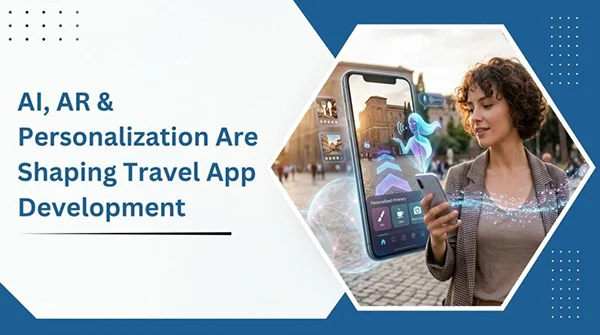
What if your travel application could do much more? An app that understands all your preferences, recommends destinations, and also helps you decide quicker without needing to search endlessly.
Travel app development makes these things come true with the assistance of AI, AR, and personalization. Such apps become truly smart, experience-driven platforms with these useful integrations.
This guide explores how these innovations are transforming travel apps, as well as some valuable insights to help you create a more effective and future-enabled solution.
Key Takeaways
- Travel planning software is designed to help users better organize their trips, create itineraries, and ultimately manage schedules for a smooth experience
- Several payment methods with secure encryption actually ensure smooth transactions
- AR is popularly helping users make faster and even more confident decisions by reducing uncertainty
- An advanced travel booking app with custom features and integration can take 4 to 8 months or more
Travel app development refers to building mobile or web applications or software. It allows users to search, plan, and then book their travel smoothly by using only a single platform.
Rather than relying on different sources, users can manage everything, from exploring destinations to making their reservations, within a single minute.
For all businesses, it’s really a powerful solution to enhance user experience and increase bookings through a digital-first approach when built with the help of a reliable app development company.
Travel apps are generally divided into 3 main types:
These are focused on reservations and let users search, compare, and book their flights, hotels, or even packages in real-time.
Travel planning software is designed to help users better organize their trips, create itineraries, and ultimately manage their schedules for a smooth travel experience.
These platforms collect data from numerous providers and present the best choices in one place, and make comparison and decision-making easier.
Your travel app has a chance to become successful only if it makes the whole booking process simple, fast, and reliable for users. In modern table app development, users don’t want complexity. They require smooth navigation, fast results, and control over their travel plans in one place.
A well-developed travel booking application should always allow users to instantly locate flights, hotels, or even packages without wasting their time. Several smart filters, such as location, budget, ratings, and travel dates, make the process even more precise and improve usability in travel apps.
Safe and flexible payment systems are really essential for building trust. Several payment methods with secure encryption actually ensure smooth transactions and increase confidence in online travel booking apps, and it directly improves conversion rates.

Instant confirmations and live availability updates always help your users to be informed at every step. Furthermore, it reduces confusion and makes the travel booking experience even more transparent and reliable.
Alerts for bookings, price changes, or sometimes travel reminders keep users engaged even after they leave the app. This approach improves retention in mobile travel apps and encourages repeat usage.
Travel apps utilize GPS-enabled tracking to provide real-time updates and assist users in navigating comfortably, enhancing convenience and reducing uncertainty while traveling.
And enhance convenience and reduce uncertainty while traveling.
Automation makes it completely easy to book flights, hotels, and transport. Users can manage their reservations, get instant confirmation, and make changes easily without manual intervention.
Travel apps integrate several services such as payment gateways, booking platforms, and customer support systems through APIs. This ensures data flow along with a hassle-free user experience.
Numerous features, such as check-ins and digital tickets, minimize paperwork and waiting time. These features make the travel process faster, more secure, and user-friendly.
Built-in maps help users explore new destinations, find nearby places of interest, and get real-time directions. The feature adds practical value, especially during trips, and makes navigation simple and easy.
Augmented Reality (AR) is when we add a whole new layer to how users explore and book travel. Rather than depending on images or some reviews, users can now interact with destinations and properties in a more visual and impressive way.
If we talk about modern travel app development, AR is popularly helping users make faster and even more confident decisions by reducing uncertainty. Here’s a detailed view of roles:
Using AR, a user can go on a virtual tour of hotel rooms, resorts, and even tourist destinations prior to evening booking.
Rather than guessing photos, users are able to navigate spaces in 360-degree perspectives, view room layouts, and have an actual sense of the entire setting. It also creates trust and lessens the possibility of dissatisfaction following booking.
Fun Fact
AI can suggest a unique, curated experience, such as specific street food tours or niche historical spots, based on your past behavior.
AR makes navigation a lot more intuitive. With just a point of the phone camera, users can receive real-time directions superimposed on their screen. It comes in particularly handy within an unknown city, airport, or even a tourist destination and makes traveling easier and less hectic.
It is one of the largest benefits of AR because it grants the possibility to try before anybody makes a purchase. Whether it is the appearance of a hotel room, the sightseeing of the surrounding places, or even a trip, AR allows users to see what they will look like at the destination beforehand.
The price of developing a travel app is not always predetermined. It greatly relies on what you are actually attempting to construct, the complexity of the features, and the degree to which you require customization.
A basic application with a basic booking system will be much cheaper than a feature-packed platform that can be fueled by AI, live conversations, and customization. The following is a fleeting glimpse:
The more sophisticated the features that you require, the higher the cost will be. The simplest functions, like search, booking, and payments, are not very advanced.
Conversely, the inclusion of e.g., AI suggestions, real-time data integration, AR previews, or multi-lingual support adds features that raise the development time and cost of a Laravel app development.
A basic travel app usually focuses on core features like listings, booking, and payments, making it suitable for startups or small businesses.
On the other hand, advanced applications come equipped with personalized options like smart filter, dynamic pricing, seamless integration with third-party APIs, and offer more scalable and competitive solutions.
The development timeline can range from a few weeks to several months. A basic application can take up to 2 to 4 months, whereas a more advanced travel booking app with custom features and integration can take 4 to 8 months or more, all depending on the scope.

Actually, building a travel application is one thing, and building an app that truly drives bookings and grows your business is another. That’s where the right development partner makes a real difference.
Mypcot Infotech primarily focuses not just on development, but on developing travel apps that are designed and developed to perform, scale, and convert. Here are more reasons to choose Mypcot Infotech:
Travel app development is really no longer just about bookings. Other than that, it’s about delivering smarter and more personalized experiences. With AI, AR, and various other features shaping customer expectations, businesses must think beyond the basics.
When it comes to a well-constructed app, it is capable of improving engagement, building trust, and boosting conversions. By following the right strategy and a reliable partner such as Mypcot Intech, you can create a travel app that truly stands out.
