
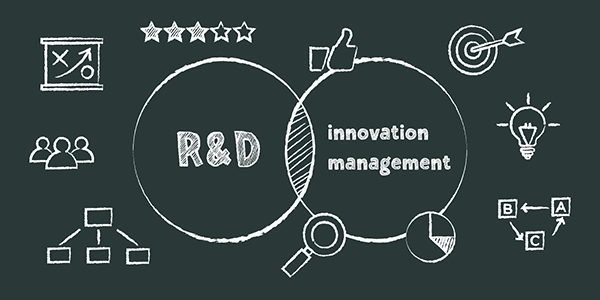
R&D processes never go according to plan. R&D teams face the challenges of changing customers’ needs, budget restrictions, technical difficulties, delayed testing, and the need to produce results in due time.
All these difficulties may be very discouraging for development, but they can also result in useful insights that would never come to the minds of the team members otherwise. The failure of the prototype may signal a design error, and lack of materials can force the team to develop a simpler solution.
Moreover, delays can give insight into possible improvements in the process of communication and planning. Instead of being disappointed with all these difficulties, businesses can use this experience to rethink their strategy.
Not every R&D challenge deserves the same response. Some are indeed real operational problems: a problem with quality, a safety issue, or a compliance issue. Others are signals that a team’s assumptions need testing.
The trouble is that many organisations handle both in the same way: by escalating, assigning an owner, and trying to return to the original plan as quickly as possible. That approach may restore momentum, but it can also bury useful insight.
Consider a development team whose prototype repeatedly misses a performance target. The instinct may be to adjust the formula, refine the component, or add another test cycle. Those actions may be necessary, but they should be paired with better questions:
Such inquiries move the discussion away from the question “How can we fix this?” and toward “What have we learned from this?” This is when troubleshooting turns into innovation.
Constraints are often treated as annoyances to work around. In practice, they can be powerful design inputs. A limited budget encourages prioritisation. A narrow technical window forces clarity. A challenging manufacturing constraint could reveal attributes that complicate matters without providing any value to the consumer.
The key is to make constraints explicit early enough that they can shape the direction of development. When they remain hidden, they tend to emerge late as costly compromises.
This is also why structured experimentation matters. Teams need a practical way to frame a challenge, test assumptions, capture learning, and decide what to pursue next. Resources such as practical tools for product innovation can help create that discipline, particularly when teams are trying to move beyond brainstorming toward evidence-based decisions.
The objective is not to formalise every conversation. This is to make sure that valuable insights are not lost in the meeting minutes, personal inbox, or in the prototype tagged as “unsuccessful.”
Many organisations hold post-mortems only after a major project has ended. At this point, memories fade, team members have gone their separate ways, and other commercial deadlines beckon. Learning becomes retrospective rather than useful.
A stronger approach is to create shorter learning loops throughout the R&D process.
Technical Specifications are crucial, but they don’t tell the full story. Every project also rests on assumptions: that customers will value a feature, that a material will remain available, that a production process can scale, or that a product can command a certain price.
Write these assumptions down and rank them by risk. Then design experiments to tackle the most important unknowns first. A team may discover, for example, that a technically elegant solution is unnecessary because customers care more about ease of use than peak performance.
That insight can save months of development effort.
A failed test is only wasted if the team cannot explain what it means. Record the conditions, the hypothesis being tested, the result, and the implication for the next decision. Sounds simple, but it avoids a typical R&D issue of conducting repetitive experiments because learning from previous research wasn’t possible or sufficiently comprehensible.
The best teams distinguish between a failure in execution and a failure in the underlying idea. If a prototype fails because it was poorly assembled, improve the prototype. If it fails because the customer need is weak or the physics will not cooperate, reconsider the concept itself.
Product innovation becomes more resilient when R&D does not work in isolation. Friction is experienced in various ways in manufacturing, purchasing, customer service, selling, quality, and marketing. Their observations can reveal issues and opportunities that laboratory testing alone will miss.
A service team may notice that customers struggle to install a product correctly. That is not merely a training issue; it may be a product-design opportunity. Procurement may identify an emerging material constraint that encourages a move toward a more local or recyclable alternative. Sales teams may hear a recurring request that challenges the product roadmap’s assumptions.
Initial cross-functional involvement appears to take more time because it is a source of diverse viewpoints and even disagreements. But disagreement grounded in evidence is valuable. It helps teams identify weak assumptions before they become expensive commitments.
Not all opportunities need a major innovation program. Often, progress comes from small experiments that answer a specific question quickly: a customer interview, a bench test, a simple mock-up, a pilot production run, or a comparison of two alternative formulations.
The important thing is to define what the experiment is meant to teach. “Let’s see what happens” is not a learning objective. “Will users understand this new interface without instruction?” is.
As teams consistently conduct experiments, the risks associated with R&D become less daunting. They are no longer interruptions to the work; they are part of the evidence that guides it. Over time, that mindset produces products that are not only technically sound, but better aligned with real-world needs, constraints, and opportunities.
Ans: Product Innovation is an improvement of the current product or creation of a completely new one by means of research, client knowledge, experiments, and creative problem-solving.
Ans: Problems like failure of prototype, lack of resources, technical constraints, and customer feedback can help come up with innovative ideas, needs that are ignored, and improvements in product design.
Ans: Constraints such as budget, materials, production processes, or timelines spur teams to redesign, refine the process, and come up with more realistic solutions.
Ans: A learning loop is an ongoing process of making assumptions, documenting them, evaluating results, and learning from the results in order to make further decisions.
