
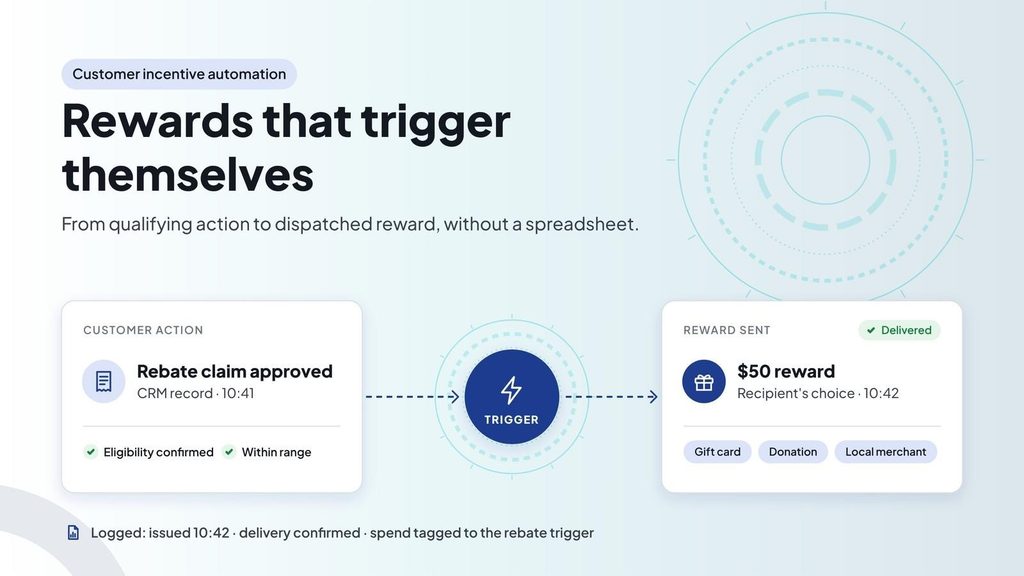
Most businesses still use a human administration process to actually start the reward workflow which in many cases has actually proven to reduce customer engagement and ruin the overall experience of a customer.
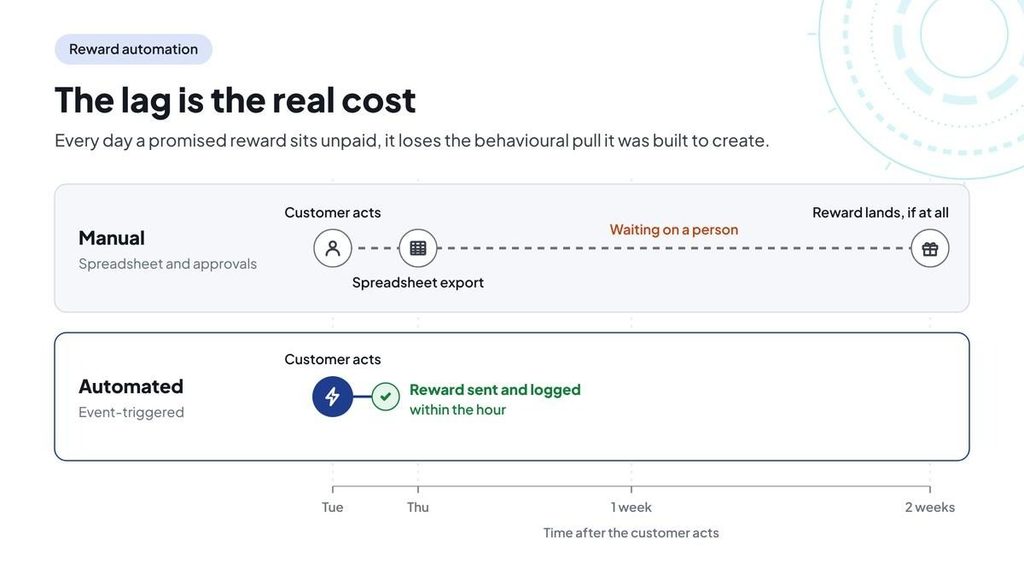
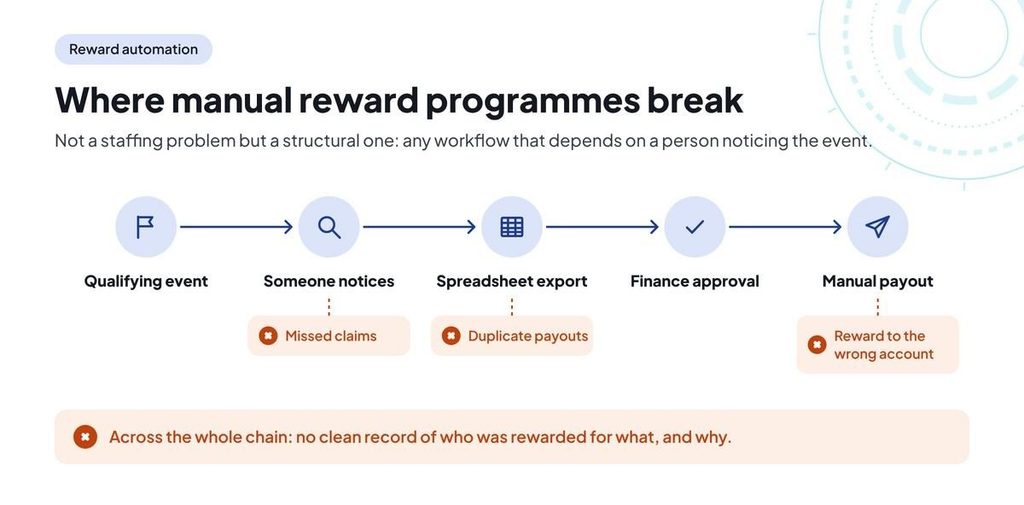
Whenever a customer switches energy providers or completes a product survey in which a reward was guaranteed, they expect the reward to arrive as smoothly as the whole experience before it went and when that does not happen the customer becomes dissatisfied. And this is what mostly happens in businesses because traditional businesses still use human observation. So only if someone notices the event happening will they move on to exporting the spreadsheet and processing the batch a few days later.
This is why in traditional business administration the friction becomes due to which customer engagement rate falls and the easiest way to remove that friction is to use automation in your customer incentive services.
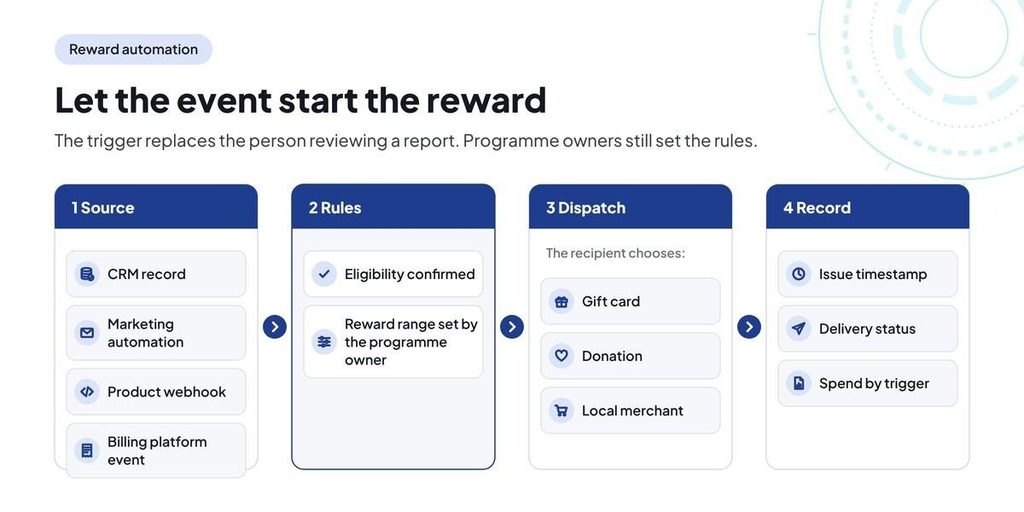
Once eligibility is established, the qualifying event can start the reward workflow itself. Giftogram’s rewards API connects reward delivery to systems that already record customer actions, so a qualifying purchase or completed referral can trigger fulfillment without somebody rebuilding the recipient list manually. The lag is gone, and as the word implies, incentive delivery becomes automatic.
The most difficult problem with handling the reward systems manually is that as the second volume of customers increases, it becomes increasingly difficult for a traditional setup to handle the heat.
This means that at a low volume one customer base is not that strong, identifying whenever a reward event occurs is easy and a dedicated employee with a clear spreadsheet is enough to get the dice rolling. However when the numbers start flowing into hundreds or thousands the weakness is depicted as the failure of the system.
A survey platform records a completed response or a CRM records a converted referral. If someone then has to extract those events, validate the list again, upload recipients, and reconcile the send, the program is just repeating work the existing systems already completed.
| Customer action | Where eligibility is confirmed | Manual failure point |
| Completed survey | Survey platform or marketing automation | Reward sent days after relevance fades |
| Qualifying purchase | CRM record | No consistent trigger for threshold spend |
| Rebate claim | Finance or operations system | Duplicate or missed payout |
| Paperless billing switch | Billing platform event | Account and reward records must be matched |
A webhook or integration lets an event in one system trigger a workflow elsewhere.
For customers incentives that can have a different meaning because while the force system which is the primary server that up business uses is responsible for checking the eligibility of a reward, the platform for rewards actually handles the distribution.
This is the part that most people get wrong because they believe that automation exists to manage the business operations end to end but that is not what happens. In fact the automation should only execute decisions which have already been approved by the business and it should not ever decide whether an ambiguous edge case deserves a reward.
Speed helps by removing avoidable delays and keeping the reward close to the action that earned it, which makes it more meaningful.
Another advantage of using an incentive platform is that customers can actually choose to get their rewards in a way that they actually use. This means that they can either receive the rewards through gift cards or they can have access to prepaid Mastercard and Visa cards. The company retains full control of the incentive value and doesn’t have to guess clients’ tastes. Large survey programs already work this way: Pew Research Center sets the incentive amount and lets respondents take it as a check or a gift code.
A campaign producing 100 qualifying events a month is manageable manually. At 10,000, a workflow that still requires exports, uploads, and reconciliation turns program success into a real administrative hurdle.
Automation lets the normal path run without intervention while people focus on duplicates, disputed eligibility, failed deliveries, and other exceptions that require human judgment. The productivity gain comes from reserving human attention for cases where it changes the outcome.
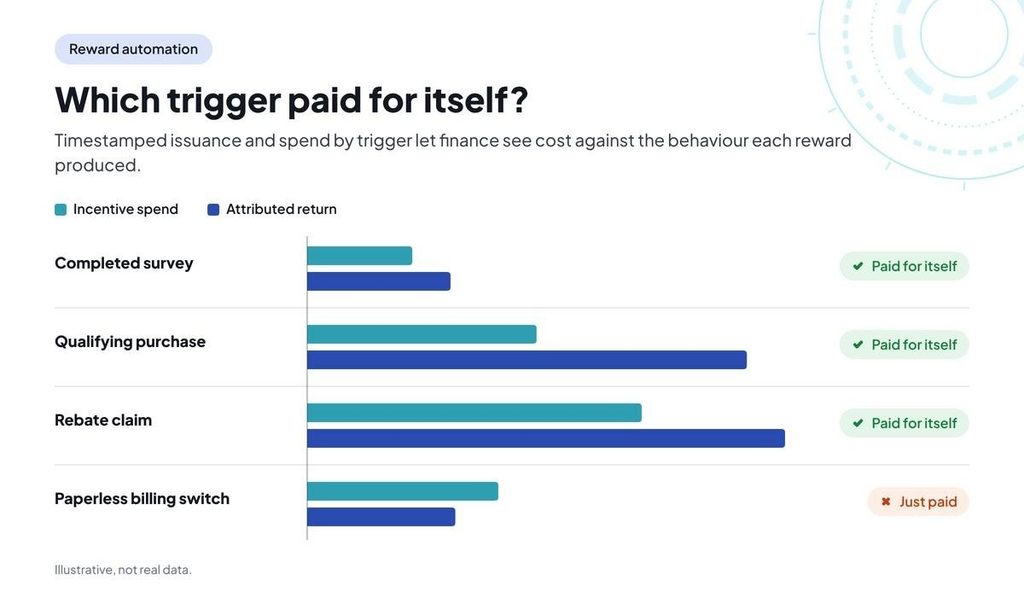
Automation also improves measurement. A manual spreadsheet can record rewards, but an integrated workflow can make issuance and delivery information part of the process. Giftogram combines automated reward workflows with reporting, giving program owners visibility into reward activity while the source system retains the customer event that triggered it.
Finance gets a cleaner basis for evaluation: referral spend against qualified acquisitions, paperless-billing incentives against operating savings, or survey incentives against completed responses. Tying incentive spend to outcomes follows the same logic that drives revenue analytics. Because reward data is recorded as each event happens, it can also support real-time decision-making instead of waiting for a report at the end of the month.
Ans: When eligibility is already recorded as a reliable system event, and rewards are issued repeatedly. One-off campaigns may still be easier to manage through bulk distribution.
Ans: Connect the eligibility system to a rewards platform through an integration, Zapier, or an API. Giftogram supports all three, so approved customer rewards can go out without teams recreating recipient lists manually.
Ans:This happens because when the volume is low and the customer numbers are less, dedicated employees with a clear spreadsheet can notice when an event of reward occurs and can pursue the process efficiently. However when the numbers start getting big just an employee with a spreadsheet starts failing and work starts lining up thus leading to dissatisfied customers.
Ans: When an automated platform is operating your business, it tends to get multiple things wrong which can put your business under heavy risk. This is why automation should only be used to carry out tasks which have already been approved by the business and the person handling that.
Ans: An automation platform can help streamline the entire process and make it way faster and efficient. Moreover it can also help the customers receive the rewards in a way that day actually use, either by gift cards or prepaid Master cards.
