
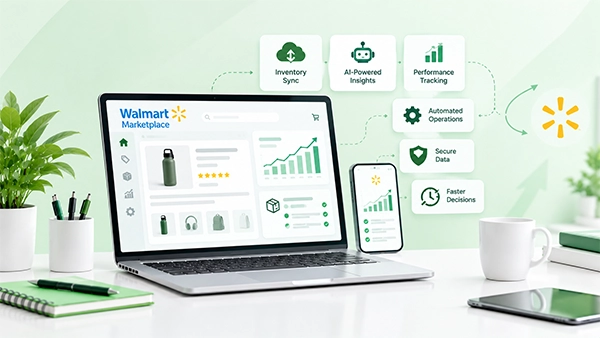
Selling your product on Walmart Marketplace isn’t just about uploading a picture of your product or services and waiting for customers to contact you. The more big a catalog and competition is the more things a seller has to do. Like listing, pricing, inventory, advertising, fulfilment, and customer service.
If you want to optimize your Walmart operations, you have to tie these pieces together with tech, data, clear systems, and automation; this helps your business run smoothly and scale up.
Walmart keeps rolling out tech for sellers, such as advertising tools, integrations, analytics, fulfillment options, a handy seller app, and Seller Center. Well, Seller Center basically covers it all. It helps you manage your orders, catalogs, and discounts; track your performance; and dig into growth and prices.
If you’re a new seller with a handful of products, you can get away with doing everything yourself. You update listings one by one, check inventory now and then, and respond to customers personally. But as your store expands, Walmart marketplace optimization becomes increasingly essential for keeping product data, inventory, pricing, and overall marketplace performance organized.
But things change fast when your product catalog increases into dozens or hundreds of items.
Suddenly, there’s way more info to keep up with, more inventory decisions, more pricing moves, more customer questions, and a pile of performance reports. And chances are, you’re running your store on Amazon, Shopify, or your own website alongside Walmart. Tech helps lighten some of that load, but honestly, you still require people who get how the system works and can spot issues, fix listings, and make sure automation doesn’t mess things up.
Product data is the heart of a Walmart Marketplace business.
Titles, descriptions, images, specs, pricing, and availability — the whole package shapes how shoppers see your items. Walmart’s Seller Center helps you stay organized, and its Growth tools let you identify listing quality and discoverability. Listing quality isn’t just about good content; it’s about how easy your products are to find, their availability, ratings, and reviews.
So optimizing your Walmart product listings isn’t a “set it and forget it” job. It’s ongoing.
Tech can flag missing info, help manage massive catalogs, and make updates easier. Still, nothing beats a human touch to keep information consistent, accurate, and on-brand.
Inventory used to be something you could track manually if you had just a few items. But with hundreds of SKUs? You need a system.
Today’s inventory management uses data. It keeps tabs on stock levels, highlights items that demand a restock, and cuts down surprise sellouts.
Walmart’s Success Hub gives tips on pricing, inventory, and assortment, and their new inventory model throws predictions out 14 days ahead. That helps. But you still need someone watching the system to decide whether to reorder, run a promo, tweak pricing, or just wait.
Marketplace prices change all the time. Competitors move theirs, promos begin and stop, inventory goes up and down, and suddenly, you’re trying to keep up with dozens, even hundreds of products.
Tech makes it possible to track and adjust prices; just don’t let automation run wild. You need firm margins, clear pricing rules, approval steps, and a way to monitor what’s happening.
The real goal? Smarter pricing, not regular price changes.
If you want buyers to find your stuff, marketplace optimization and search visibility matter.
When shoppers search Walmart.com, you want your products to pop up fast and catch their eye. Titles, descriptions, categories, images, stock status, and reviews all shape the shopper’s experience.
Enter Walmart SEO.
Using keyword research and marketplace data, you can figure out how buyers are searching and polish your listings. Walmart’s own guidance ties listing quality to discoverability; it’s not just about keywords; it’s about representing products honestly and clearly.
Advertising on Walmart is a whole lot more data-driven now.
Sellers can run ads through Walmart Connect, like Sponsored Products, which put your items in front of shoppers when it matters most.
Walmart says sellers got a 5:1 return on ad spend through Walmart Connect in its FY26 reporting (according to their own data). That doesn’t mean every campaign will hit those figures, but it does show why you should keep an eye on your ad spend with structured monitoring.
A good Walmart PPC routine includes tracking campaigns, tweaking keywords, watching the budget, analyzing searches, comparing product performance, and reporting regularly.
Tech gives you the numbers. You need people to make those numbers mean something.
Here’s something that’s really changed: You can connect Walmart to other systems.
Walmart provides integration options: Seller Center, APIs, and solution providers. They help with catalog work, order handling, pricing, inventory, fulfillment, returns, customer service, advertising, and reporting.
If you’re selling on more than one channel, integrations let you avoid entering the same information over and over. Instead, updates flow across systems automatically, assuming you set it up right.
The trick? Pick the integration that suits your business. More tech is not always better if it just adds complexity.
Seller operations aren’t tied to desks anymore.
With the Walmart Seller app, U.S. Marketplace sellers can handle crucial tasks right from their phones. You get notifications on orders, customer messages, inventory problems, plus sales metrics and some product controls.
So you don’t have to be glued to your computer to catch critical problems. Still, mobile tools should add to your process, not replace it.
Picture a small home goods brand starting out with 20 products on Walmart Marketplace.
The owner does it all: handles listings, checks inventory, answers customers, watches orders, and tracks sales.
The business expands to over 100 products.
Now listing updates drag on, inventory checks are overwhelming, customer messages pile up, and ad data needs more attention. The owner spends hours every week inside the Seller Center — time that could’ve gone to launching new products or managing suppliers.
At this point, scaling means mixing Walmart’s tech with specialized operational support.
Automated tools and Seller Center pinpoint inventory, listing, ad, and performance trends. A marketplace specialist can come in, review info, update products, monitor for issues, prepare statements, and only loop in the owner for the big stuff.
Tech brings efficiency. People keep it consistent.
This combo is critical if you want growth without chaos.
You don’t need fancy automation from the beginning.
Automation and expert assistance really pay off when:
How EcomVA Helps With Walmart Operations
Tech can speed things up, but you still need people skilled at using those systems.
EcomVA delivers Walmart automation services to take recurring tasks off your plate. They cover product listing and monitoring, keyword research, pricing strategies, shipping support, store performance management, and more.
For evolving sellers, this means you don’t have to personally juggle every marketplace task.
If manual work is holding you back, EcomVA’s Walmart automation services could fit right into your workflow, letting you concentrate on bigger goals.
Walmart selling isn’t just about plugging in more automation. It’s finding the sweet spot between technology, data, and hands-on expertise.
Automation is great for cutting repetitive work. Analytics turn raw info into opportunities. Integrations link your systems up. But you may still require experienced marketplace support to make decisions, keep listings sharp, monitor performance, and ensure everything runs smoothly.
For small and growing brands, the right mix can make Walmart operations way easier. Rather than being buried in routine Seller Center tasks as your catalog expands, you can build processes where tech and expert support keep things humming.
If your Walmart business is starting to feel overwhelming with too many listings, inventory headaches, pricing messes, and constant ad management, EcomVA’s Walmart automation services can give you specialized help. Check out EcomVA’s Walmart Automation Services and see how a trustworthy team can make your operation more efficient.
Ans: It’s about making your store run better by improving listings, inventory, pricing, discoverability, advertising, fulfillment, and other operations so you’re more efficient and competitive.
Ans: It cuts out a lot of repetitive tasks like managing products, monitoring inventory, processing orders, reporting, and more.
Ans: It’s the main platform where Marketplace sellers handle catalogs, orders, pricing, performance tracking, shipping settings, and growth tools.
Ans: Absolutely. Discoverability drives performance. Walmart’s listing-quality guidelines link good product info with findability, so nailing your product details is crucial.
Ans: Yes, tech and integrations help track inventory and flag items needing attention. Walmart also gives inventory tips through Success Hub.
Ans: Walmart advertising can boost product visibility, and if you manage campaigns well, it’s definitely worth using. Walmart Connect offers Sponsored Products and other ad tools.
