
Modern SaaS companies have a very serious operational challenge: achieving rapid product innovation without the linear (and expensive) increase of engineering headcounts. The structural pressure is increasing as a result of converging technical demands that incorporate various modern technologies, from native artificial intelligence to cutting-edge defense standards, complicated cloud systems, and many different third-party integrations.
Dev teams are maxed out, and finding backup is not easy. According to McKinsey, 60% of companies call the tech talent shortage a major barrier to progress, and only 16% of executives are confident they can find the right people.
This has become a large concern for SaaS startups; it is no longer simply a hiring issue. It’s a growth issue. While hiring takes too long, the product roadmap affects retention, expansion revenue, and position in the market. With hiring inefficiencies, modernization efforts, technical debt reduction, and customer-requested features all compete for limited resources.
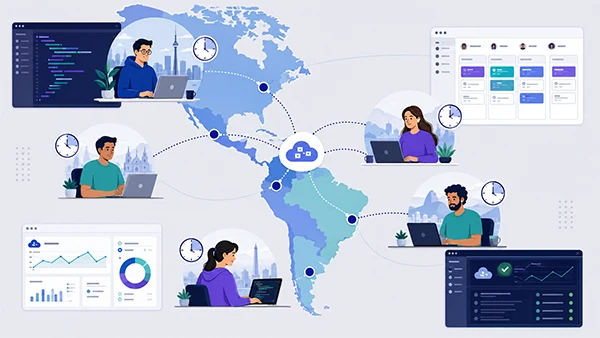
This is one reason more companies hire LATAM developers as part of a nearshore strategy. Latin America offers engineers across major technical disciplines, while overlapping working hours support coordination with North American teams. Still, geography alone does not make the model effective. Companies must understand where nearshore hiring creates value and how those engineers will fit into the product organization.
Traditional workforce planning assumes that companies can forecast how many engineers they will need and which skills those engineers should have. SaaS development rarely follows a stable pattern.
A new enterprise customer may require an unplanned integration. A security review may reveal infrastructure work that cannot be delayed. A growth initiative may create an immediate need for data engineering or front-end development. These requirements can appear faster than permanent hiring can respond.
Nearshore hiring gives companies another way to manage this variability. Instead of treating every capability gap as permanent headcount, a business can add a specialist or create a small engineering pod around a product area. This can be useful during a migration, product launch, reliability project or expansion into a new customer segment.
Companies can then add capacity gradually, measure its effect on delivery and quality, and expand when the operating case is clear.
One of Latin America’s practical advantages is its overlap with North American working hours. Building a great product takes a village—it requires engineers, product managers, designers, QA specialists, security teams and customer-facing staff to remain in constant communication.
When all these groups are online and available at the same time, questions get answered on the spot instead of turning into major bottlenecks. A developer may need clarification about an API dependency, permission model or customer workflow. Several hours of overlap allow the issue to be addressed within the same development cycle.
An integrated nearshore team can provide:
Remote hiring is now part of how distributed product organizations operate. According to the World Economic Forum, 84% of employers in Latin America and the Caribbean are planning to upskill their teams to keep pace with rising demand for digital and technology talent.
While cost is usually a major factor when deciding to nearshore, looking only at base salaries does not provide the whole picture. Companies need to factor in the total cost of building a highly productive engineering team, including recruitment, onboarding, management, compliance, talent retention and the hidden cost of unfinished projects.
A lower hourly rate will not save money if a developer is a poor fit, needs constant supervision or is completely cut off from the rest of the product team. Instead of looking only at salaries, companies should focus on the reliable engineering capacity they receive for their investment.
An engineer who can quickly become productive in an established codebase, contribute to product strategy and ship features independently is often worth more than a cheaper hire who needs constant direction. The equation ultimately depends on two variables: speed of impact and management overhead.
Today, Latin America’s technology ecosystem has matured beyond simple labor arbitrage, offering expertise in cloud infrastructure, DevOps, data engineering and cybersecurity. An Inter-American Development Bank analysis of more than 6.2 million digital vacancies across 15 Latin American countries between 2022 and 2025 found sustained demand for digital skills and rapid growth in AI-related roles.
For expanding SaaS enterprises, this talent pool makes it possible to assemble teams around precise roadmap requirements rather than accept the rigid structure of a standardized outsourcing package.
Nearshore teams tend to underperform when they are treated as a separate delivery unit. Engineers receive tickets, complete isolated tasks and wait for internal approval. This may increase activity without improving speed, quality or accountability.
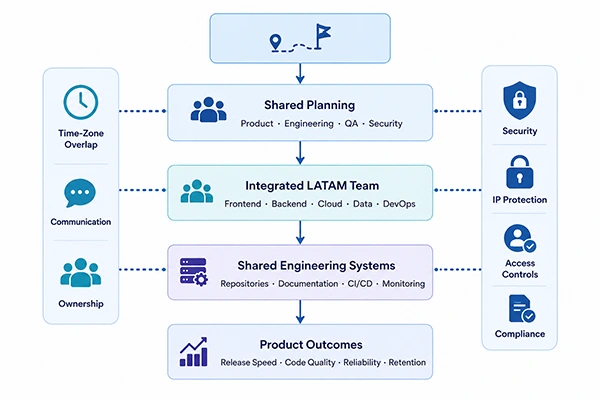
A stronger approach places LATAM engineers within the same planning and decision-making system as internal employees. They should understand the roadmap, technical standards, customer constraints and reasons behind product priorities. Access to documentation, repositories, analytics and relevant meetings should be established during onboarding.
Ownership needs to be clear. Every product area should have a dedicated technical lead, and engineers need to know which outcomes they are responsible for. Performance should be judged by delivery reliability, code quality, maintainability and contribution to team goals—not by the number of hours they appear online or the number of tickets they close.
Companies should establish the legal and security framework before expanding. Contractor classification, intellectual property, data access, confidentiality and employment obligations vary by country. Direct contracting, employer-of-record arrangements and vendor-managed teams create different levels of control and administrative responsibility.
SaaS companies should approach LATAM hiring as an engineering capacity decision rather than a search for lower-cost labor. The model works best when it addresses a defined operating problem.
Shared working hours can reduce coordination delays. A broader talent market can shorten searches for specific skills. Flexible teams can support expansion without committing to permanent headcount before demand is established.
The decision should be evaluated through the same measures used for any engineering investment: time to productivity, release performance, code quality, retention, management effort and business impact. Companies that focus only on hourly rates may create another fragmented vendor relationship. Those that design the model around product outcomes can add durable capacity without weakening accountability or execution.
Ans: SaaS businesses are using LATAM engineering teams to deal with regional talent shortages, obtain fast scaling capacity, and sync their working hours with North American companies instantly.
Ans: The greatest advantage of LATAM nearshoring is that both locations operate in the same time zone and can effectively cooperate with each other, resolve emerging problems, and perform code reviews easily and quickly.
Ans: Rather than concentrating only on the hourly pay rate, organizations ought to consider factors such as project influence, management costs, onboarding time, compliance costs, and overall contribution to developing quality code.
