
Almost every aspect of the marketing business knows that speed determines success in performance marketing. Over time, those ads start to feel ineffective, and the teams just demand to overcome the delays and struggles of slow testing and limited opportunities.
Here comes the magic of AI. It helps to put one above the mindset of manual design approaches and helps to generate, build and scale assets faster. As a result, this shift helps marketers move faster.
Read more to explore how modern AI tools like Banana AI help performance teams to boost production velocity.
Key Takeaways
- Creative production speed has become a crucial factor that determines how a marketing team wins.
- Image-to-image generation allows marketers to build various environments and variations in the present ones.
- The best approach mixes AI-powered tools and technologies along with human supervision and strategic thinking.
In a standard creative operations model, production is a short, resource-heavy queue. Each change—a change in base color, a different model, or a shift in surround—requires manual correction. When a media buyer requires 50 changes to find one statistical bug that lowers the Customer Acquisition Cost (CPA), the design team shifts to a service desk bounded by tickets.
This “bespoke” formulation creates a lag. If a special “hook” starts operating well on a Tuesday, the team might not have the next changes ready until Friday. By then, the audience saturation or the auction performance might have already aged.
The industrialization of this procedure means treating fresh production like a data-driven manufacturing system. The approach is no longer to produce one peak asset, but to produce a huge pool of high-quality nominees that the algorithm can then cut through.
High-frequency testing is the new foundation. To cope with this change, performance teams are moving away from the “Big Idea” campaign and toward a daily influx of fresh visuals. The barrier is no longer the designer’s capacity, but the team’s capability to manage the volume of output.
The first major change occurs at the discussion stage. Traditionally, a brief is a descriptive document meant to comply with human standards. In a generative workflow, the brief goes on to look more like a logical prompt library. Instead of asking a developer for “a cozy living room with a modern sofa,” we are using platforms to generate these environments in seconds.
By inserting Banana AI Image into the early stages of artist development, teams can skip the initial 48-hour mockup phase entirely. Media buyers and creative researchers can experiment with visual proposals before a designer ever opens Photoshop. This isn’t about taking out the designer; it’s about presenting them with a “warm” starting point.
When using layouts like Nano or Z-Image Turbo, the focus is on speed and aesthetic precision. If the brand rules call for a specific desaturated look or a strong cinematic feel, these can be woven into the prompt engineering process.
This short-circuits the back-and-forth “can we try it in blue?” cycle that fills so much billable time. However, a moment of doubt remains: while we can search for a “vibe,” getting a generative model to match the precise physics of a specialized physical product is still a major race that requires human mixing.
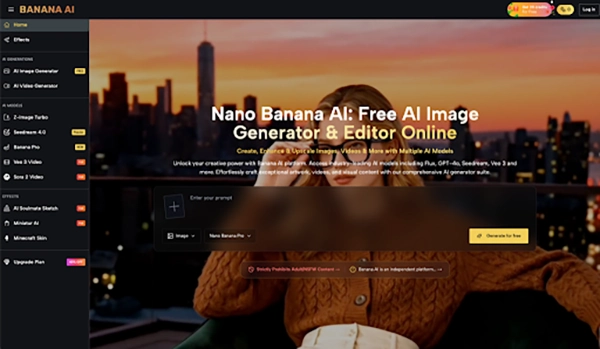
The real power of generative tools for performance teams arises in the “Image to Image” (Img2Img) progress. This is where Banana AI Image acts as an operational add-on. If you have a base quality—perhaps a product shot that has formerly performed well—you can use it as a structural pattern to generate plenty of environmental shifts.
Imagine an e-commerce brand that offers outdoor gear. A single studio shot of a traveling boot can be changed into:
Each of these roles acts as a different “hook” for different audience intervals. Previously, this would call for three separate location shoots or hours of complicated masking and compositing. Now, these patterns are displayed in the time it takes to refresh a browser.
This capacity to define creative for different geographic markets or psychographic profiles becomes a lower cost. You aren’t getting paid for the hours spent making the modifications; you are billed for the price and the strategic care needed to select the right ones.
This leads to a “shot on goal” school of thought. If you can test 20 environments instead of two, your chances of picking the one that aligns with a specific niche increase exponentially. Banana AI serves up the engine for this volume, permitting teams to move from “what do we think will work?” to “let the market tell us what works.”
As production velocity increases, the problem moves down the chain to the review cycle. If a team can create 200 ad ideas in an afternoon using Banana AI, who is expected to look at them?
We are seeing a change in the role of the Art Director. Their job is progressing from “the person who makes the thing” to “the person who hosts the pool.” This called for a change in review standards. In the old world, we looked for “pixel perfection.” In the high-velocity world, we look for a “Vibe Check.”
Is the lighting reliable? Does the subject feel closer to the brand? Does it stop the scroll? These are the factors that matter. We have to settle on a trade-off: in exchange for record volume and rapid testing, we might lose some tight control over every single pixel. For many winning teams, this is a trade-off worth making, given the core product is kept clear and the brand isn’t abused.
It is important to reset your priorities here: reviewing 200 images is mentally taxing. “Creative fatigue” doesn’t just arrive to the audience; it happens to the media buyer as they stare at a screen of AI-generated candidates. Carrying this memory load is the next great battle in creative operations.
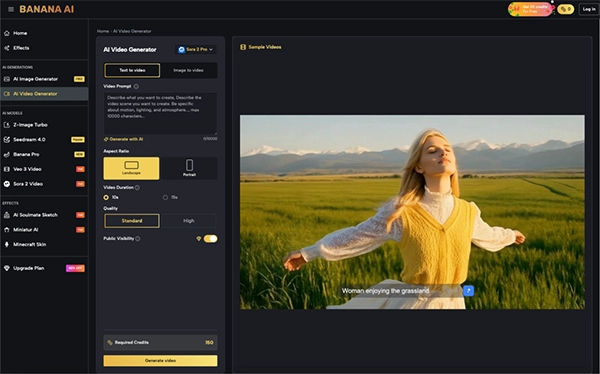
The major goal of using Banana AI is to drive down CPAs. There is a direct connection between creative change and platform efficiency. When an ad set starts to plateau, the most valuable lever is usually a new creative move, not a change in bid techniques.
By using the Banana AI video production system, teams can take their winning still images and insert life into them, creating short-form video content that fits the “Reels” or “TikTok” aesthetic. This builds a multi-modal pipeline where a single prompt can link to a static ad, which then leads to a motion ad, all within the same space.
Commercially, the ROI of this solution is found in the elimination of “dead time.” When a media buyer sees a winning idea, they can act on it right away.
The cost of generative credits is nothing compared to the cost of a designer’s hourly rate for repetitive tasks like resizing or background switching. This causes the creative budget to be divided toward “Big Swing” concepts—the kind of high-level creative thinking that AI still tries to copy.
Despite the efficiency boosts, we must be honest about the current limits of the technology. Velocity without a theory is just noise. If you create 500 images but don’t have a set way to test them or a reason why they might work, you are simply using memory and time.
There are also technical difficulties that urge caution. AI currently has issues with:
At the end of the day, the future of performance marketing is not limited to the vague thought of replacing creative teams with AI – it is about allowing them to work faster and with more efficiency. Generative AI allows performance teams to produce a large volume of creative things while responding smoothly to emerging trends.
Moreover, one still needs a clear strategy and thoughtful testing. Just relying on advanced workflows won’t ensure efficient performance.
