

Today’s retail is less divided between online and offline sales, as customers require the same quality of service across all channels: physical, mobile, and online. A stable Magneto POS integration allows that to happen by managing real-time inventory, orders, prices, and customer data of a business.
Usual errors in balances, duplicate orders, and issues in accounting are dealt with when a company utilizes professional e-commerce Magento integration services to integrate POS solutions.
This article outlines the benefits of such systems and how one can integrate it to their existing workflow.
Key Takeaways
- Once the system is integrated, inventory, customer profile, payments, and sales information are updated between the online store and the retail store
- The main benefit of POS integration with Magento is a single ecosystem for managing online sales
- Employees are no longer required to enter information from one system to another, thereby decreasing the chances of human errors
- API-based integration is considered the best option for businesses, allowing you to adapt the synchronization logic to specific processes
The Magento integration with POS systems is a connection between the Magento e-commerce platform and the point-of-sale system for data exchange. Once the system is integrated, inventory, customer profile, payments, and sales information are updated between the online store and retail store.
This approach is especially important for omnichannel retail. A customer can place an order online and pick it up at the store or return the item via physical location. Without Magento POS system integration, similar processes require manual processing.
The newest Magento 2 POS integration usually works through APIs, middleware, or special connectors. Some point-of-sale systems providers offer ready-made Magento-native solutions that simplify implementation and reduce technical errors.
Some solutions are considered particularly convenient for retail, as POS is a Magento-native solution or offers seamless implementation with Magento via prebuilt APIs and sync modules.
The main benefit of POS integration with Magento is a single ecosystem for managing online sales. The company gains centralized control over inventory and customer activity.
Once connected, a business can perform several important and useful functions at once:
Another advantage is improved customer experience. If a product has finished in the retail store, the system immediately shows the current status in the online store. This reduces the risk of overselling and increases customer trust.
According to statistics from POS integration research, companies with integrated retail infrastructure process orders faster and manage omnichannel operations more efficiently. For modern retail brands, this is becoming the standard rather than an extra feature.

The Magento integration POS system includes a few key functions, without which it is difficult to ensure stable retail operations. The specific set of opportunities depends on the selected point-of-sale system provider and project architecture.
Most often, implementation includes the following important components:
Other Magento POS Software solutions also feature warehouse management systems and special barcode scanners, as well as loyalty programs. Large retail businesses need to be able to manage their stock across several stores and allocate it automatically to each of them.
Additionally, a reliable and seamless eCommerce platform integration also helps the company ease the workload of the staff. Employees are no longer required to enter information from one system to another, thereby decreasing the chances of human errors.
Fun Fact
The first cloud-based POS software was launched in the UK in 2002, paving the way for today’s tablet and smartphone-based systems.
You can use both types of Magento for such tasks. But keep in mind that there are several Magento point-of-sale systems that work with Magento 2. The decision will be made based on the scale of the business, the number of stores, and the characteristics of the retail infrastructure.
The most popular solutions are:
Cloud-based modern solutions are considered the most flexible. They simplify remote access, upgrades, and scale your business. Mobile POS systems are often used in small retail stores or different pop-up locations.
Some providers create POS as a Magento-native solution, originally developed for the eCommerce ecosystem. Such solutions are usually easier to integrate as they already support Magento APIs and data structure.
Before proceeding with the implementation process, it’s important to select the right point-of-sale platform. Keep in mind the speed of synchronization, support for third-party integrations, security, and scalability.
The process of POS integration in Magento can be implemented in several ways. The method of connection affects system speed, level of customization, and project cost. The most common options are:
API-based integration is considered the most reliable option for growing businesses, allowing you to adapt the synchronization logic to specific processes of the company.
Custom integrations are used mostly by enterprise retailers, who need advanced automation and implementation with ERP, CRM, or warehouse systems.
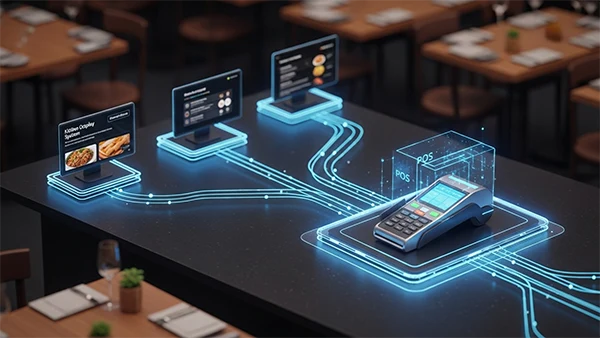
Magento POS seamless integration requires a preliminary analysis of business workflows and technical infrastructure. Errors in the planning stage can lead to synchronization failures and data conflicts.
A typical implementation process looks like this:
After launch, it’s important to regularly check sync logs and performance metrics. Even a stable, seamless integration with Magento can require optimization when the number of orders or stores is increasing.
Some companies additionally integrate Magento with ERP platforms and analytics systems. This helps to centralize reporting and improve inventory forecasting.
For large retail types of businesses, eCommerce platform integration with POS solutions becomes the basis of an omnichannel strategy.
Without the presence of a synchronized infrastructure, scaling online and offline sales becomes increasingly complicated.
