
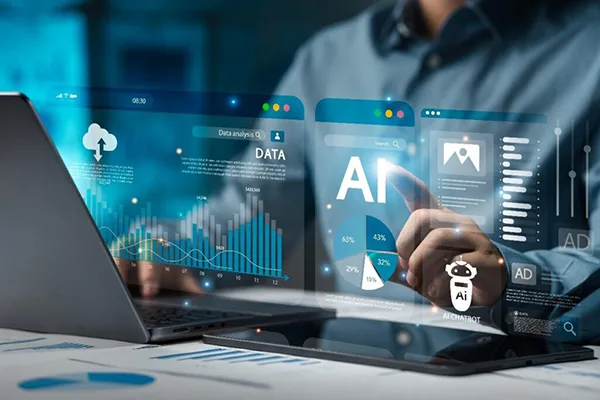
Artificial intelligence and automation are no longer just buzzwords for the future. These are strong foundations of the digital horizon on which modern commerce is built.
The question is no longer, “Should we use AI?” but “How fast can we take advantage of it?” This shift in the thinking of businesses has brought about a paradigm shift, as firms try to incorporate machine learning, generative AI, and RPA into their traditional workflows.
Let’s understand these evolving trends and how they are shaping the future by rewriting traditional methodologies.
Key Takeaways
- Hyper-automation has become increasingly popular among workforces as businesses look to move away from manual and time-consuming tasks.
- Generative AI can create creative visuals and enhance existing footage dynamically, with a single text prompt input.
- AI tools can generate predictive analysis, warning companies of potential risks even before they occur, which saves them a lot of money.
- These are ethically correct tools as they only function within set guardrails and cannot override commands set by the administrator
While basic automation is used for routine tasks, the era of hyper-automation is now upon us. This is a concept that leverages various technologies, such as AI, low-code development tools, and RPA.
This combination allows businesses to attain the highest degree of IT process automation. It is the concept of developing a “digital twin” of the firm where the processes enhance themselves.
In this critical period of technological evolution, the value of DynamoLogic Solutions’ AI development services could make the difference between a disjointed digital strategy and a cohesive one.
It is the difference between a business that is able to move away from the concept of isolated task automation and one that is able to achieve end-to-end transparency in its processes.
The year 2023 was when the world was introduced to Generative AI. The year 2024 and beyond were the years in which the business world implemented it. We’re no longer talking about simple chat boxes.
We’re talking about complex, domain-specific AI. Businesses are now using AI to train their own proprietary data to build knowledge bases that can write contracts, code programs, or create marketing campaigns in a matter of seconds.
The fastest emerging theme is customization. Businesses are beginning to realize that generic AI is definitely a good thing, but personalized AI that understands unique voice, regulations, and history is a business powerhouse.
This is why small teams are now capable of punching well above their weight class.
The common belief is that automation means replacement. However, the new emerging trend is augmentation. The key to the most successful businesses in the coming decade will be the mastery of the Human-in-the-Loop (HITL) approach.
This implies that while AI is doing the data-crunching and first draft, humans will focus on the emotional intelligence, moral compass, and final creative touch. The combination will enable a level of scale that was previously unimaginable.
In customer relations, for example, AI can take care of 80% of the interactions, but when the issue is complex and emotionally charged, the conversation can be handed off to a human agent who now has the time and the data to deliver a truly personalized experience.

One of the biggest transformative trends is the change from reactive to proactive business objective models.
Using predictive and prescriptive analytics, AI is capable of predicting market trends, equipment failures, customer behaviors, etc., with uncanny accuracy. Here are some examples:
While automation is a powerful thing, it’s a double-edged sword. Automation without trust can lead to a lot of reputation risks. The future belongs to those who are using AI to not only get faster, but to get fairer.
As AI plays a larger role in decision-making, from hiring to loan approvals, Explainable AI (XAI) is a trend that is gaining momentum. Consumers and regulators are increasingly asking to understand why a particular decision was made by a machine.
Companies that place a high value on ethical approaches to AI, data privacy, and algorithmic transparency are the ones that will win the trust of their marketplace over time.
Fun Fact
One of the most common, everyday examples of AI automation is your email spam filter, which makes use of machine learning to constantly adapt to new junk mail tactics
The entry costs for AI and automation are dropping sharply. We’re experiencing a massive growth in the adoption of low-code/no-code platforms that enable non-technical team members like marketers, HR managers, and accountants to build their own automation workflows.
This phenomenon means that innovation is no longer limited by the IT department. When the people closest to the problem have the power to build the solution, the organization can change incredibly quickly.
AI-based building blocks make it possible for a leader of a department to deploy their own automation solution in a weekend rather than spending the whole quarter figuring out its functioning.
The combination of AI and IoT is giving birth to the concept of the ‘Industrial Metaverse’ in the domain of manufacturing and logistics.
In this environment, a digital replica of a factory or a warehouse is created at a scale of 1:1. Millions of different ‘what if’ scenarios can be simulated in a virtual environment to arrive at the best possible solution.
This reduces the cost of failure to almost zero. You don’t have to stop the production line to test a new process. You test the new process in the virtual environment, let the AI do its magic, and only implement the solution when you are guaranteed to succeed.

In marketing, the trend is moving away from customer segments toward the ‘segment of one.’ AI allows for hyper-personalization at a global scale. Every email, every product recommendation, and every price point can be tailored to the individual user in real-time.
This level of customization creates an impactful and meaningful customer experience. When a platform knows what the user actually requires before they even search for it, brand loyalty is forged through sheer convenience and relevance benefits.
The integration of AI and automation technologies is not a one-time process. It is a continuous process of evolution.
The trends that are currently being witnessed in the industry, such as hyper-automation, generative AI, and predictive analytics, are merely a starting point for a brand new era of business where speed and intelligence will be the primary drivers of business value.
For those organizations that are ready to embark on this next level of evolution, DynamoLogic Solutions’ AI development services offer the expertise and technological capabilities necessary to navigate this complex landscape.
Whether the business seeks to automate traditional repetitive processes or develop custom AI-enhanced technologies to redefine your industry, bespoke AI strategies such as the ones mentioned above can definitely propel your organization towards growth and success.
