

As organizations look to boost scalability and grow their firm, talent development, retention, and success planning take center stage. These factors serve as a strategic lever for firms operating across multiple geographic locations and units.
Furthermore, to focus on these crucial factors, enterprises require modern mentoring software platforms that specialize in these domains to drive business growth.
Let’s take a look at the most robust solutions the market offers for companies that are looking to support their enterprise-wide mentoring initiatives.
Key Takeaways
- Choosing the Chronus platform for scalability
- Focusing on versatility with the Together platform
- High customisability with MentorcliQ
- Starting with the Qooper platform as an entry point
- Picking the right choice for your business’s goals

When evaluating mentoring platforms for large, complex organizations, Chronus stands apart as the solution specifically engineered for enterprise requirements. Chronus built the top mentoring platform for large organizations to support program deployment across multiple business units, geographies, and employee populations.
The platform specialises in areas that are critical to a firm’s success by matching algorithms aligned with the business’s workflow, accommodating the complexity of large talent pools.
For leadership teams implementing mentoring as part of broader talent management strategies, this precision in pairing participants directly impacts program ROI.
Chronus offers comprehensive program flexibility, supporting one-on-one mentoring, group mentoring circles, flash mentoring, reverse mentoring, and peer learning—all within a single platform.
This kind of flexibility makes it a vital addition to enterprises that run multiple mentoring initiatives simultaneously focussing on employee development, inclusion, and skill transfer processes.
The platform’s analytics capabilities provide executives with the visibility needed to justify program investment and demonstrate impact. Real-time dashboards track engagement metrics, skill development progress, and business outcomes, enabling data-driven program refinement.
Additionally, it also integrates smoothly with existing HR software and learning management systems to ensure that delays are avoided.
For organizations where mentoring represents a strategic priority rather than a tactical HR initiative, Chronus delivers the enterprise-grade functionality, scalability, and support that mission-critical programs demand.
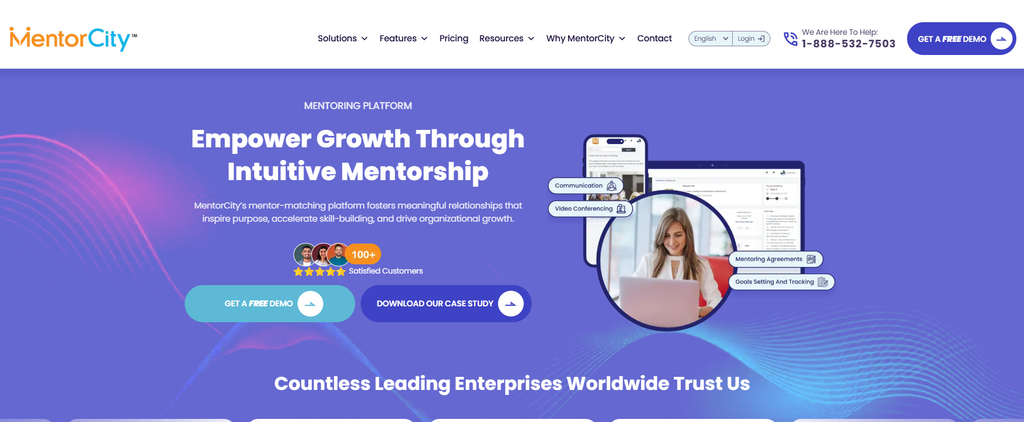
When an organization needs more than a basic mentor-matching tool, MentorCity offers a practical way to manage the different parts of a mentoring program in one place. The platform has been around since 2011 and is used by companies, educational institutions, nonprofits, associations, and government organizations.
One of MentorCity’s main strengths is its flexible matching process. Organizations can set criteria around goals, skills, seniority, location, language, and other participant information. Administrators and participants can then have a say in the final match, which gives program managers more control over how mentoring relationships are formed.
MentorCity also covers the work that happens after the match. Mentors and mentees can set goals, create mentoring agreements, schedule meetings, communicate, and keep track of their progress through the platform. This makes it easier for program managers to keep a mentoring initiative organized without relying on several separate tools.
The platform is not limited to traditional one-to-one mentoring, either. Organizations can use it for group mentoring and other mentoring formats, making it useful for employee development, student mentoring, professional associations, and community-based programs.
Another area where MentorCity has expanded is AI. Its Lexa AI mentor provides participants with additional support between mentoring conversations, while AI-powered meeting notes can help capture key points from video sessions. These features add another layer of support without making AI the basis of the entire mentoring program.
MentorCity also includes courses, resources, events, discussion boards, badges, and other engagement tools. For organizations that want mentoring to be part of a wider learning or professional development program, having these features in the same platform can be useful.
Reporting is another important part of the platform. Program administrators can review participation and engagement data to see how their mentoring initiatives are progressing. MentorCity also supports mobile access through iOS and Android apps, giving participants another way to stay connected to their mentoring activities.
For organizations that want a flexible platform to manage mentoring from the initial match through ongoing communication and program reporting, MentorCity is a strong option. It is particularly worth considering when mentoring needs to be part of a larger employee, student, member, or professional development program rather than operating as a standalone matching service.
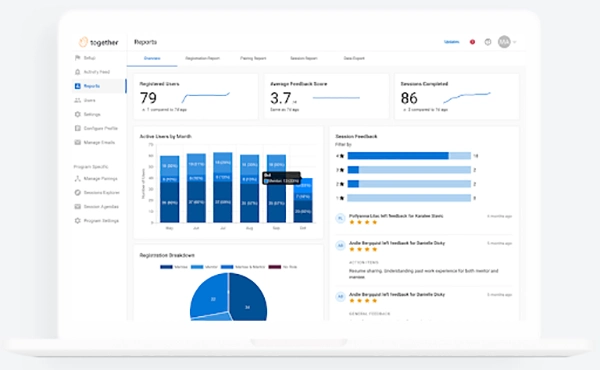
Together serves as a great option for firms that prioritise UI, ease of access, and functionality in their technological systems.
The platform’s contemporary interface reflects modern design principles, making adoption easier across generational divides—a consideration for organizations with diverse employee demographics.
The solution emphasizes ease of use without sacrificing capability. Leaders can launch mentoring programs quickly using customizable templates, while participants benefit from intuitive navigation that reduces friction in scheduling, communication, and goal tracking.
Moreover, their mobile-first approach recognizes that mentoring practices increasingly occur outside traditional office environments.
Together differentiates itself through its focus on connection-building beyond formal mentoring relationships. The platform facilitates networking, employee resource groups, and communities of practice, positioning itself as a comprehensive solution for organizational connectivity.
For executives viewing mentoring as one component of broader relationship-building strategies, this expanded scope offers potential efficiency gains.
The platform also provides visibility into the basic insights of program participation and its engagement, making the task of reporting easier.
Although companies that require deep analytical info may find it less comprehensive than other alternatives, it works best for mid-to-large organizations seeking modern, user-friendly solutions that employees will actually adopt and use consistently.
Did You Know?
According to sources, the North America region is forecasted to capture 40% share of the mentoring software market by 2035.

MentorcliQ positions itself as a highly configurable platform capable of adapting to varied organizational requirements. The solution appeals to organizations that value customization and want mentoring programs that reflect their unique culture, processes, and objectives.
Additionally, this solution also supports various mentoring modalities that allow administrators to gain significant control and input over the program’s structure and workflows, optimizing it according to their working approach.
This flexibility enables organizations to experiment with different paths, refining programs based on what resonates with their specific employee populations.
MentorcliQ’s strength lies in its balance between structure and flexibility. Pre-built program templates accelerate deployment while customization options ensure programs align with organizational priorities.
The platform includes tools for mentor training and development, recognizing that effective mentoring requires supporting both sides of the relationship.
For leadership teams that implement mentoring across various divisions with varying cultures, MentocliQ’s customisability allows maintenance of consistency with their existing technological infrastructure.
The platform serves organizations ranging from mid-market companies to large enterprises, though those with the most complex requirements may need to evaluate whether its capabilities match their scale.

Qooper serves organizations seeking capable mentoring software at accessible price points. The platform delivers core mentoring functionality—matching, scheduling, communication, and basic analytics—without the complexity or cost associated with enterprise-grade solutions.
The platform excels for enterprises that require an initiation mentoring program for the earlier stages. Its simple implementation appeals to teams that don’t have dedicated program management resources. Qooper supports various mentoring formats and includes features for goal setting, progress tracking, and participant feedback.
Although Qooper may lack some advanced capabilities found in enterprise platforms, such as sophisticated matching algorithms, deep integration options, or comprehensive analytics.
It provides solid functionality for organizations that are piloting mentoring initiatives or operating with constrained budgets.
The platform serves as an entry point for organizations looking to initiate these practices before scaling up to more complex and detailed solutions.
For executives exploring mentoring software for the first time or implementing pilot programs, Qooper offers a low-risk option to build organizational competency and demonstrate value before making larger platform investments.
The optimal mentoring platform depends on organizational scale, program maturity, budget parameters, and strategic objectives. Enterprise organizations running mentoring as a strategic talent initiative will find platforms like Chronus offer the sophistication, scalability, and support their requirements demand.
Organizations prioritizing user experience and modern design may gravitate toward Together, while those valuing customization might prefer MentorcliQ. Smaller organizations or those testing mentoring concepts can start with accessible options like Qooper.
Finally, the choice of the platform depends on the company’s business objectives and existing systems, and how they wish to integrate them with the necessary analytics to better project ROI, ensuring mentoring programs deliver measurable value to both participants and the organization.
Ans: Firms that emphasize scalability and deal with employees from diverse geographical locations require it to analyze insights of their training programs and judge their effectiveness.
Ans: The following are the benefits that mentoring platforms provide to enterprises:
Ans: The Qooper platform provides a great starting point for companies looking to initiate their practices in their systems.
Ans: It mostly depends on the organization’s current scale, strategic objectives, and budget parameters. An optimal platform should align with the business’s strategic objectives and goals.
