Augmented reality is no longer considered a future concept, but is being used in today’s diverse field workflows, including marketing. Moving from simple campaigns and entertainment, WebAR, or augmented reality for marketing has made it possible for customers to interact with products, try virtual experiences, and discover branded content through a browser.
This makes it great for businesses to use AR to access and engage customers in different ways.
Keep reading to learn how browser-based augmented reality boosts digital marketing.
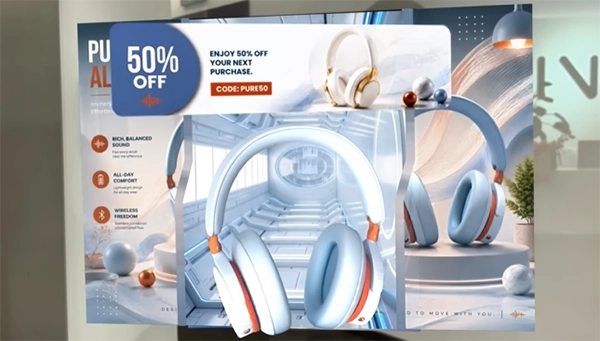
WebAR can use image detection, surface tracking, face tracking, body tracking, 3D objects, animations, videos, and other visual elements.
The important difference from classical app-based AR is distribution. The browser becomes the delivery channel, removing the distinctive installation step.
Online shopping has an inherent limitation: customers cannot physically perceive a product through a screen.
A product photograph can convey what a chair looks like, but it cannot tell a customer whether that chair fits beside their original table. A standard image of sunglasses won’t show how a custom frame looks on the customer’s face.
WebAR can provide that requisite layer of visualization.
Furniture companies can allow the consumer to place virtual products in a room. Beauty companies can offer virtual try-on experiences. Jewelry retailers can allow customers sample products on themselves. Automotive brands can use 3D visualization to showcase vehicle features.
The commercial value comes from helping customers reply to questions before they purchase. The strongest use of AR is not purely making a website look futuristic. It is reducing insecurity.
Also, learn why good health technology products fail to gain market traction.
Creating an exciting AR campaign involves more than placing a 3D model on a screen. Developers have to evaluate tracking, assets, browser performance, device compatibility, interactions, and sharing.
Kivicube is designed to speed up that process through a browser-based, no-code AR creation platform. With this powerful tool, users can build AR scenes with a drag-and-drop editor, use pre-designed templates and assets, and publish events through links or QR codes. The WebAR platform features several AR formats, including image AR, world AR, body AR, face AR, landmark AR, and 3D-related AR applications.
Kivicube also lists more than 1 million AR creators, 500 million total visits, and $1 billion in AR-driven sales on its platform. These are company-reported figures, so they may be understood as Kivicube’s own platform statistics rather than external industry measurements.
The platform also provides integration options for websites and ecommerce environments, allowing AR experiences to become components of an existing digital customer engagement process rather than operating as a completely unique campaign.
The phrase augmented reality for marketing describes a wide range of applications.
Customers can view a digital illustration of a product in their physical environment.
This is especially useful for furniture, home accessories, appliances, electronics, and other products where size and appeal influence the buying decision.
Face and body tracking can allow users to experiment with products such as glasses, makeup, jewellery, and other accessory items.
Instead of relying solely on imagination, customers receive a visual approximation using their own camera streams.
Brands can extend AR experiences to physical packaging.
Scanning the package could result in a product demonstration, animation, recipe, tutorial, game, promotional offer, or additional product specs.
AR can make physical spaces virtual.
A visitor at an expo could scan a display and open a 3D product demonstration. A retailer could use AR to provide extra information without adding more physical signage.
Traditional advertising does not have to remain fixed.
A magazine advertisement, poster, flyer, or billboard can become an introductory point to digital content when connected to a QR code or visual navigation system.
The biggest advantage of WebAR is not strictly the technology itself. It is the reduced barrier between the customer and the atmosphere.
With an app-based campaign, a user may need to find the tool, download it, install it, open it, and then use the AR feature.
With WebAR, the route can be much briefer: scan, open, allow camera access, interact.
Recent industry analysis continues to pinpoint app installation as a major source of difficulty for one-off branded AR campaigns. Browser-based AR removes that specific requirement.
That makes WebAR especially effective for campaigns where the audience may have no previous experience with the brand.
WebAR has clear gains, but it also has limitations.
Complex applications may still gain from native mobile development. High-end AR experiences can require costly 3D production, optimization, device testing, and technical development in spite of whether they are displayed through a browser.
Internet connectivity also requires attention. Large 3D assets and video content can affect loading times, specially on slower connections.
The quality of the basic 3D models is another important factor. A poorly constructed product model can make an AR experience less efficient rather than more convincing.
So the objective should not be to use AR simply because it is publicly accessible. The objective should be to use it where experiential visualization provides information that conventional content won’t.
A WebAR campaign should be analyzed like any other digital marketing activity.
Important measurements can include:
Kivicube states that its dashboard sells metrics such as page views and user views, giving campaign owners a way to estimate usage.
For ecommerce brands, the most useful measurement is typically not simply how many people opened the AR experience. The primary question is whether those interactions influenced commercial decisions.
The future of WebAR will likely rely on three things: better browser capabilities, better 3D content, and better ties with ecommerce.
As smartphones improve their cameras and mental understanding, AR experiences can become more useful. At the same time, advances in 3D creation tools are making digital product assets easier to build.
The result is a shift from AR as a promotional concept toward AR as a practical interface.
A customer may not notice, “I am using augmented reality.” They may simply think, “I want to see how this sofa fits in my room.”
That is where WebAR becomes commercially profitable.
Also, explore what release management is in software development?
At the end of the day, WebAR makes it possible for brands to experience augmented reality while removing the need for a dedicated app. From product visualisation and virtual try-ons on packaging and advertising, it allows businesses to make informed decisions and make customers more engaged and pleased.
This way, the most effective campaigns can take advantage of AR to take action to resolve real customer needs and improve the product experience to make a purchase.
Ans: WebAR is augmented reality that supports teams in using AR to improve customer experience without a dedicated app.
Ans: Yes, it can help shoppers visualize products in their surroundings or see how certain products can look.
Ans: No, WebAR works efficiently for marketing campaigns, while more complex AR applications require a dedicated app.