
Anyone who’s stood in a spectacularly long entry line holding on to a paper ticket knows the frustration of watching a venue’s gates open way too slowly for the size of the crowd. That problem isn’t linked to a staffing problem. It’s a credentialing issue.
Venues that have transitioned to digital, scannable credentials move people through multiple entry points a lot faster than those who still depend on visual ticket checks or barcode printouts that staff have to personally inspect by hand.
This article discusses the shift towards digital access credentials and how they are changing how concerts, conferences, and sporting events manage stressful parts of any attendee’s experience.
Key Takeaways
- Slow entry doesn’t just ruin the experience of attendees but also delays the entire event schedule and creates dangerous crowding near gates
- Each attendee receives a credential embedded with a chip that provides wireless communication with readers positioned at entry points
- Concerts, conferences, and sports events all utilize these virtual credentials a little differently, even though the underlying technology remains the same
- Digital cerentialing’s biggest contribution to attendee experience is mostly invisible, removing friction that attendees would otherwise complain about for days later
Event organizers spend many months designing the lineup, vendor logistics, and marketing, but entry flow gets a lot less attention than it deserves. A single gate handling many people in a small window creates a huge logistical challenge, especially when staff are manually checking printed tickets.
Slow entry doesn’t just ruin the experience of attendees but also delays the entire event schedule and creates dangerous crowding near gates.
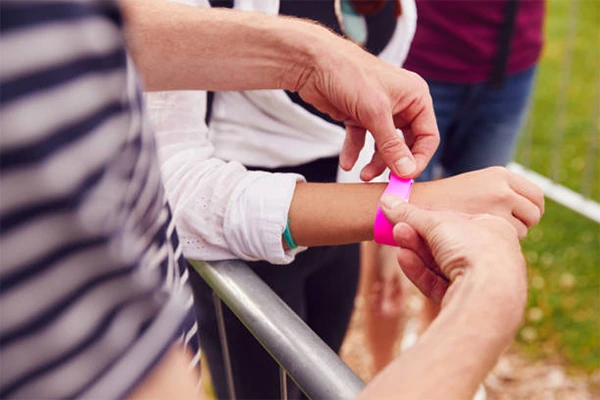
Digital credentials solve this by letting attendees simply tap or scan a wristband, badge, or card instead of presenting something a human has to visually verify. The read happens in a fraction of a second, which sounds minor until you multiply it by several thousand people trying to get through the same set of doors.
The mechanics are quite simple once you see them in practical applications. Each attendee receives a credential embedded with a chip that provides wireless communication with readers positioned at entry points, bag check stations, or VIP areas.
Staff don’t need to inspect anything personally. The system verifies the credentials and grants or denies access instantly. This matters greatly at large-scale events where even a two-second delay per person adds up to hours of total wait time.
Beyond raw speed, automated credential verification reduces the human error that comes with manual inspections. Tired staff working a twelve-hour shift are far more likely to miss a forged ticket or wave someone through incorrectly than a reader scanning a verified chip.
For events involving paid upgrades like backstage access or premium seating, this carries real financial impact, since unauthorized access directly affects revenue.
Concerts, conferences, and sports events all utilize these virtual credentials a little differently, even though the underlying technology remains the same. A music festival might issue wristbands that double as cashless payment tools at concession stands, while a conference badge usually needs to track session attendance for continuing education credit.
Sports venues tend to focus on tiered access, separating general admission from field passes without delaying the line for everyone else.
A few common credentialing scenarios across event types include:
Matching the credential type to the event format makes a real difference in how smoothly the whole operation runs.
Did You Know?
Digital credentials often feature single-click sharing to social media, allowing fans to show off their concert attendance and milestone badges directly on their professional profiles.
Speed and convenience matter, but credentialing systems also play a serious security role for venues handling thousands of strangers in one location. Properly implemented access control RFID tags make it far harder to forge or duplicate access credentials compared to a printed ticket that can be photographed and reprinted. That added layer of protection matters most at high-profile events where ticket fraud and unauthorized access carry genuine safety implications, not just lost revenue.
This becomes more relevant for events with tiered pricing, where someone might try to use a general admission ticket to sneak into another section. A reader-based system flags that mismatch almost instantly, rather than depending on a staff member to recognize a fake VIP wristband.
Venues handling high-value backstage or sponsor areas tend to see the clearest return on tightening this layer of access control.

None of this technology matters if attendees don’t notice the difference, and the truth is, they do, but in a different way than organizers expect. People rarely praise a smooth process out loud, but absolutely remember a frustrating one.
Digital cerentialing’s biggest contribution to attendee experience is mostly invisible, removing friction that attendees would otherwise complain about for days later.
As ticketing fraud and unauthorized resale continue causing headaches for organizers, the appeal of credentials that are difficult to copy or transfer keeps growing. Conferences benefit from the bonus of attendance verification tied directly to professional credit requirements, which paper sign-in sheets never reliably handle.
Whether the goal is faster gates, tighter security, or better data on who actually showed up, digital credentialing is quickly becoming the default rather than the exception across live events.
Ans: The following are the scenarios:
Ans: Beyond raw speed, automated credential verification reduces the human error that comes with manual inspections.
Ans: Digital credentials let attendees simply tap or scan a wristband, badge, or card instead of presenting something a human has to visually verify.
Ans: Slow entry doesn’t just ruin the experience of attendees but also delays the entire event schedule and creates dangerous crowding near gates.
