

Anyone can build a shiny trading interface faster than they can build a trustworthy financial company. Charts react to a swipe, and deposits land in seconds. But none of that tells you which company gets your money, who supervises it, or how you will get your cash back.
That gap is where trading app safety starts. The app itself is only the surface. Underneath sit a legal entity, an account agreement, payment channels, custody arrangements, and an execution system. A broker like Versus Trade can be judged by those layers, while screenshots and store ratings remain supporting evidence, not proof.
A search for “is it safe to deposit money” usually returns reviews, star ratings, and lists of popular app features. The evidence that matters more is operational. A legitimate platform tells you which company runs the account, lists the products it provides, and publishes its terms before you fund it.
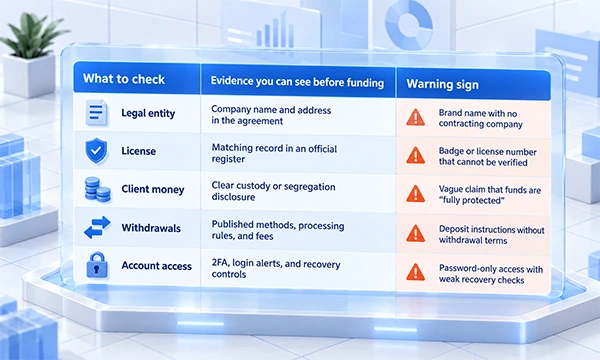
The app store listing should name the developer and link clearly to the legal entity in the client agreement. You can compare that legal name against a regulator’s register. Contact details, a physical address, and the governing jurisdiction should match on the website, the agreement, and the payment page. One small mismatch doesn’t prove fraud, but several of them deserve a closer look.
You should also review the fee disclosure. Spreads, commissions, overnight charges, currency-conversion costs, and inactivity fees can change what an account costs you. A clear platform spells out its payment and withdrawal rules, including any requirement for withdrawals to return to the original funding source. Store reviews can expose recurring problems, but anonymous praise and complaints are easy to fake.
App usability still matters, because mistakes cost real money. Order controls, pricing, and reliability belong in your comparison. A clean interface matters when you evaluate the best app for stock trading, but it won’t make up for an operator you can’t verify.
The word “regulated” means nothing by itself. Licenses attach to specific legal entities and defined activities, not to a logo that gets pasted everywhere. A global group can run several companies, and the entity that serves an Indonesian resident might differ from the one listed on a European or Australian page.
Indonesia divides oversight by activity as well. OJK supervises financial services and capital-market businesses. On 10 January 2025, the job of regulating and supervising digital financial assets, including crypto assets, moved from Bappebti to OJK. Bappebti remains responsible for regulating Indonesia’s commodity futures sector. So the register you check depends on what the app provides and which company signs the agreement.
Here is how to know if a claim means anything: compare four details, the legal name, license number, permitted activity, and official website or contact information. A real registration for one business does not authorize an unrelated app. A license covering securities does not automatically cover every derivative, crypto service, or deposit product promoted under the same brand.
Broker regulation does not guarantee profits or stop every failure. It sets conduct, reporting, and regulatory obligations within a jurisdiction. Compensation arrangements, complaint routes, and retail protections differ. An offshore broker may follow the rules of its home jurisdiction while having complaint and compensation arrangements that differ from those available under Indonesian law.
Online trading firms run under different regulatory models. The comparison that matters is between the entity in your account documents and the protections that apply to that account.
Disclosures should separate custody arrangements from trading-risk controls. Segregated client accounts usually mean customer money is kept apart from the broker’s operating funds. That lowers the risk that routine company expenses get paid from client balances. It does not insure the money against trading losses, cybercrime, or every form of insolvency.
The wording in materials that help you learn about online trading and CFDs matters. An app might refer broadly to “secure funds” without naming the bank, custodian, legal arrangement, or relevant rule. A disclosure that explains where client money sits and how it gets treated tells you more than a shield icon on the deposit screen.
Negative balance protection covers a different risk. Where offered and applicable, it may prevent an eligible account from owing more than its available balance after leveraged positions move sharply. Conditions vary by entity, customer category, and product. It does not replace segregation, and it does not guarantee that you can recover the amount you deposited.
KYC verification is another normal control that can feel inconvenient during onboarding. Regulated financial firms usually collect identity and address information to meet compliance duties. Requests should come through an authenticated site or mobile app, with a privacy policy that explains how personal data gets handled. A demand to send identity documents to a person through an informal messaging account is a very different situation.
You can see strong security at several points. Two-factor authentication adds a second step to the login process. An authenticator app or hardware-based method usually avoids some of the interception risks tied to SMS, and a properly implemented second factor gives more protection than password-only access. Biometric access can make a mobile app easier to use, but it should not replace server-side authentication and recovery controls.
Data encryption should cover financial information while it travels and sensitive information while it sits on the service. You can’t audit an app’s entire architecture, but you can look for a privacy policy, limited permissions, active updates, and alerts for new logins, password changes, and withdrawals. Independent security testing or recognized standards can add evidence, though badges still need checking.
The risks get more immediate on a phone. It puts the trading interface, email, SMS, and sometimes the authenticator used to approve a transaction all in one place. For mobile-first trading, device locks, current operating-system updates, and careful reading of notification contents reduce the damage if the handset gets lost or compromised.
Network security matters too. Public Wi-Fi can put your device on an untrusted network, while fraudulent overlays and copied login pages can grab your credentials. An official app store listing lowers the risk of downloading counterfeit or malicious software, but it does not prove that the brokerage itself is legitimate. The developer name should still connect clearly to the provider.
Depositing is built to feel smooth. Withdrawals test the platform’s processes, customer support, and control over client records. Published processing windows can be reasonable, especially when anti-money-laundering checks or a return to the original funding source is required. Silence, shifting explanations, or new fees invented after a request are more worrying.
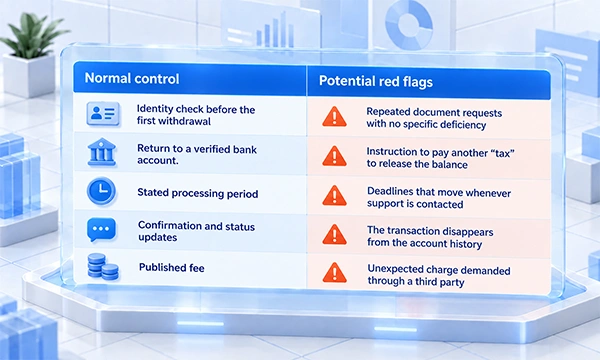
Withdrawal problems are easier to manage when your first deposit is small. A completed test withdrawal does not prove the platform is safe, but it shows that one withdrawal went through successfully under those conditions. Keep records of confirmations, chats, and transaction references in case a complaint follows.
Knowing how to spot a trading scam means watching behavior as well as software. Pressure to deposit right away, guaranteed returns, remote-access requests, and instructions to send money to a personal bank or crypto address are serious red flags. Fabricated profits that you can’t withdraw and customer support that turns aggressive when you refuse to add more money are red flags too.
An app can pass the operational checks and still give you access to investments that lose value. Regulation, authentication, and segregation address different failures from margin, volatility, and poor trade decisions. Getting familiar with the interface also cuts down on avoidable errors. A MetaTrader 5 guide can explain order controls before you risk live funds.
“Trading is often reduced to one question: Will it go up or down? But markets don’t work in isolation. There’s always another side, another asset competing for capital.”
Co-Founder and COO at Versus Trade—Yurii Matkovskiy
Advanced tools can make online trading look simple. Real-time market data and analytics don’t show every risk a position carries. Diversification cannot turn speculation into a guaranteed investment.
Evidence should form a chain: the right entity, a verifiable license, clear custody, credible cybersecurity, and withdrawals that work. A glossy app proves very little.
By Versus trade Partnership Product Lead—Karyna Tsyhanok
