
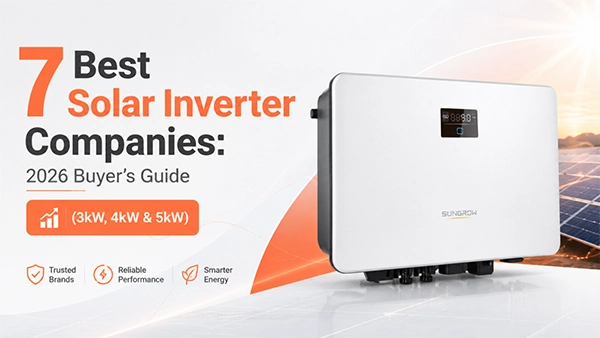
Solar inverters have advanced drastically. Choosing the right one is no longer just about comparing the prices, but comes down to a point of choosing how many years it will last and perform efficiently.
But with the wide range of options available in the market – a3kW, 4kW or 5kW – it becomes a bit confusing to find the right one.
This detailed guide will help you explore the leading brands in the solar energy landscape, focusing on their benefits and ideal use cases to end on the most suitable one.
Key Takeaways
- Selecting the right inverter depends on specific energy usage, specific budget considerations and present roof conditions.
- Solely relying on price is not a suitable approach. It is always better to consider warranty and safety features.
- Brands like Growatt stand out as an entry-level residential string supplier – fitting both the budget and brand considerations.
Separately evaluating each brand might be a bit time-consuming. Below is a quick comparison of 3-5kW on-grid inverters:
| Brand | 3kW / 4kW / 5kW Models | Peak Efficiency | Max Input Voltage | Standard Warranty | Price Tier |
|---|---|---|---|---|---|
| Sungrow | SG3.0RS / SG4.0RS / SG5.0RS | 98.1% | 600 V | 10 yr (extendable) | Mid |
| Huawei | SUN2000-3KTL-L1 / 4KTL / 5KTL | 99% (L1 series) | 600 V | 5 yr | Mid–High |
| SMA | Sunny Boy 3.0 / 4.0 / 5.0 | 97.0% | 600 V | 5 yr | Premium |
| Fronius | Primo GEN24 3kW / 4kW / 5kW | 98.1% | 800 V | 5 yr | Premium |
| GoodWe | DNS G3 3–6kW | 97.6% | 550 V | 10 yr | Budget–Mid |
| Growatt | MIN 3000TL-XH / 5000TL-XH | 98.2% | 550 V | 5 yr | Budget |
| SolarEdge | SE3000H / SE4000H / SE5000H | 99.0% (weighted) | 480 V | 12 yr | Premium |
With the wide range of options available in the market, it becomes a bit challenging to find the right one. Below are the best 7 on-grid solar inverter brands:
Sungrow is best for buyers who need proof of large-scale efficiency, a 10-year warranty at mid-market price, and a credible global service site.
Founded in 1997, Sungrow exported 198 GW of inverters globally in 2025, holding an approximate 30% global market share by volume. The company partnered first alongside Huawei in Wood Mackenzie’s 2026 Global Solar Inverter Manufacturer Ranking, the only two brands to hit every eight desired criteria.
The SG3.0/3.6/4.0/5.0/6.0RS residential string range offers 3kW, 4kW, and 5kW in one product family, with a listed maximum efficiency of 98.1% and a 600 V max PV input voltage.
The SG5.0RS-ADA variant features a third MPPT for three-orientation roofs, a configuration rare at this price class.
Built-in are fault circuit interruption (AFCI), integrated Type II DC and AC surge protection, and a C5 corrosion protection rating are part of the default across the RS range — hardware-level safety features that most often include optional add-ons from other manufacturers.
Standard 10-year warranty backed by a service network spanning 100+ countries; Sungrow’s 198 GW combined shipment base means parts logistics runs at genuine scale rather than regional estimates.
Consider if: You want a single supplier that accurately covers the 3–5kW residential range and shifts to commercial if the next project is larger.
For homes in bustling markets with Huawei distribution that want a single-vendor solar-plus-battery ecosystem, it is one of the most considerable option.
Founded in 1987, Huawei’s FusionSolar had offered the division clean energy for 4.2 million homes in over 170 countries by the end of 2025.
The SUN2000-L1 single-phase series (3kW, 4kW, 5kW) has a specified output efficiency of up to 99% with dual MPPT trackers and a 600 V max input voltage.
Standard warranty is 5 years, extendable to 20 years; the brand documents an annual inverter crash rate below 0.5%.
Consider if: You are assembling in an industry with active Huawei distribution and want a fully merged solar-plus-battery ecosystem from a single vendor.
Watch for: Huawei exited the UK residential solar market in January 2026; buyers in targeted markets should test your local distributor availability before defining.
Serve best in long-established criteria of bankability, grid-code acceptance in European utility projects, and projects where SMA’s 40+ year track record is an acquisition need.
Founded in 1981, SMA Solar Technology AG is one of the world’s oldest and most reputable inverter manufacturers.
The Sunny Boy 3.0–6.0 single-phase series covers 3kW, 4kW, and 5kW with a verified peak efficiency of 97% and dual MPPT trackers, functioning across a -25°C to +60°C temperature range.
An integral shade regulation algorithm (SMA ShadeFix) is included as standard and can work without external optimizers.
Consider if: The project require features European-manufactured equipment or the lender requires a brand with 25-year warranty extension access.
Watch for: SMA shared the withdrawal of its Sunny Boy and Sunny Tripower lines of goods from the Australian residential and commercial market in April 2026; confirm regional offerings before specifying.
Suitable for mid-range residential starts where installer choice runs to Austrian engineering, active cooling, and flexible multi-orientation string design.
Founded in 1945, Fronius is known for manufacturing DC power equipment for over 75 years, with its photovoltaics division now operating in residential and commercial markets across Europe, Australia, and the Americas.
The Primo GEN24 Plus covers 3kW, 4kW, and 5kW (single-phase) with a published peak efficiency of 98.1%, dual MPPT trackers, and a max 800 V input voltage.
Consider if: The roof has three or four distinct orientations and you want to avoid per-panel optimizer cost while still offering string-level choice.
Watch for: Fronius inverters use active fan cooling, which increases noise compared to passively cooled alternatives; placement near living spaces warrants checking acoustic specs.
Great option for residential projects that need a 10-year standard warranty at an entry-to-mid price point.
Founded in 2010, GoodWe serve residential and commercial inverters across more than 100 countries and start manufactures inverters for General Electric and other OEM partners under licensing needs.
The DNS G3 series covers 3–6kW single-phase with 2 MPPTs and an 80 V default startup voltage.
Consider if: The project budget leans mid-range pricing with a longer standard warranty than most Chinese peers normally include at this price point.
Watch for: Field reports from high-ambient-temperature climates note GoodWe units can derate more actively than European counterparts in sustained heat above 45°C .
Cost-sensitive residential installations adds up-front inverter price is the immediate restriction.
Founded in 2010, Growatt is one of the higher-volume residential inverter manufacturers globally, with products served across Europe, Australia, Asia, and the Americas mainly.
The MIN 3000TL-XH and MIN 5000TL-XH serve 3kW and 5kW on-grid output with a published extreme efficiency of 98.2% and 2 MPPT trackers across a DC input range of 80–550 V.
Remote element adjustment and firmware updates are available via the ShinePhone monitoring app.
Watch for: The 5-year standard warranty is shorter than the 10-year presented by Sungrow and GoodWe at equivalent price points; factor in the extension cost when comparing total cost of ownership.
Suitable for roofs with slight shading, complex multi-orientation arrays, or buyers who want panel-level reporting and the option to expand into smart home energy management.
Founded in 2006, SolarEdge developed the DC optimiser-plus-fixed-voltage-inverter architecture that now comprises its commercial portfolio.
The SE3000H, SE4000H, and SE5000H Home Hub inverters have a published estimated efficiency of up to 99% and support up to 200% DC oversizing.
Standard warranty is 12 years, extendable to 25 years.
Consider if: The roof has powerful shading from chimneys, dormers, or trees, and panel-level performance tuning is needed to protect system yield.
Watch for: Every SolarEdge installation needs DC optimizers fitted to each panel, adding equipment and installation cost; total installed cost runs higher than conventional string inverter setups of equivalent capacity.
Also, explore how to integrate inverters into business energy management systems.
At its core, a solar inverter is a long term investment that makes it a smart step to invest in a brand that not just makes fake promises but has served customers with positive reviews for many years. While a range of producers meet the budget criteria, brands like Sungrow have always performed considerably over the last few years.
The fact is to take some time and compare the prices, brand authority and read reviews for a better investment.
Ans: There is no universal best brand. One that meets your specific use case such as budget and brand considerations is the best one for you.
Ans: Solar inverter is an asset that is considered a long term investment. Considering this, it is best to evaluate and then choose a suitable one.
Ans: Yes, a 3kW solar system can smoothly run an air conditioner, but it depends more on the type of AC and your system setup.
