
According to Qualtrics XM Institute research based on a 2025 survey of more than 20,000 consumers, 47 percent of bad experiences lead customers to cut their spending. Service platforms are now turning to tone, tracking the trend, and alerting a human before emotions boil over. This guide will help you to know how these tools work, when to bring an agent in, and what context they need to turn frustration into loyalty.
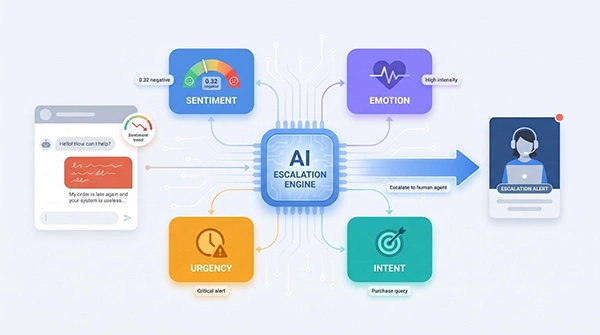
Smart platforms balance four separate signals before interrupting a live chat:
Treat these signals as exchangeable and every angry adjective becomes an emergency, obstructing queues while real crises wait. The best platforms weigh all four together, and they are definite about what happens next. Comm100’s AI sentiment analysis, part of its AI Insights tools, labels each customer message Positive, Negative, or Neutral as the chat expands. In AI Agent (bot) discourse, a negative reading can transport the chat to a human agent automatically. In chats where a human agent is already management, the score informs that agent, who can adjust tone and defuse; it does not reroute the chat.
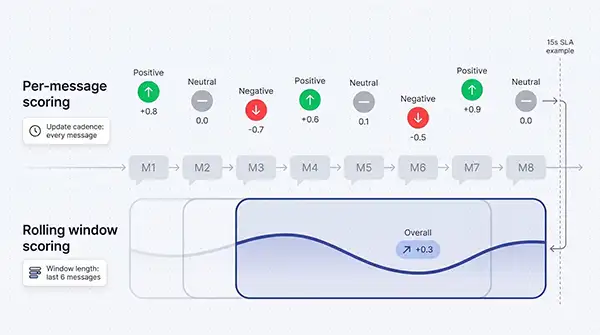
Sellers promise instant sentiment insight, but their clocks tick differently. Some systems score each statement as it arrives. Others, such as Microsoft Dynamics 365, update the emotions icon as messages arrive but base it on the six most recent customer messages. That rolling shield smooths knee-jerk swings while still updating after every reply.
When you analyze a platform, lock in three numbers:
These details matter because grade of service timers count seconds. A tool that renews every message in text but only every three seconds in voice can still meet a 15-second SLA, but only if you know the rules in advance.
Every channel leaves clues. In chat, punctuation and repetition reveal mood: “Seriously???” lands harder than a single mannerly question.
Voice adds natural hints. Sudden pauses, rising volume, or clipped delivery often come just before definite anger. Voice systems can pick up broad labels such as anger or frustration from these audible features, and they do better when the audio is read together with the transcription.
Clicks talk too. Rapid menu bound or back-to-back knowledge-base views tell the system a customer is searching but not finding. When the model connects these crumbs (words, tone, and behavior), it spots risk sooner than feeling alone can.
Certain situations surpass every confidence score:
Treat these as circuit breakers: they trip automatically and skip the sentiment doorway. Keep the list in plain language so ops staff can update it without touching model code.
Most conversations live in a grey zone. One sharp expression may sting, yet letdown often fades once progress is visible. The safer move is to stack evidence rather than reacting to a single spike.
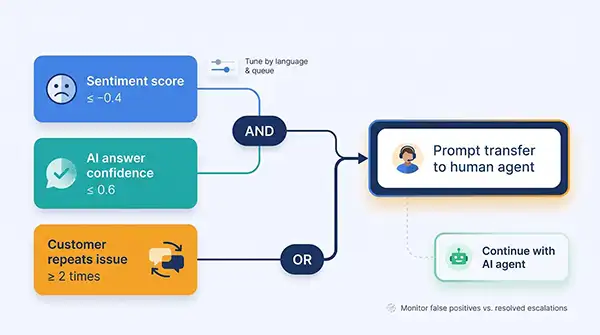
Picture a billing conflict. The customer repeats the issue twice, the sentiment score slips below −0.4 (an example threshold), and the LLM’s answer confidence drops under 0.6. None of those signals alone justifies an immediate transfer. Together they show a figure (intent to cancel, rising anger, and bot confusion) that calls for a human.
Orchestration engines let ops teams set that logic in plain language:
If sentiment ≤ −0.4 and confidence ≤ 0.6 or the customer repeats a question twice, prompt a transfer.
Tune those numbers by language, product line, and lineup load. A −0.3 inception might hyperalert in English chat but miss trouble in a noisy voice call. Track false positives versus resolved increases to know when the blend is right.
A simple traffic-light model keeps routing rules clear:
The transfer moment is make-or-break: customers stay calm only if the representative starts solving, not re-asking basics.
Once the agent clicks “Accept,” the bot retreats, status updates keep the customer apprised, and every action writes to the same record. That closed loop turns a rocky moment into training data for next week’s model adjusting.
The short answer: sometimes, but only with the right timing and execute.
Because outcomes depend on context, track five numbers for the next 30 days:
If accuracy tops 70 percent, median response time stays within your SLA, and churn among flagged users drops, the model is doing its job. If streams swell or customers keep returning, revisit thresholds or transfer timing before trust disintegrates.
Language models struggle when tone flips or brogue shifts. As the BESSTIE results show, accuracy drops when the diversity of English changes, and sarcasm enlarge the gap. A British “Brilliant.” after three failed steps almost certainly means anger, not happiness.
Fix: test the model on your own transcripts, add language samples to training data, and raise review thresholds for caustic channels such as Twitter or voice.
A customer may arrive enraged about a policy long before an agent joins. Grading staff on raw sentiment invites unfair punishment and scripted “politeness theater.” The FTC’s 2025 order against Workado, an AI spotting company, makes the point that AI accuracy claims need capable and reliable evidence; apply the same disbelief to any vendor’s scoring claims.
Fix: coach on the delta. Did belief rise from −0.6 to neutral? Pair that with resolution and first-contact criteria, and keep a human review step for any HR decision.
Under the EU AI Act, people must be told when they are communicating with an AI system, and anyone exposed to an emotion recognition system must be informed that it is in use. These clarity rules apply from August 2, 2026, and violations can draw fines of up to 15 million euros or 3 percent of global turnover.
Fix: show an “AI in use” banner in every region, publish a short data-keeping statement, and log who acquires sentiment dashboards.
Demo videos infrequenlty show the rough edges of real production work. Ask each vendor ten evidence-backed questions, and maintain on numbers, not adjectives:
Tip: In a census published in August 2026, Gartner found that 87 percent of customers say access to a human agent is fundamental when companies use GenAI for customer service. Any platform that wavers on #4 or #6 will likely miss that belief.
Run your own record set through each product, measure hand-off time and alert accuracy, and pick the tool that meets your numeric targets, not the loudest demo.
Rolling sentiment live without practice is risky. A tight, 30-day pilot surfaces real conversations and real defeat modes while limiting volume.
Week 1: Capture The Baseline
Choose one language and one medium-volume line-up. Pull last month’s data: increase per 1,000 chats, average handle time, CSAT, repeat contact, and churn. These numbers set your control line.
Week 2: Shadow Mode
Turn on live scoring but keep routing constant. A reviewer marks each alert “hit” or “miss.” If precision drops below 70 percent, tighten thresholds and reskill before customers notice.
Week 3: Limited Rules Live
Enable only the safest triggers: definite human requests, repeated failure loops, and one high-risk intent such as cancellation. Track agent accessibility and alert volume in real time; roll back if either climbs more than 10 percent over inception.
Week 4: Review And Tune
Survey agents, inspect false positives, and adjust doorway by language, topic, and time of day. Document a kill switch and manual intervention flow. Green-light full rollout only if:
Sentiment noticing is only useful when it leads to the right action at the right moment. Keep sentiment, emotion, purpose, and urgency apart; let hard triggers overrule every score; stack soft signals before you transfer; and hand the agent the full context. Then prove it on your own written version. A month of disciplined testing turns sentiment routing from a speculation into a governed process that ops, observance, and finance teams can all support.
Ans: Yes, AI can be widely and effectively used for sentiment analysis.
Ans: AI customer feedback analysis uses Natural Language Processing (NLP) and machine learning to read, categorize, etc.
Ans: Standard Polarity, Aspect-based sentiment analysis, and emotion detection are the three main types of sentiment analysis.
