
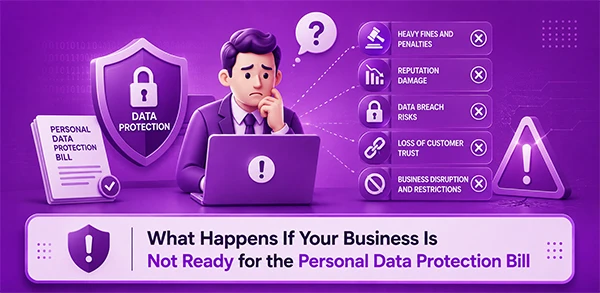
Besides being an IT or legal concern, data privacy can directly affect your company’s finances, operations, customer relationships and reputation.
According to IBM’s 2025 Cost of a Data Breach Report, the average cost of a data breach in India reached ₹22 crore, a 13% increase from the previous year. Now, businesses also have to account for India’s evolving data protection regime, which can impose penalties of up to ₹250 crore for certain violations under the Digital Personal Data Protection Bill, 2023 (DPDP Act).
So, what happens if a business is still not prepared?
Certainly, it’ll not be just a regulatory fine. Poor data protection practices can expose your organization to financial penalties, operational disruption, contractual disputes, customer distrust and expensive remediation efforts.
Terminology has changed. India’s proposed Personal Data Protection Bill (PDPB) evolved into the DPDP Act, 2023. The government subsequently notified the DPDP Rules, 2025, with the Act and Rules being brought into force in phases.
The takeaway is that preparing for data protection requirements is no longer a last-minute compliance exercise. If your organization collects, processes or stores personal data, now is the time to identify gaps and put the right safeguards, processes and accountability mechanisms in place.
This blog explores the potential consequences of being unprepared for DPDP compliance and the key steps businesses can take to become compliance-ready.
Complying with data privacy regulations is key for smooth business operations. Here’s what may happen if your business isn’t ready for the Personal Data Protection Bill:
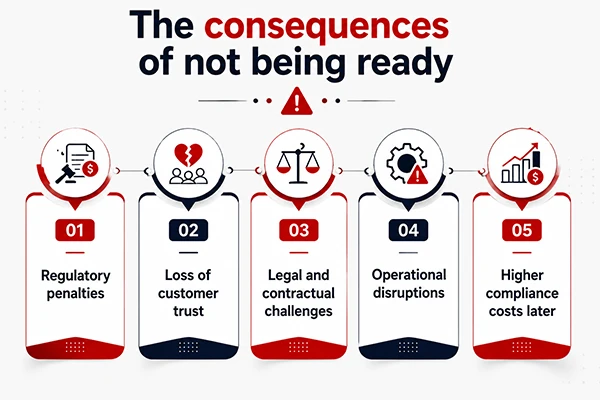
If your company fails to showcase compliance with the Personal Data Protection Bill or DPDPA, appointed authorities can impose substantial financial penalties. Depending on the nature and impact of the violation, the fine may go up to ₹250 crore.
Privacy charges, personal data mismanagement and publicised compliance failure can sabotage customer trust. Once the trust is destroyed, rebuilding it requires significant time, investment, and demonstrating better data handling procedures regularly.
If privacy requirements are not met, it may lead to contractual disputes, indemnity suits, termination of vendor agreements, or legal action from affected stakeholders.
If a problem occurs, organizations may need to redesign their applications, tweak internal processes, rewrite contracts, conduct emergency security improvements, or eliminate current data processing activities to address compliance gaps. These remediation measures disrupt and delay normal business operations.
It’s a higher investment to incorporate security and privacy controls into existing systems than to create a security system that supports DPDPA compliance from the beginning.
One of the most important aspects of the Digital Personal Data Protection Act is its penalty framework. Rather than prescribing criminal punishment or imprisonment, the Act imposes financial penalties to encourage compliance. The penalty depends on aspects including the nature of the violation, its severity, and whether it was repeated.
The following are the major penalties and punishments under the DPDPA:
Clients provide organizations with their personal data, trusting that it will be protected. Companies are expected to preserve that trust by demonstrating stringent security towards their data.
If a company fails to implement security tools and a breach occurs due to the absence of effective measures, it’s at risk of major financial trouble. Security neglect can lead to a fine up to ₹250 crore, which is one of the highest penalties under the Act.
If a personal data breach occurs, data fiduciaries are supposed to immediately report to concerned data principals and the Data Protection Board of India.
A penalty will be charged under DPDPA if the company chooses to not inform or causes delay in notifying the required parties within the prescribed timelines. This penalty can go up to ₹200 crore, as delay in reporting leads to delay in incident response management.
Significant Data Fiduciaries are held in high esteem in matters of data security, as they possess large amounts of sensitive data of customers. These companies are obliged to fulfil even stricter requirements as they are more prone to cyberattacks.
These institutions are bound by additional obligations like appointing a data protection officer, conducting audits and instilling advanced tools for fool-proof security.
Inability to comply with these commitments can result in penalties of up to ₹150 crore.
DPDPA takes minors’ data just as seriously.
The Act imposes more stringent rules on companies that process children’s personal data or people with disabilities who rely on lawful guardians.
Institutions that fail to meet obligations, including obtaining verifiable parental consent, or are found engaging in prohibited processing activities, may face penalties of up to ₹200 crore.
The DPDPA has authorized the Data Protection Board of India to charge financial penalties as and when required, even if the offence is not specifically mentioned under the Act. Organizations may face regulatory action if they practice non-cooperation, either with the panel or the regulatory framework.
DPDPA does not prescribe imprisonment for non-compliance, but it can have a wider impact that goes beyond legal consequences. If found guilty of non-compliance, public disclosure of violations can lead to loss of customer trust and brand stature, disputes with clients and business partners, an increase in regulatory evaluations and compliance checks, loss of business opportunities, and higher remediation costs.
Thus, businesses must get DPDPA compliance-ready before they get exposed to failure, losses and penalties.
Here are some practices your business can use to prepare for compliance:
Now that you’ve understood what’s at stake- which is quite literally your entire firm. It is advisable to take DPDPA compliance as a core priority, especially if you deal with customer data daily. Otherwise, financial penalties, punishments, operational troubles, disputes, and reputational damage may be closer than you think.
Businesses that treat compliance proactively not only rescue themselves from risks and fines but also rank above in terms of competition from other companies by building customer trust and relations. If you want to take the proactive path towards compliance, consider getting a consultation done with experienced firms, including CyberNX, that deliver excellent Personal Data Protection Bill consultation services and can help you excel beyond just necessity.
Ans: The DPDP Act, 2023 is India’s framework for regulating the processing of digital personal data.
Ans: The DPDP Act provides for financial penalties of up to ₹250 crore for certain contraventions, including failure to take reasonable security safeguards to prevent personal data breaches.
Ans: Non-compliance can result in financial penalties and may also create operational, contractual and reputational risks.
