
Today’s generative media tools can create breathtaking visuals in seconds, but achieving consistency across multiple images remains a major challenge.
While generating a single impressive image is easier than ever, recreating the same character with identical features, clothing, and proportions from one output to the next is often difficult.
Once you move beyond a single image and start creating videos, ad campaigns,or ongoing social media content. Random seeds and the stochastic nature of diffusion models mean that a character’s identity is inherently unstable. To achieve visual continuity, teams are moving away from the “one-shot” generation mindset.
Instead, they are adopting a “seed-and-correct” pipeline where a high-fidelity foundation is refined in a dedicated AI Photo Editor before being used to anchor temporal motion.
Key Takeaways
- Exploring the identity drift problem in generative media
- Establishing the source of truth with high-fidelity models
- Assessing precision refinement via the AI photo editor
- Bridging static assets to temporal stability
Identity drift occurs because most large-scale models prioritize aesthetic “correctness” over historical consistency.
Relying solely on text-to-image or text-to-video instructions is a low-probability strategy for anyone doing serious brand work.
A brand’s mascot or a recurring narrative character cannot afford to look like a cousin of themselves in the next shot.
The solution is the creation of a “Source of Truth”—a single, high-fidelity anchor asset that serves as the definitive reference for every subsequent generation. This asset must be more than just a lucky generation; it must be a curated, edited, and technically sound blueprint.
The pipeline begins with selecting a foundation model that offers high prompt adherence and structural integrity.
In this initial phase, the goal is to define the character’s “identity markers.” These include:
Once a base image is generated that matches the general intent, it is rarely production-ready.
There is an inherent uncertainty in the first output; maybe the eyes are slightly asymmetrical, or the hair clips into the shoulder. This is where the workflow transitions from generation to precision editing.
Before moving into video or further iterations, the anchor image needs a high-resolution pass.
If the video model sees noise where a pupil should be, it will attempt to animate that noise, leading to the dreaded “blinking eye” artifacts or flickering skin textures.
Using an integrated upscaler ensures that the source of truth is sharp enough to survive the compression of the video generation process.
Directing AI is as much about what you remove as what you create. A professional AI Photo Editor is the essential bridge in this process.
Rather than re-rolling a prompt a hundred times to fix a wonky hand or a distorted earring, creators use targeted tools to enforce consistency manually.
One of the most effective ways to maintain character stability across a campaign is to generate the “perfect” face once and then use Face Swap technology to project that identity onto different poses or scenes.
Similarly, an Object Eraser is used to prune the scene of distracting elements that might confuse a video engine.
If a character is meant to walk through a room, but the background contains a stray floating artefact (a common AI quirk), the video model will likely try to turn that artefact into a moving object, ruining the shot.
In production, errors compound.
A small anatomical glitch in a static image becomes a horrific transformation when animated at 24 frames per second.
This level of manual oversight is what separates hobbyist “prompt engineering” from a professional creative operations pipeline.
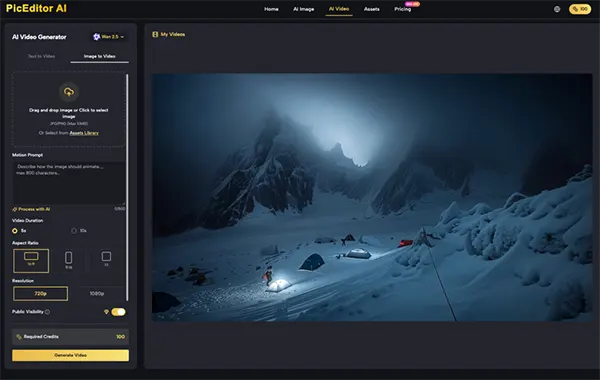
Once the refined anchor image is finalized, it moves into the temporal phase.
The structural integrity of the output from the Photo Edit acts as a rigid constraint for the video engine.
When you upload a high-fidelity image as a reference, the AI isn’t just looking at the prompt; it is using the pixels of the source image as a starting point. This is why “Subject Permanence” is much higher in I2V workflows compared to Text-to-Video workflows.
It isn’t just the character that needs to stay stable; the scene must also remain consistent.
If the source image has a specific warm, golden-hour glow, the video engine will attempt to maintain that luminosity across the motion path, provided the source pixels are clear and well-defined.
Despite the rapid advancement of these tools, we must acknowledge the current technical limitations.
Even with a perfect source image and a high-end video engine, AI still struggles with complex physics.
There is a high degree of uncertainty when a character turns 180 degrees; the model has to “invent” what the back of the head looks like based on the front, which can lead to sudden shifts in hair length or texture.
Currently, no automated system can guarantee 100% temporal consistency for durations longer than a few seconds without significant manual rotoscoping or post-production cleanup in a traditional NLE (Non-Linear Editor).
Another area of uncertainty is “lighting bleed.”
When a character moves past a vibrant object, the AI often over-emphasizes the color reflection on the skin, sometimes changing the skin tone entirely for a few frames.
The issue often stems from the way diffusion models process :
That’s why a human review is often necessary–to catch small inconsistencies, such as a character’s skin taking on an unintended green tint simply because they were standing near a plant or another coloured object in the scene.
The most successful AI creators are those who view these tools not as “magic buttons,” but as components of a complex assembly line.
The “Source of Truth” method—generating, editing, upscaling, and then animating—is currently the only reliable way to produce content that meets commercial standards for identity and continuity.
This approach acknowledges that while generative AI is incredible at creating “stuff,” it still requires human-led architectural oversight to create a “story.” Visual continuity isn’t an accident of the algorithm; it is a result of deliberate technical intervention at the most critical points of the production pipeline.
Maintaining character identity across AI-generated content is essential for creating a cohesive and believable visual experience.
By establishing clear design guidelines, using consistent reference materials and refining materials. As AI tools continue to evolve, a structured approach to character management will remain key to preserving brand consistency.
