
“Meta,” just like many terms used in gaming, is easy to understand until you try to find out what it really means. It is used by players in League of Legends to talk about popular champions, builds, roles, and strategies; however, the term metagaming can also be used to make choices using external information in games.
The difference sounds small, yet it explains why the term causes so much confusion across gaming communities. Understanding it becomes easier once you separate the state of the game from the actions of the player.
There are several meanings of metagaming, which one needs to know before using the term.
The metagame, shortened to “the meta,” is the set of strategies, champions, builds, and role assignments the player base currently believes are strongest. It is a snapshot of consensus. A statement about a meta champion indicates what the consensus is at a certain point in time, and not any rule.
Metagaming is the act of making moves within a game based on information that was gathered outside the game. The definition of metagaming that holds up best comes from a peer-reviewed 2021 paper in the International Journal of Esports by Kokkinakis and colleagues, which frames it as selecting or creating an optimal playing strategy using means outside of the game itself to affect the outcome of a game. That paper is also the reason the term metagame and the act of metagaming should be kept apart: League of Legends players collapse them constantly, and the collapse is where the confusion starts.
In the League of Legends community, the current metagame covers which champions are strong, what you build on them, which of the three lanes they belong in, and how a team should spend its first fifteen minutes. It is the game within the game: an ongoing argument about the optimal way to play that runs above the matches themselves and updates faster than most players can keep up with.
It is nothing official. Riot Games never releases a meta. No patch note declares a champion meta. The meta game is an emergent read on the rules, assembled from millions of matches, professional results, and data sites, and it is descriptive rather than binding. You can ignore it entirely. The game will not stop you. The game does not care if you choose to disregard it.
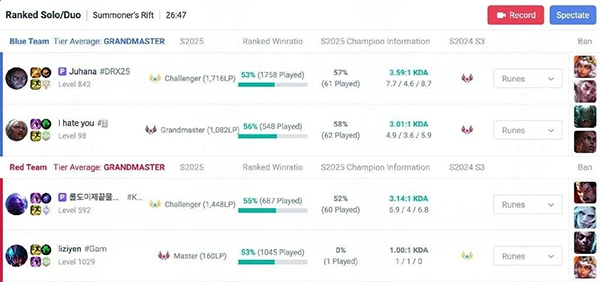
The older and stricter sense is any in-game decision informed by information the game itself never gave you. You open a match history site before champion select, see the enemy AD carry has two hundred games on one champion and almost nothing else, and you ban that champion. Nothing inside the game handed you that. The game did not give you that information; you had to go find it.
That is metagaming in its purest form, and in League of Legends it is entirely normal. That does not apply everywhere, however.
Metagaming predated video games. It grew out of game theory and the study of how players model each other, then landed in tabletop role-playing and card games, where the community argued about deck metas long before anyone queued for Summoner’s Rift.
In a role-playing game, metagaming is a dirty trick. Your character does not know the troll regenerates unless fire or acid touches it. You know because you read the monster manual. Acting on that split breaks the fiction everyone showed up to build, so tables ban it in their house rules, and role-play servers in online gaming list it as a reportable offense. The objection is not about fairness. This is not a matter of balance; rather, this is your character making something that he has no idea about.
League of Legends does not protect any fiction. There is no character whose knowledge can be separated from yours, so the exact same behavior, studying opponents and preparing counters, gets a different name: preparation. The word travels across game genres, but the moral charge attached to it does not.
While we are cleaning house, kill the backronym. “Most effective tactics available” is a folk etymology invented after the fact, and it circulates widely enough that student guides repeat it. Meta is a Greek prefix meaning after or beyond, and the “beyond” sense reached English through a later Latin misreading of the ordering of Aristotle’s books. The gaming usage descends from “metagame,” the game that wraps around the game. Nobody built an acronym. Someone just realized there was a level above the games.
Every metagame of League of Legends begins with an equation that no one at Riot could solve for the players. Summoner’s Rift has three lanes. Teams of five. Minions supply gold and experience, and gold does not duplicate: two champions sharing a lane split one lane’s worth of it, while experience pays each of them 65 percent rather than half. CS, short for creep score, counts the minions you personally land the killing blow on, and it drives the whole economy.
Five players, three lanes. Somebody has to double up, and doubling up makes two players poor. The jungle, the neutral monster camps between the lanes, is the escape hatch: a fourth income stream for a player who leaves the lanes entirely. That solves four. The fifth still has to share with someone.
Season 1 teams tried everything. Double jungle, with two players splitting camps and both ending up underfed. Kill lanes, pairing two aggressive champions who ignored farm and hunted the enemy team instead. Roaming setups with one champion in each lane and floaters cycling between the top lane and middle lane. Most of those strategies were even worse than what they were replacing, which the community realized through losses.
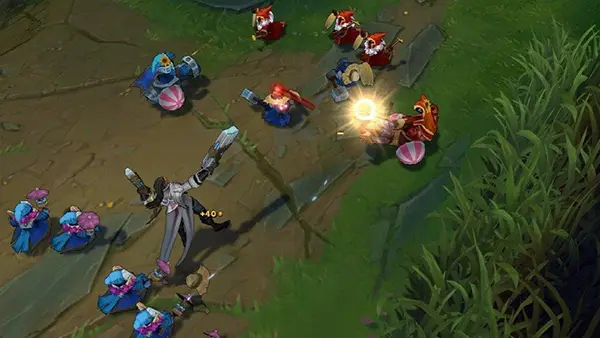
The one that stuck was the 0 CS support: the one who just sits in the bottom lane and does not take any minion kills on purpose. Every last hit goes to the AD carry, a ranged damage champion whose power curve is almost entirely item-dependent and who therefore converts gold and experience into map pressure better than anyone else on the roster. The support instead buys an item that generates income passively, the World Atlas line in the modern game, which pays out for helping kill minions and for trading damage with enemy champions, then upgrades as it earns.
Before this strategy became obvious, it seemed crazy. You are deliberately keeping one of your five players poor in a game where gold is power. The insight is that gold’s value is not equal across champions. A thousand gold spent on a marksman’s first item buys more winning than a thousand gold spread evenly, so the correct move is to concentrate it and let the second player buy utility that scales off vision and crowd control rather than items.
Riot eventually wrote the invention into the rules. Support items carried a minion gold penalty for over a decade, until Riot removed it in patch 26.7, which means a community solution became a game mechanic. Metas are always discovered by the players first.

Competition itself becomes the accelerant. Fnatic won the first World Championship at DreamHack in Sweden in 2011, and both finalists were European teams running that bottom-lane pairing. That was enough. When the two best teams on the planet share a structural choice, the entire player base copies it within weeks, because pro results are the highest quality evidence available about what actually raises your chance of winning.
Korean teams did the same thing later at higher resolution, exporting tower-push timings, vision discipline, and the habit of playing for objectives instead of kills. Bootcamping in Korea became standard preparation for every other region, which is the transmission mechanism by which one region’s metagame becomes everyone’s. Imitation of good players by other good players is the most cost-efficient way to get around a few thousand hours of trial and error.

Four driving forces determine the current metagame, and these act at varying speeds.
Riot’s balance patches move it fastest, landing on a roughly two-week cadence under the year-based numbering the 2026 season uses. The patch chosen for Worlds freezes the competitive metagame for the length of the tournament.
The clearest case of developers steering on purpose is gold funneling in 2018. Players discovered they could route both a lane’s income and the jungle’s income into a single hyper-scaling champion, usually Master Yi, with a support-style enabler beside him.
Tier list third parties are the main source of info for players. Pick rate measures popularity, which is a lagging indicator of what streamers and pros played last week. Ban rate measures perceived threat, contaminated by irritation, since a champion can be banned for being miserable to lane against rather than for being strong. Win rate measures outcomes but is skewed by who chooses to play the champion.
Rank bracket filtering is also important over the headline tier. Mechanically demanding champions underperform in low brackets and spike in high ones, and simple, high-impact champions do the reverse. That is also why the metagame you practice against depends on which bracket you actually queue in, and why some players skip the climb entirely by getting LoL rank boosts through marketplaces like BoostRoyal rather than grinding into the bracket to see how it plays.
Meta strategies also follow a consistent pattern. That same esports paper describes a cycle: exploration after a patch, convergence as the best answers get found, then staleness until a new discovery or the next nerf breaks it open. “What is meta right now” is a question with a recurring rhythm, not a list to memorize.
Ans: In League of Legends, ‘meta’ mostly denotes effective strategies, champions, builds, and roles, while ‘metagaming’ may be understood as utilizing information from outside of the game to make decisions.
Ans: There is no distinction in League of Legends between player knowledge and character knowledge, unlike in the case of the latter.
Ans: Before adopting the common three-lane structure and the bottom-lane duo role of carry and support became a widespread choice, players tried many other combinations.
Ans: Balance patches, the competitive scene, player creativity, tier-list statistics, the popularity of certain champions, and the division of the ranks due to skill differences all affect the metagame.
