

“Privacy is not an option, and it shouldn’t be the price we accept for just getting on the Internet.” — Gary Kovacs (Mozilla CEO)
For European businesses, web hosting is no longer just a technical decision. It is a compliance decision.
Every contact form submission, customer account, newsletter signup, purchase, and analytics event generated data needs responsible handling. With GDPR enforcement continuing across the EU and cybersecurity regulations like NIS2 raising expectations around security and incident management, choosing the wrong hosting provider can create unnecessary legal and operational risk.
European regulators issued €1.2 billion in GDPR penalties in 2025 alone.
The good news is that an EU-hosted cloud does not have to be complicated. The right provider can simplify compliance through EU-based infrastructure, transparent data processing practices, and clear contractual protections.
This guide explains what GDPR-compliant hosting actually means in 2026, the key features to evaluate, and six European hosting providers worth considering.
KEY TAKEAWAYS
- GDPR-compliant hosting involves more than server location; ownership, data processing practices, and contractual protections matter as well.
- Businesses should prioritize providers that offer EU-based infrastructure, Data Processing Agreements (DPAs), encryption, and transparent privacy policies.
- Different hosting providers serve different needs, from beginner-friendly shared hosting to developer-focused cloud infrastructure.
- Choosing the right provider early can simplify GDPR compliance, improve security posture, and reduce future migration costs.
Under GDPR, a hosting company can be treated as a data processor when it stores or handles personal data from EU residents. In practice, that covers nearly every interaction on a modern website, from contact form submissions and customer accounts to payment details, support requests, and server logs.
The risky part is not only where the server sits. Legal control matters too. A provider with EU servers but non-EU ownership may still create questions around access, transfer rules, and disclosure obligations. Schrems II already showed how fragile EU-US data transfer arrangements can be, and ongoing uncertainty around the EU-US Data Privacy Framework keeps many privacy-focused companies cautious.
For SMBs, agencies, healthcare firms, legal offices, SaaS teams, and e-commerce stores, this is not about becoming legal experts. It is about choosing a hosting that makes compliance easier from the start. In 2026, NIS2 adds one more reason to treat hosting as part of business risk, not just IT setup.
The GDPR principles are as follows:
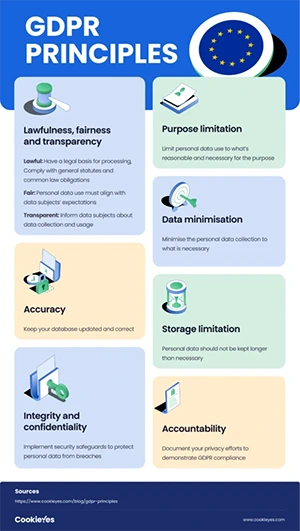
A trustworthy GDPR-focused hosting provider should make compliance-related information easy to find and verify before you become a customer. If the answer is hidden across five pages of legal text, that is already a warning sign.
Not every provider that says “GDPR-ready” meets these points in the same way. The details matter, especially if the website handles payments, medical inquiries, legal forms, or customer accounts.
This is a curated overview, not a ranking. The right choice depends on the company’s size, technical skills, compliance needs, and budget.
NebStack is based in Germany and offers shared hosting, WordPress hosting, VPS Linux, domains, SSL, and business email. It’s a practical starting point for smaller teams that want cloud hosting.
Its biggest advantage is simplicity, offering EU-based hosting, cPanel management, and predictable pricing without overwhelming less technical users. The limitation is scale. NebStack has a smaller product range than providers such as Hetzner or IONOS, so larger infrastructure projects may need more comparison.
Hetzner is also based in Germany, with data centers in Germany and Finland. It is popular with developers, agencies, SaaS teams, and businesses that want strong performance without enterprise-level pricing.
For EU VPS hosting, Hetzner is often on the shortlist because its price-to-performance ratio is strong. It gives technical teams plenty of control, but that is also the catch. Beginners may find it less friendly than a managed website hosting platform, and managed WordPress is not its focus.
IONOS is one of the biggest European hosting brands, with products ranging from shared hosting to VPS, cloud, and dedicated servers. Its data center footprint includes Germany, France, the UK, the US, and Spain.
The advantage is breadth. A small business can start with a simple package and later upgrade. IONOS also highlights DPA availability and ISO 27001-certified data centers, which helps when comparing GDPR compliant web hosting. The drawback is that pricing can feel busy once renewals, add-ons, and optional services enter the picture.
OVHcloud is based in France and operates data centers across Europe. It is a strong option for teams that want cloud, VPS, dedicated servers, and web hosting.
It stands out by combining European ownership with one of the largest cloud infrastructure footprints in the region. Agencies and technical teams may appreciate that range. Non-technical users may not. Support can feel slow, and the interface is not always the easiest place to start.
Well-known in the DACH market, Germany-based Strato offers
Strato can work well for a local company site, a small WordPress project, or a simple European hosting setup. The appeal is familiarity and straightforward plans. The trade-off is flexibility. Developer-heavy workflows, advanced server settings, or custom infrastructure needs may outgrow it.
One.com is based in Denmark and offers shared hosting, WordPress hosting, email, domains, and a website builder. It is designed for users who want a simple setup rather than deep server control.
Basic European web hosting is easy to understand and usually affordable. That makes it useful for freelancers, small shops, and early websites. It is less suitable for larger systems, complex scaling, or teams that need advanced configuration from day one.
The right hosting provider depends less on brand recognition and more on the specific operational and compliance requirements of your website. A brochure site for a local service business does not need the same setup as a SaaS platform or a WooCommerce store taking orders across several EU countries.
Use a quick filter before deciding:
There is no single best European hosting provider for every case. For simple shared or WordPress hosting with EU servers, compare NebStack, one.com, and Strato. For more control, VPS, or cloud infrastructure, Hetzner, OVHcloud, and IONOS are usually stronger candidates.
The safest move is to start with the provider that fits the business size, technical skill level, and compliance risk, then test with a small plan before committing long-term. That keeps hosting GDPR concerns manageable without turning the whole project into legal research.
