
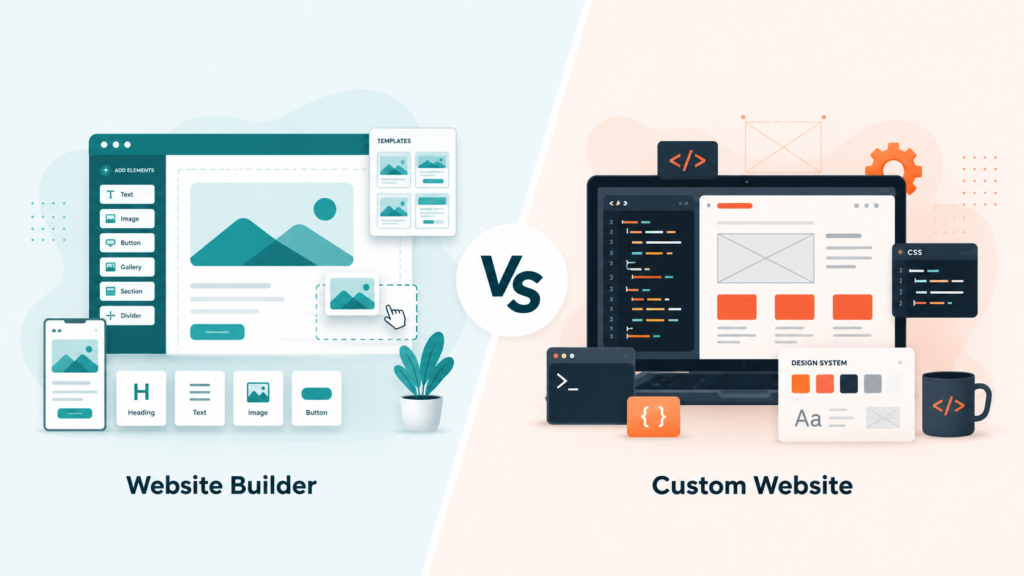
A common mistake businesses make is randomly choosing a way to build their website. While this seems like a minor task to be done during the rush time, in reality, it imparts a strong impact on the growth for many upcoming years.
The right choice between custom website development services in Minneapolis and a website builder is not about the cost involved, but has a strong relation with the future goals and other routine operations.
This guide helps to compare a custom website vs a website builder to find the right fit for your business.
Key Takeaways
- For basic and starting use, a website builder might be a perfect option, but later on, it brings barriers for advanced growth.
- Opposite to this, a custom website might need a higher investment at the start, but it brings more flexibility and leaves more space for expansion.
- Businesses that depend more on SEO, custom integrations and cutomized customer experienced usually benefit more from custom development.
A website builder is a platform — Wix, Squarespace, Shopify, and similar tools — that allows someone to generate a site using ready-made templates and a visual editor. All with zero code.
And guess how? Simply choose a template, swap in text and images, bring its components around, and publish. Hosting, security updates, and infrastructure are provided by the platform itself.
The concept is simple: a functional site can go live in a day or two, monthly costs are clear and low, and no technical background is required. For most small businesses, that’s strictly what’s needed early on, when speed and clarity matter more than tight control over every detail.
A custom website is crafted from the basis — or from a modular framework — by developers who write code entirely for the business, rather than converting a pre-built template. This varies from a custom-designed site on a content management system to a fully tailored web application.
The tradeoff is the converse: more time, more upfront cost, and the need to work with a developer rather than managing everything alone. In exchange, the business receives a site unbounded by what a template offers — every message and structural move can be constructed around the actual business rather than designed into someone else’s model.
At its core, custom websites and website builders hold various differences. The two tactics vary most clearly once you look past the surface-level “how fast can I launch” comparison:
Cost is usually the key element early on, but the comparison looks different depending on the time horizon. A website builder may cost a simple monthly subscription with little or no design or development fee. A custom website, by analogy, can run from a few thousand dollars for a simple site to tens of thousands for something more complex — based on scope and paid largely upfront.
| Factor | Website Builder | Custom Website |
| Upfront cost | Low ($0–$500) | Higher ($2,000–$50,000+) |
| Ongoing cost | Monthly platform fee, indefinitely | Hosting, maintenance, and occasional updates |
| Scalability cost | May require plan upgrades or a rebuild | Can be planned around expected growth |
| Ownership | Platform-dependent | More control over code, hosting, and data |
| Best cost fit | Early-stage, low-complexity sites | Growing businesses with specific needs |
Over five years, a business paying $40 a month for a builder spends approximately $2,400 just to keep the site online — before accounting for boundaries it may eventually outgrow. A custom site with a higher starting cost but lower platform-related fees can sometimes become a better value long-term, particularly once the business surpasses the simplest use case.
Website builder templates are tuned to look polished out of the box, but that polish comes from a shared design language across thousands of other sites using the same template. Customization is usually limited to colors, fonts, and pre-set layout blocks — enough to feel branded, but rarely unique.
Custom websites remove that ceiling completely. Layout, interaction design, animations, and unique page structures can all be built to follow a brand precisely, rather than adjusted within someone else’s design system. For businesses where visual style is a competitive advantage — a design studio, a luxury brand, a product with a strong visual story — this difference seems to matter a great deal.
Website builders are set up for the average use case, which means performance can degrade once a site moves outside that average — large catalogs, heavy traffic spikes, or complex custom functionality can all show the platform’s limits. Page speed, in particular, is harder to control since much of the hidden code isn’t accessible.
Custom websites are built with the specific technical needs of the business in mind from the start, which generally makes them more powerful at handling growth without a ground-up rebuild later. This doesn’t mean every custom site is by default faster — poor development can slow one down just as easily — but the ceiling for what’s technically possible is usually higher.
Most modern website builders offer major baseline SEO tools: editable meta tags, basic sitemap generation, alt text fields. For clear sites, this is often sufficient. The barriers show up with more advanced work — custom schema markup, granular control over site architecture, page speed optimization, or technical fixes the platform doesn’t reveal to the user.
Custom websites give developers full control over technical SEO elements, from URL structure to server-side rendering choices that affect how search engines crawl the site. For businesses competing in search-heavy industries, that control can affect rankings in ways a builder’s built-in tools can’t always copy.
Website builders handle hosting security and platform updates automatically, which is truly valuable for businesses without technical staff. The tradeoff is limited control: if a needed mixing isn’t supported natively or through the platform’s app ecosystem, it can be difficult or impossible to add.
Custom websites place more actively on the business (or its development partner) for ongoing maintenance and security patches, but they allow far more integration support — a specific CRM, a custom inventory system, a proprietary internal tool — none of which would necessarily fit inside a builder’s ecosystem.
Not every condition can be satisfied with a website builder. A builder makes sense for:
Custom development becomes the best choice once a business has exceeded template restrictions, needs deep integrations, or depends on its website as a core earnings channel rather than a digital business card. This shift often happens when temporary fixes, plugin limitations, and manual processes start eating up more time and money than a proper custom build would require.
There’s no single right answer for every business, but the decision becomes clearer once it’s built around where the company is planned rather than where it stands today.
At the end of the day, a great website is not just differentiated by how it is built, but based on how well it helps your business to grow. For some brands, a website builder serves everything one needs to set a great online presence. At the same time, many find it relevant to use a custom website that gives flexibility to grow without technical issues.
This way, selecting a solution that matches your long-term future goals can save time, reduce other costly expenses and make it possible for the website to grow alongside.
Ans: Yes, for those who require a professional website with basic features, a website builder is enough.
Ans: The moment your business demands advanced functions, custom integrations and better controls – switching is perfect.
Ans: Yes, but the process might be time-consuming, based on the platform. Planning now and making a good decision early is the right approach.
