

Do you know that technicians spend nearly 25% of their time on non-value tasks, and poor scheduling increases job travel time by 15%. Every unnecessary trip, scheduling conflict, or delayed repair increases costs while hurting customer satisfaction.
Artificial intelligence is helping businesses tackle these challenges, provided you choose a generator carefully. By analyzing service history, technician availability, customer requests, and real-time conditions, AI helps companies make faster, smarter decisions across their entire field operation. From intelligent scheduling and predictive maintenance to optimized routing and automated customer communication, AI is transforming field service from a reactive function into a proactive competitive advantage.
KEY TAKEAWAYS
- AI improves technician scheduling by matching jobs based on skills, availability, location, and real-time conditions.
- Predictive maintenance helps reduce equipment downtime and lowers repair costs by identifying issues before failures occur.
- AI optimizes routing, inventory management, and customer communication to improve productivity and service quality.
- Businesses achieve the best results when automation is supported by accurate data, employee training, and integrated service management systems.
Dispatching is arguably the hardest part of the job. A dispatcher has to weigh technician availability, skill match, job type, location, and appointment windows, often all at once, while the day’s schedule is already falling apart.
AI tries to recommend assignments most efficiently as situations change throughout the day around:
Say a tech wraps up early near a customer with an urgent issue. The system can reroute the job their way instead of sending someone from across town. A technician with training on a specific piece of equipment gets bumped to the top of the list for related calls.
The result is fewer delays, less wasted mileage, and more jobs completed per day. Dispatchers still make the calls, but with better information.
Most field service teams are used to reacting: something breaks, someone gets dispatched. Emergency repairs happen, but they’re almost always costlier and more disruptive than a scheduled fix would have been.
AI can detect early warning signs before a failure occurs by analyzing:
If a certain machine has historically required repairs at a specific number of operating hours, the system can flag similar units as they approach that threshold. That means less downtime, longer equipment life, and a maintenance schedule that’s actually predictable instead of reactive.
Driving eats up a huge chunk of a technician’s day, and inefficient routing makes it worse. AI-based route planning reduces wasted travel by analyzing factors like:
It isn’t a set-it-and-forget-it schedule, either. If traffic backs up or an emergency call comes in, the route adjusts on the fly rather than sticking to a plan that no longer makes sense. That keeps technicians closer to on time, keeps fuel costs down, and builds trust with customers who’ve been burned by vague arrival windows before.
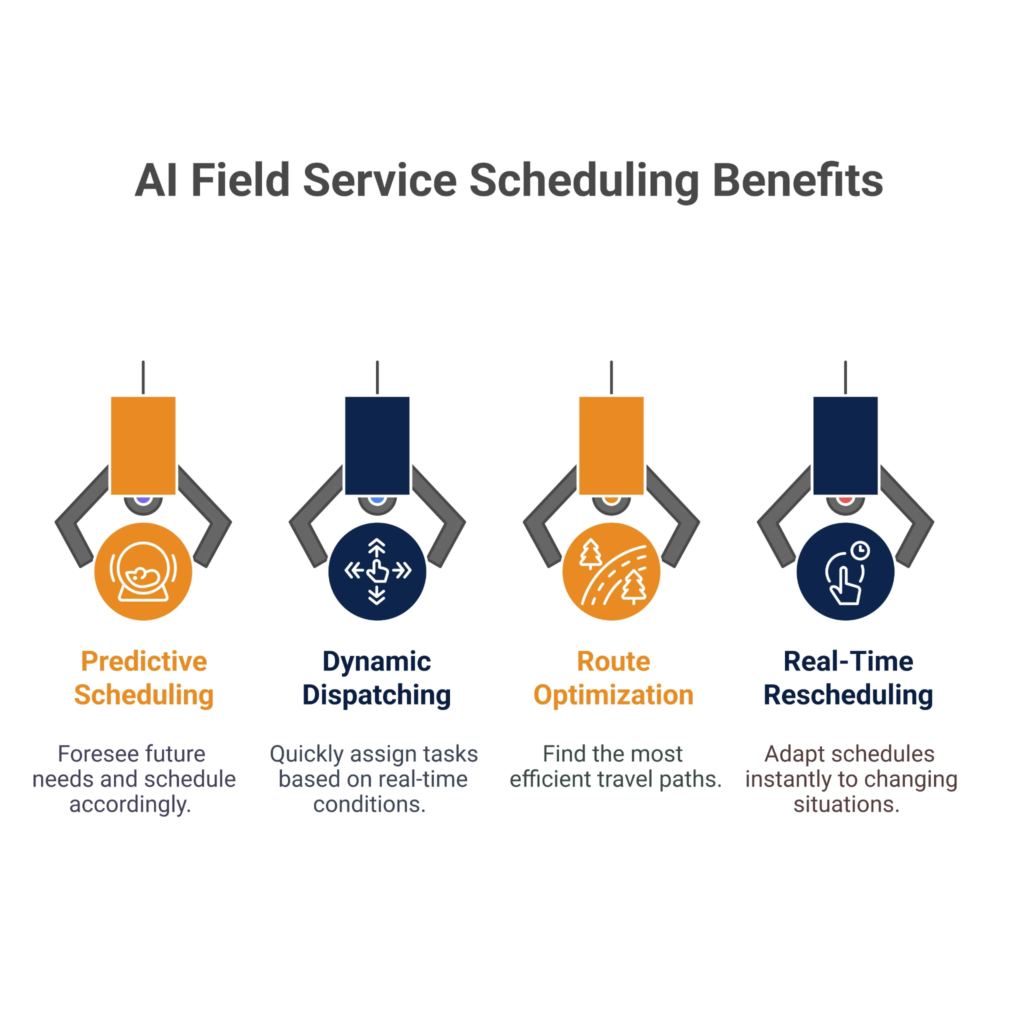
The infographic summarizes the routine and scheduling benefits of automation in field service:
Nothing kills a service visit like a technician showing up without the right part: a second trip, a frustrated customer, wasted labor.
AI forecasts future parts demand by analyzing:
It helps technicians arrive with the right components on the first visit. It also helps managers spot which items are sitting unused, so money isn’t tied up in stock that never moves.
Customers mostly just want to know what’s happening: when the technician is arriving, what’s being done, and whether anything’s changed. Silence or vague updates turn even a good repair into a bad experience.
Automated systems can handle a lot of that automatically, including confirmations, reminders, arrival windows, delay alerts, and follow-ups. Chatbots can field simple scheduling questions or gather details before a technician is even dispatched. None of this replaces a real person for complicated issues, but it frees up staff to focus on conversations that actually need a real person.
Once a technician is on-site, AI can still help. Techs often need quick access to manuals or past service records, and digging through paperwork slows everything down.
A technician can enter symptoms into a mobile app and get likely causes or notes from past jobs, which is especially useful for someone still building experience. AI can also nudge technicians through checklists and prompt proper documentation, which pays off the next time that equipment needs service.
Field service companies generate mountains of data: appointment times, repair outcomes, technician performance, customer feedback. Most of it goes unused without the right tools to make sense of it.
As companies weigh different digital tools for managing teams and customer requests, commercial service AI fits into that broader move toward smarter operations, away from guesswork and toward decisions backed by real patterns in the data. Maybe certain jobs consistently run long, one region has an unusually high rate of repeat calls, or a specific equipment model keeps needing extra maintenance. That kind of insight helps managers rethink training, pricing, or staffing before a problem becomes obvious.
The cost benefits come from several directions at once: less idle time, lower fuel costs, fewer emergency repairs, and less wasted inventory. While each efficiency gain may not seem much individually, together they significantly reduce operating costs while improving technician productivity and customer satisfaction.
None of this works without groundwork. AI is only as good as the data behind it, so incomplete or outdated service records produce weak recommendations. Staff needs real training too, not just on how to use the tools, but on when to trust a system’s suggestion and when human judgment should override it. Integration matters as well: automation tools need to actually talk to existing field service software, CRM systems, and inventory platforms, or you’ve just added complexity instead of removing it.
If anything goes wrong, it’s your business that’ll lose reputation. And AI now plays an important part in business reputation monitoring and management.
AI is reshaping on-site service management by helping businesses schedule smarter, prevent equipment failures, optimize technician routes, manage inventory more efficiently, and deliver better customer experiences. Automation won’t replace the judgment and experience that good technicians and dispatchers bring to the job. But it can free people up to focus on work that needs a human touch. For companies running field operations, that’s not a passing trend. It’s a practical way to run a tighter, more reliable operation.
Ans: It improves on-site service management by automating scheduling and inventory, optimizing technician routes, predicting equipment failures, and improving customer communication, resulting in greater operational efficiency.
Ans: Predictive maintenance analyzes equipment performance, service history, and sensor data to identify potential failures before they happen, reducing unexpected downtime and repair costs.
Ans: No. AI supports technicians by providing better information, faster diagnostics, and automated administrative tasks, but human expertise remains essential for complex repairs and customer interactions.
