
Your business receives a message from a customer on WhatsApp who is about to ask a question or buy something. However, how do you respond if your response comes after hours? You might just lose that potential buyer, make them unhappy, and ultimately fail to make a sale.
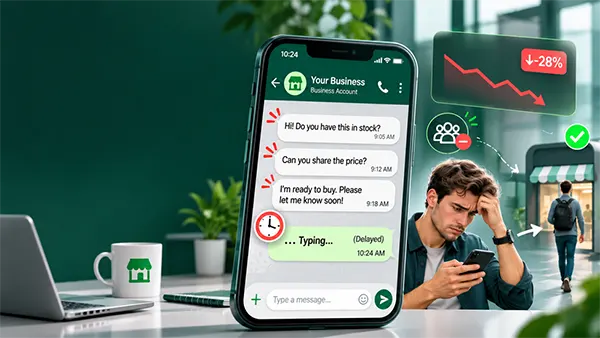
Today’s era calls for fast and convenient ways of communication, where just a minor delay can cost your business a customer. The use of WhatsApp has increased greatly in recent times for queries, bookings, quotations, and customer service purposes.
Yet, when businesses struggle to keep up with incoming messages, opportunities can easily slip away. Understanding why these delays happen is the first step toward better customer relationships and fewer missed sales.
WhatsApp has emerged as an important mode of communication as it enables businesses to communicate with their customers via the popular messaging platform. Instead of making phone calls or waiting for email responses, customers can send questions, share images, request information, and discuss purchases through a single conversation.
This convenience creates an opportunity for businesses to make customer communication easier, but it also creates a responsibility to manage conversations effectively. A business that offers WhatsApp support but regularly ignores incoming messages may create a disappointing experience for customers who expect timely assistance.
According to Meta’s official WhatsApp Business Platform documentation, businesses can use messaging APIs to communicate with customers and build more advanced conversational experiences. These capabilities create opportunities to connect messaging with business applications, customer support systems, and automated workflows.
Automation may be able to assist with these problems for firms that receive many inquiries. For example, businesses exploring custom conversational systems can consider AI chatbot development services, which include customer support automation, lead qualification, business integrations, and human agent handoffs. The objective is to help businesses manage conversations more efficiently while ensuring customers can still receive assistance from real employees when necessary.
Customers generally choose messaging because it is convenient and accessible. They can contact a business while working, travelling, shopping, or comparing different products without having to make a phone call.
This convenience also shapes their perceptions regarding communication. For example, someone looking for a laptop may contact three different computer stores to ask about prices, specifications, and availability. If one store provides a detailed answer within a few minutes while the others remain silent, the responsive business has a better opportunity to earn the customer’s attention and potentially secure the purchase.
The customer might not necessarily choose the cheapest option. A clear and timely response can make a business appear more reliable and easier to deal with.
Customers often contact businesses when they are already considering a purchase. They might need one final piece of information before placing an order, confirming an appointment, or selecting a service provider.
When the answer does not arrive promptly, their attention may shift elsewhere. They may choose to keep comparing different options, lose sight of their original question, or even buy from a competing company that offers more communication.
Businesses therefore need to understand that responding to a customer is not simply an administrative task. It is an important part of the purchasing experience and can influence whether an interested person becomes an actual customer.
Slow WhatsApp communication rarely happens because of a single problem. It often results from poor message management, limited staffing, unclear responsibilities, and outdated customer support processes.
It is through such problems that businesses understand where their communication system falls short and what measures will do them the most good.
One of the biggest disadvantages of slow WhatsApp communication is that customers can easily contact competing businesses. Unlike traditional communication channels, messaging applications allow people to send the same question to multiple sellers without much effort.
Consider someone searching for a particular smartphone. Three electronics stores are contacted in order to find out about its price, storage capacity, and delivery details. The first retailer responds quickly with the requested details, while the other two take several hours to reply.
By the time the remaining retailers respond, the customer may already have completed the purchase. This means a business can lose a sale even when its products, pricing, and quality are competitive.
What businesses should do: Establish a clear response process for new inquiries and prioritize messages from customers who are actively considering a purchase. A useful starting target is acknowledging new inquiries within five minutes during staffed business hours, while providing a realistic timeframe for more detailed answers.
Trust is particularly important when customers purchase from businesses they have never used before. They want to feel confident that the company will provide accurate information, process their orders correctly, and remain available if something goes wrong.
If a customer sends a WhatsApp message and gets no reply, uncertainty might arise. They might wonder whether the business is still operating, whether their inquiry has been ignored, or whether the company will provide proper support after receiving payment.
For example, imagine a customer contacting an online clothing store to confirm the availability of a particular size. If the business does not respond until the following day, the customer may question whether ordering from that seller is worth the risk.
What businesses should do: Acknowledge incoming inquiries even when the complete answer is not immediately available. A short message explaining that the team is checking the details can reassure customers that their questions are receiving attention.
Not every WhatsApp inquiry represents an immediate purchasing opportunity. However, certain questions indicate that customers are actively evaluating a product or service and may be close to making a decision.
Messages such as asking about final prices, product availability, delivery charges, payment methods, or appointment bookings often indicate genuine buying interest. If a business delays answering these questions, it risks losing customers who are already interested in purchasing.
As an example, an electronics shop may get a message from a person who intends to buy a laptop right away but has to confirm the warranty and the payment methods. If the response arrives after the customer has already ordered from another retailer, the opportunity may be lost.
What businesses should do: Introduce a simple process for identifying high-priority inquiries. Sales-related messages should be directed to the appropriate employee, while routine questions can follow a standard support process.
Many small businesses depend on a single employee or owner to manage every incoming WhatsApp message. While this system may work for a company that gets only a few queries daily, it gets increasingly tough to cope with rising customer communication.
Messages can get buried beneath newer conversations, employees may forget to follow up, and important questions can remain unanswered. When multiple employees share responsibility without a clear process, customers may even receive duplicate responses or conflicting information.
For example, an online store might receive messages about product availability, delivery arrangements, returns, payment confirmations, and wholesale orders simultaneously. Without an organized system, employees can spend more time searching through conversations than actually helping customers.
What businesses should do: Organize conversations according to their purpose, assign responsibility to specific employees, and regularly review unanswered messages. Growing businesses can also consider shared customer support inboxes that allow teams to manage conversations more efficiently.
Slow responses are frustrating, but poor follow-up can make the situation even worse. Imagine a customer explaining a delivery problem through WhatsApp, waiting several hours for an answer, and then having to explain the entire situation again to another employee.
This results in wasted effort and leaves the customer feeling as though the business does not comprehend their issue. The situation becomes particularly frustrating when someone is already dealing with an incorrect order, delayed delivery, or payment issue.
Customers expect businesses to maintain enough information about previous conversations to provide relevant assistance without repeatedly asking for the same details.
What businesses should do: Maintain conversation history and make sure employees review previous messages before replying. When a conversation is transferred to another team member, provide the necessary background so the customer does not have to start again.
Customers do not always contact businesses during regular office hours. Someone might discover a product late at night, search for a service during the weekend, or send an appointment inquiry after finishing work.
If a business has no process for managing messages outside working hours, these inquiries may remain unanswered until the next business day. It does not suggest that every organization needs round-the-clock availability for its staff; however, customers need to know their times of response.
What businesses should do: Use WhatsApp Business greeting and away messages to communicate operating hours and expected response times. For example, an automated message can explain that the business has received an inquiry and will respond when its support team becomes available.
Winning a customer is only one part of running a successful business. Maintaining customer satisfaction after a purchase is equally important because existing customers may return, purchase additional products, renew subscriptions, or recommend the business to others.
Poor communication after a transaction can weaken these relationships. A customer who repeatedly struggles to obtain delivery updates or resolve problems may decide to purchase from another company next time.
For example, someone purchasing furniture may need to confirm delivery arrangements or ask about installation. If the seller repeatedly delays responses, the customer may feel that the company was more interested in completing the sale than providing proper support.
What businesses should do: Treat WhatsApp as an ongoing customer relationship channel rather than a tool used only to generate sales. Provide order updates, answer support questions, address complaints, and follow up when necessary.
Delayed communication can affect business revenue in several ways. A clear result would be the loss of a possible sale, although there could be more far-reaching financial results in terms of customer loyalty and business performance as well.
Consider an online store that receives 300 WhatsApp inquiries each month. If its average order value is $50 and approximately 10% of inquiries normally convert into purchases, the business would generate $1,500 in monthly revenue from those conversions.
If poor response management causes the business to lose 10 potential orders, it could miss approximately $500 in revenue. This is an illustrative calculation rather than a measured industry statistic, but it demonstrates how relatively small communication problems can create noticeable financial consequences.
Every unanswered inquiry represents a potential opportunity that may never convert into revenue. A customer asking about product availability or pricing might be ready to purchase, but a delayed response gives competitors an opportunity to capture that demand.
Companies that get leads through social media advertisements need to take notice of this issue in particular. Investing in advertisements without having a reliable process for responding to inquiries can reduce the value of marketing campaigns.
Customers who experience poor communication may hesitate to purchase from the same business again. Even when the original product or service is satisfactory, an unpleasant support experience can influence their future decisions.
Businesses that provide timely and helpful assistance have better opportunities to maintain relationships and encourage repeat purchases. Consistent communication can also make customers more comfortable recommending a company to friends, colleagues, and family members.
When business organizations miss out on potential clients due to delayed responses, they will have to spend extra cash on advertising and promotions.
For example, a company might spend money generating WhatsApp leads through social media campaigns but fail to respond quickly enough to convert those inquiries. Improving the communication process can help businesses make better use of the interest they have already generated.
There is no universal response time that works for every business. Customer expectations depend on the industry, urgency of the inquiry, type of service, and communication promises made by the company.
Nonetheless, research in customer service can provide some background information. The 2025 Consumer Perspectives report from Execs In The Know found that 82% of surveyed consumers expected an initial response to online chat within three minutes or less. The report also found that 61% expected an initial SMS response in less than five minutes. These findings relate to online chat and SMS rather than WhatsApp specifically, so they should be treated as broader messaging benchmarks rather than direct WhatsApp measurements.
Businesses can use the following suggested response targets as a starting point for developing their own customer service standards.
| Response time | Suggested business approach |
| Within 1 minute | Excellent for urgent inquiries |
| Within 5 minutes | Useful target during staffed hours |
| Within 15 minutes | Suitable for some routine inquiries |
| Within 1 hour | Acknowledge delays and provide an update |
| Several hours | Potential risk of losing time-sensitive opportunities |
| Next business day | Communicate this expectation in advance |
These are recommendations for operational targets and not the standards set by WhatsApp or customer satisfaction guarantees. The most important principle is consistency. Businesses should establish realistic service levels and make sure customers understand when they can expect a response.
Improving response times does not necessarily require hiring a large customer support team. Businesses can make meaningful improvements by introducing better communication processes, using existing WhatsApp Business features, and adopting suitable automation technologies.
The right approach depends on the number of incoming conversations, the complexity of customer questions, and the resources available to the business.
The WhatsApp Business app has many features that assist small businesses in managing customer communication. Greeting messages, away messages, quick replies, and conversation labels can make it easier to organize inquiries and provide consistent information.
For example, a clothing retailer can prepare quick replies covering delivery charges, payment methods, return policies, and available sizes. Employees can then provide accurate answers without repeatedly typing the same information throughout the day.
These features are particularly useful for businesses that receive recurring questions but do not yet need a more advanced customer support platform.
Many businesses receive similar questions from different customers throughout the day. Instead of writing every answer from scratch, employees can prepare approved responses for frequently requested information.
For example, a delivery response might explain which locations the business serves and ask customers to provide their city for an accurate delivery estimate. A pricing response could request the product name or image before sharing the latest price and availability.
Quick replies save time, improve consistency, and allow employees to focus on questions that require more detailed attention. However, businesses should customize these responses whenever necessary rather than sending irrelevant automated messages.
Each new customer interaction needs to have an owner. If multiple employees manage the same WhatsApp account, businesses should establish who handles new inquiries, existing orders, complaints, and follow-up activities.
Without clear responsibilities, employees may assume someone else has already responded, allowing important messages to remain unanswered. Assigning ownership also makes it easier for managers to identify communication problems and understand which areas require additional support.
Automation can help businesses manage repetitive customer interactions without requiring employees to answer every basic question manually. Depending on the system, automated workflows can greet customers, collect inquiry details, share product information, answer common questions, and direct conversations to the appropriate department.
For example, a travel agency could use an automated WhatsApp assistant to collect a customer’s destination, travel dates, and number of passengers before forwarding the inquiry to a travel consultant. This allows employees to spend less time collecting basic information and more time helping customers make decisions.
Businesses interested in broader AI-powered automation can explore MindRind, which covers AI solutions, custom software development, chatbot development, and business process automation. These capabilities are relevant to companies looking to connect customer communication with wider operational workflows rather than relying entirely on manual messaging.
The default WhatsApp Business app could be helpful for small businesses; however, those having larger amounts of conversations would require a more sophisticated communication system.
The WhatsApp Business Platform provides business messaging capabilities through APIs. It can support integrations with customer relationship management systems, customer service tools, automated workflows, and other business applications.
Meta’s official developer documentation explains how the platform supports the Cloud API for sending and receiving WhatsApp messages, along with features such as templates, webhooks, and business management capabilities.
Meta for Developers
Businesses should evaluate these options according to messaging volume, integration requirements, staffing structure, and budget. They should also review applicable WhatsApp messaging policies, pricing, and customer consent requirements before implementation.
Businesses cannot improve response performance if they do not know how many messages are being missed. Regularly reviewing conversations helps identify inquiries that have not received responses, customers waiting for additional information, unresolved complaints, and conversations requiring follow-up.
An easy way to do this would be to conduct a quick review on a daily basis to see if there are some employees who receive too many questions.
This information allows managers to make practical improvements instead of relying on assumptions about customer service performance.
Businesses should communicate their availability clearly through their WhatsApp Business profile and automated away messages. Customers should understand when support is available and when they can expect a response.
If a business operates from Monday to Saturday, for example, its profile should display those hours accurately. An away message can explain that the team has received the inquiry and will respond during the next working period.
Setting realistic expectations is more effective than advertising constant availability that the business cannot consistently provide.
Businesses should track communication performance rather than relying on general impressions. Important metrics include first response time, resolution time, rate of unanswered messages, conversion rate of inquiries, and customer satisfaction.
First response time measures how long customers wait before receiving their first meaningful business response. Resolution time measures how long it takes to address their questions or problems. Conversion rate helps determine how many relevant inquiries eventually result in purchases or bookings.
By reviewing these indicators regularly, managers can identify recurring problems and measure whether new communication processes are improving customer experiences.
Manual communication and automation both play a vital role in customer service. The right approach depends on the complexity of customer inquiries, the number of messages received, and the level of personal assistance required.
Manual responses allow employees to understand individual customer situations, provide detailed explanations, and handle complicated requests. However, managing every conversation manually can become difficult when a business receives a high volume of inquiries.
Automation is useful for repetitive interactions, such as answering frequently asked questions, collecting customer details, and directing messages to the appropriate department. It can also help businesses acknowledge inquiries outside normal working hours, although automated assistance does not guarantee that a human employee is available at all times.
| Factor | Manual responses | Automated responses |
| Personal interaction | Direct human communication | Depends on automation design |
| Basic questions | Requires employee time | Can handle repetitive questions |
| Availability | Depends on staffing | Can provide automated assistance outside working hours |
| Complex problems | Better suited to human judgment | Usually requires human escalation |
| High message volume | Can become difficult to manage | Can help manage repetitive conversations |
| Implementation | Usually straightforward | May require integration and configuration |
Personal communication is very effective when consumers require personal suggestions, explanations, negotiations, and help with difficult issues.
For example, a customer purchasing a customized website development service may need to discuss specific requirements, technical limitations, and project timelines with a consultant. An automated greeting can acknowledge the inquiry, but a human employee should handle the detailed discussion.
Automation is particularly useful for repetitive inquiries that follow predictable patterns. A restaurant, for example, may receive dozens of questions about opening hours, menu options, reservations, and delivery availability.
An automated assistant can provide basic information, collect booking details, and direct more complicated requests to employees. This helps the business manage routine communication without unnecessarily increasing the workload of its support team.
For many growing firms, a combination of automation and human help provides a viable compromise. Automated systems can manage initial greetings, frequently asked questions, and information collection, while employees handle conversations that require personal attention.
The objective is not to remove human communication. It is to make sure customers receive timely assistance without forcing employees to spend unnecessary time answering the same basic questions.
Improving WhatsApp response times requires more than installing a messaging application or activating an automated greeting. The company needs a communication strategy that ties questions from customers to relevant people and systems within the business.
The first step is to establish realistic response time targets. Different types of inquiries may require different priorities, so businesses should distinguish between urgent complaints, sales questions, general product information, and existing order requests.
Companies should also maintain consistent communication standards. Employees need to understand how to greet customers, explain products, provide accurate information, and transfer complicated conversations to the appropriate team member.
Another important consideration is customer information management. When necessary, a CRM solution will be helpful for organizing the contact information, past communications, purchasing history, and follow-up efforts. This makes it easier for employees to provide relevant support without repeatedly asking customers for information they have already shared.
Finally, businesses should regularly review their response performance and customer feedback. Monitoring communication quality helps identify problems early and ensures that improvements are actually benefiting customers.
Even companies that react fast may provide bad customer experience because of their bad communication. Speed matters, but customers also expect useful information, professional behavior, and clear answers.
One common mistake is sending automated greeting messages without providing meaningful follow-up. An automatic acknowledgment can reassure customers that their message has been received, but it should not replace an actual answer when one is required.
Another problem is providing unclear or incomplete information. Customers asking about prices, availability, delivery, or payment methods should receive direct answers that address their questions rather than generic messages that force them to ask again.
It is necessary that organizations do not ignore their customers even after making the sale. Communication should continue when customers need order updates, assistance with returns, or help resolving complaints. Similarly, companies should avoid promising unrealistic response times that their employees cannot consistently meet.
Finally, automation should never become a barrier between customers and human assistance. When an automated system cannot understand a request or resolve a problem, customers should have a clear way to reach an employee.
Digital messaging is growing to become an integral part of business-to-customer interactions. Customers want convenient ways to communicate with companies, obtain information, receive updates, and resolve problems without unnecessary effort.
Developments in artificial intelligence, customer relationship management integrations, and business messaging platforms are creating new opportunities for companies to improve communication. AI-powered assistants can help understand customer questions, suggest relevant responses, collect information, and direct conversations to appropriate employees.
But then again, business organizations must use these technologies cautiously. Automated responses should be accurate, customer information should be handled responsibly, and complicated requests should have an appropriate human support option.
The future of business messaging is not simply about responding faster through automation. It is about creating a communication experience in which customers receive relevant information, understand what happens next, and can access human assistance when necessary.
Companies that combine reliable technology with professional customer service will be better positioned to manage growing communication demands and maintain stronger customer relationships.
Poor reaction time on WhatsApp can cost companies more than just one lost sale. They can weaken customer trust, interrupt purchasing decisions, reduce repeat business, and create unnecessary pressure on marketing and sales activities. In competitive markets, customers may choose another company simply because it provides clearer and faster communication.
The problem is not always a lack of employees or technology. In many cases, it comes from poorly organized conversations, unclear responsibilities, and the absence of a consistent response process. Businesses can address these challenges by using WhatsApp Business features, introducing quick replies, assigning message ownership, monitoring unanswered conversations, and implementing automation where appropriate.
Growing firms will have more options to manage their communications through the WhatsApp Business Platform and integration with the Customer Management System. The most effective approach combines technology with human support, ensuring that routine inquiries are handled efficiently while complicated customer needs receive personal attention.
Ultimately, customers want to feel that their questions matter. A timely, helpful, and professional response can make the difference between someone choosing your business and moving to a competitor.
Ans: Businesses lose customers because delayed replies create uncertainty, interrupt purchasing decisions, and make competitors more attractive. Customers may choose another company that provides faster and more helpful communication, especially when they are comparing prices or trying to make an immediate purchase.
Ans: A practical starting target is to acknowledge customer inquiries within five minutes during staffed business hours. However, expectations vary depending on the industry, urgency, type of inquiry, and service commitments made by the company.
Ans: Yes. WhatsApp automation can help businesses respond to common questions, provide basic information, collect customer details, and route conversations to appropriate employees. However, human support remains important for complicated requests and situations requiring personal attention.
Ans: Ignoring messages can result in lost sales opportunities, frustrated customers, negative experiences, reduced trust, and fewer repeat purchases. Businesses may also waste marketing expenditure when potential leads generated through advertising never receive proper follow-up.
Ans: Yes. WhatsApp Business provides useful features such as business profiles, greeting messages, away messages, quick replies, and conversation labels. These tools can help small businesses organize customer communication without immediately investing in more advanced software.
Ans: Businesses can monitor first response time, resolution time, unanswered messages, customer satisfaction, and inquiry conversion rates. Reviewing these metrics regularly helps identify communication problems and measure whether new processes are improving customer experiences.
