
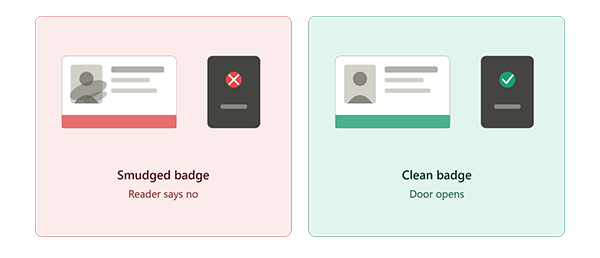
Identity badges are common in offices, educational institutions and medical facilities. Badges allow people to be recognised as staff, pupils and guests and can also grant access to facilities.
Despite their basic nature, identity badges require printing solutions, media and design applications.
Basically, these issues are due to bad design, media or printer maintenance. There are personalised identity badge printers which allow you to manage both the design and information along with the printing process.
You decide which printing solution best suits your requirements.
Previously, ID cards would have been printed by a third party, making the procedure inappropriate. If new team members required ID cards or existing ID cards required replacing.
Now, with modern printing technology, businesses can print plastic ID cards within their office. Different designs can be created with multiple portions of information.
As internal printing is now possible, it is much easier to update data and maintain regularity throughout the business. Orders can be made at any time, meaning that businesses can print ID cards as and when needed.
Different printing technologies can be used to create cards with variable qualities.
This type of printing produces images and text directly onto plastic cards. It is suitable for common ID cards such as staff, student and member ID cards.
In re-transfer printing, the design is first printed onto a transparent film. This film is then adhered to the surface of the card. This printing procedure can be used to achieve full coverage at the borders of the card. It is useful for groups who need complex designs.
Another factor to consider is if the printer allows single- or double-sided printing. While a single-sided printer may be enough for simple identification, double-sided printers mean you can provide further information.
Depending on how many cards you wish to print, what design you would like and which features you want to make regular use of, choosing the right Card Printer will allow you to meet your requirements efficiently.
A good ID card design will make it easy for users to interpret the information. It is important that information is clearly laid out on the card, but we should avoid overcrowding.
Designing ID cards can be made easier by using software. Multiple pieces of information such as photos, names, departments, business logos and others can be added to ID cards in an organised way. Many pieces of software offer pre-designed templates to make building new designs quicker.
If many IDs need to be created, adding correlation with databases can be useful. By importing data from a matching database, multiple ID cards can be formed quickly, without having to type in all the information.
Further elements can be added to meet additional requirements for ID cards and community. Barcodes and QR codes can be contained on ID cards.
Choosing appropriate materials will affect the quality of the printed ID cards.
PVC material is commonly used in ID cards. It provides a smooth surface, which means a high-quality print can be achieved. It is also very stable so that normal handling of the card has little effect on the card.
Using appropriate ribbon styles for your printer will give you authentic colours and readable text. Using inappropriate materials may lead to poor print consistency or cause disruptions.
Including these objects in your range means that you can maintain your printing equipment and so reduce issues caused by build-up of dirt and waste.
Choosing the proper materials from the beginning will enhance dependability during printing.
Identification cards have a lot of uses in various places, yet their function differs depending on the institution.
In corporate buildings, employee cards assist in recognizing one another and implementing access control within the company.
In educational institutions, the student card helps differentiate between students and manage different services on campus.
Healthcare organizations use identification cards as well. All doctors, nurses, administrative staff, and other individuals who have permission to enter the building are identified using professionally designed staff cards.
Membership-related companies, such as gyms and private clubs, use customized cards for determining registered members. Professional events, seminars, conferences, and additional groups usually provide attendees and speakers with badges.
This shows the importance of good card design and printing machines in different fields.
When dealing with card issuance, having a printing facility in the organization works more effectively. The organization’s staff will have the authority to print new cards, make updates to old cards and even replace any faulty badges in the organization without seeking any services from a third party.
It is important in instances where the organization will be drafting more people into the organization, or where students are being accepted into the organization or even when growing.
There are specific aspects that an organization requires to take into consideration when coming up with a printing facility in the organization.
Some of these aspects include the frequency of printing of the cards, the number of employees working at the printer, and other additions required in the printer.
The organization does not need to have the technology-updated printer in the market.
The selection of proper equipment will be an easy process once all necessary specifications are known before buying.
Points to consider are speed of printing, type of cards, printer quality, and software.
Businesses should review whether the printer chosen is compatible with the requirements. While some firms may need standard PVC cards, there could be particular security needs in other firms that require access cards.
Availability of maintenance and key replacement parts should also be considered. Even though the equipment may fulfill all the requirements. Its maintenance will depend upon the supply of ribbons, cleaning items, and other accessories.
Companies in search of various ID Card Printers can examine proper models provided by technical firms such as Bondo. Their range includes card printers, ID card software, PVC cards, ribbons, and accessories.
Once installed, right maintenance of a printing method may help it to work efficiently. The printer may become covered with dust or additional particles that can impact its efficiency.
The most useful thing to do is to follow the procedure for cleaning the printer as advised by its producer. Apart from the right cleaning materials, it is also essential to store excess ribbons and cards properly.
In any case, keeping track of the supply availability would be very valuable. Having compatible substitutes available would ensure that there are no delays once the identification cards run out.
Such routines may improve the lifespan of a printing machine and produce good results.
Identification card printing technologies consist of different systems that function to reach the same aim: producing attractive and functional identification records.
Such things as printing technology, software schedules, plastic cards, and ribbons are just some of those elements that are essential for reaching the expected result.
Printing devices are essential for good ID card printing by any organization, whether it is a business, school, clinic, or club.
It is crucial to understand what type of devices are needed for that.
Ans: Retransfer is good at printing onto chips. However, DTC can cause smearing and/or non-uniformity around a chip. Always test on your cards.
Ans: Yes, if the correct-sized card stock can be used. Often, events will print staff cards and then attach a clip.
Ans: Yes, if the card needs to contain information, for example, a stripe, contactless or contact chip. Cards can be printed with a barcode and do not require an encoder.
Ans: They are 85.60 x 53.98mm and are 0.76mm in thickness. This conforms to the ISO/IEC 7810 ID-1 specification.
