

A payment company often onboards a few companies whose registry extract and ownership chart disagree. Then, surprisingly, after six months, a director resigns. The compliance lead searches for answers like: will the platform that cleared the customer also catch the change, apply the same policy, and show a reviewer the evidence?
Strise is one such platform that is designed to answer the question. It’s not the only option, but the right pick depends on how much control a team wants over its own rules, data providers, and AI agents. Read the full blog to learn more about six Strise alternatives on those points, with one question in mind: which setup keeps a team clear to launch, with boundaries known and decisions defensible.
Table of Contents:Key Takeaways
- Strise bundles onboarding, screening, tracking, and risk scoring around its own data layer.
- Alternatives vary most on policy control, data provider flexibility and where a person signs off.
- Do the same test case through every vendor before comparing proposals.
Strise automates the compliance lifecycle for financial institutions, covering onboarding, screening, monitoring, remediation and risk scoring. Its platform collects data from company registries, sanctions lists, PEP databases and adverse media across 250+ jurisdictions into a single knowledge graph. On its KYB onboarding page, company records, filings, ownership and watchlists are collected at the same time, and routine low-risk cases can clear without manual work.
Most evaluations start with fit instead of failure. Common reasons include:
Each platform was checked on four points: how it handles KYC and KYB onboarding, how ongoing changes reach a reviewer, how much control a team has over policies and information sources, and where a person approves decisions. Product information comes from each vendor’s own pages and announcements as of November 2026.
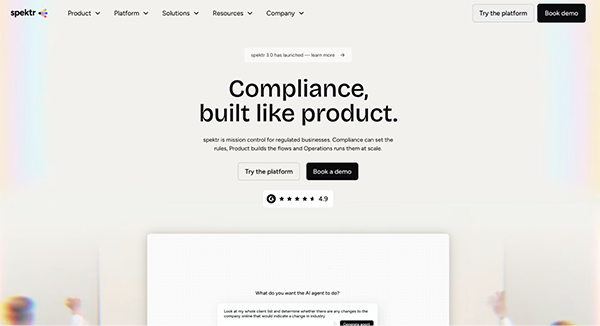
spektr is configurable compliance infrastructure that offers Product, Operations and Compliance one shared system for KYC and KYB onboarding, ongoing tracking and case work. Teams adjust workflows without engineering support and use pre-built AI agents for tasks, for example, KYB, document review, and source of funds analysis, or build their own. Its Policy Engine, added on September 1, 2026, turns uploaded policies into rules a compliance officer approves, and workflows and agents are assessed against them. Agents take on repetitive groundwork and suggest outcomes with cited evidence, while people make the final call and every action is noted for audit. Data is hosted in the EU, and the company holds ISO 27001, ISO 27701 and ISO 42001.
Best for: Teams that need their own policies to govern every process and agent.

Taktile is an agentic decision platform utilized for onboarding, credit, and fraud decisions. On its business onboarding page, agents verify entities, map UBOs, assess financials, and screen risk so reviewers receive a decision-ready case. Agents can recommend a decision and show their evidence and rationale for a human to approve. The platform mixes deterministic rules, machine learning models, AI agents, and human review in one flow.
Best for: Teams that need to design risk logic in a decision engine.
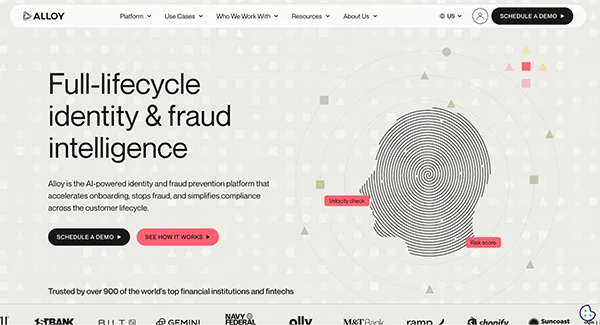
Alloy is an identity and fraud orchestration platform. Its orchestration page contains 270+ identity and fraud solutions available through the in-dashboard Partner Center, so teams can enter an applicant across several data providers. In January 2026 Alloy launched perpetual KYB in the UK and Europe, which re-runs checks and reassesses risk when meaningful business and ownership changes happen. Its July 2026 update reported more than 900 financial institution and fintech customers.
Best for: Teams that want broad access to third-party data providers through one orchestration layer.
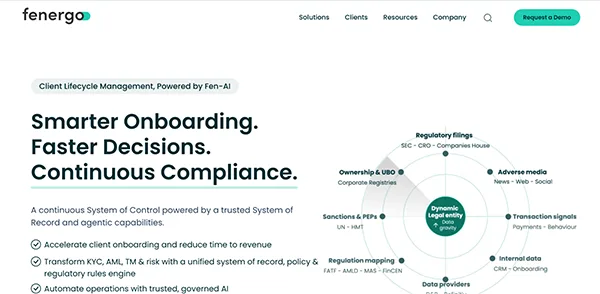
Fenergo is a client lifecycle management platform designed for banks and large financial institutions. On July 29, 2026 it launched Fen-AI, an orchestration layer for its KYRA agents covering onboarding, periodic reviews, ongoing tracking, and material client changes. The initial KYRA release includes six automation agents, and Fenergo explains human-in-the-loop oversight with detailed audit trails.
Best for: Large institutions running full client lifecycle management across several jurisdictions.

Pega’s CLM and KYC applications handle country- and product-specific rules such as AML/CTF, FATCA, CRS, and MiFID II for multi-jurisdiction clients. They include retail, wealth management, commercial, and institutional banking. Compliance teams can check rules through a zero-code rule management portal, and the applications cover a large library of out-of-the-box regulatory rules maintained with legal and regulatory specialists.
Best for: Enterprise banks onboarding complex multi-product clients across several countries.

NICE Actimize is a financial crime platform that combines KYC, screening, transaction monitoring, case management, and regulatory reporting. Its Suspicious Activity Monitoring product checks money-laundering patterns for investigation. The Enterprise Case Manager utilizes AI to support investigations from alert generation through case disposition. Its ActOne case management combines generative AI with human oversight.
Best for: Large institutions running detection-led AML programs.
Here’s a comparison table:
| Platform | Core focus | Policy control | Data sources | Human sign-off |
| spektr | Configurable compliance infrastructure with AI agents | Uploaded policies become approved rules that govern every process and agent | Connects existing registries and providers | Case AI recommends; a person signs off |
| Taktile | Agentic decision platform | Rules authored in decision flows | Integrated data providers | Humans approve agent-suggested decisions |
| Alloy | Identity and fraud orchestration | Configured decisioning policies | 270+ solutions via Partner Center | Analyst review in case workflows |
| Fenergo | Enterprise client lifecycle management | Policy-driven CLM workflows | Integrated screening and data providers | Human-in-the-loop oversight |
| Pega | Enterprise CLM and KYC | Zero-code rule management portal | Integrated data partners | Analyst-led review |
| NICE Actimize | Detection-led financial crime suite | Configured detection scenarios | Managed within its platform | Investigator review in case manager |
Ask each vendor to show one applicant: a company whose registry extract and ownership chart disagree, a missing proof-of-address document, and a director change after onboarding.
Evidence. Can a reviewer open the source behind each ownership link?
Exceptions. Where must an authorized person approve, and is the decision kept with its evidence?
Changes. Does the director change update the customer record and reach the right queue?
Integrations. How does the platform connect to the registries and data providers you already use, and who handles API management tasks such as access control and monitoring once it is live?
Commercial scope. Ask for a written breakdown of platform charges, data-provider costs, check volumes, implementation, and support.
Ans: It is a compliance platform that covers some or all of the same work, such as KYC and KYB onboarding, ongoing monitoring and case review, with a different approach to data, policy control or AI agents.
Ans: The platforms in this guide keep a person in the approval step for the agent work they describe. Agents take on repetitive groundwork such as gathering evidence, so analysts spend more time on judgment calls. They support people rather than replace them, and they do not guarantee regulatory compliance.
Ans: Most vendors in this space quote custom pricing. Ask each one to separate platform fees from data-provider costs so proposals can be compared fairly.
