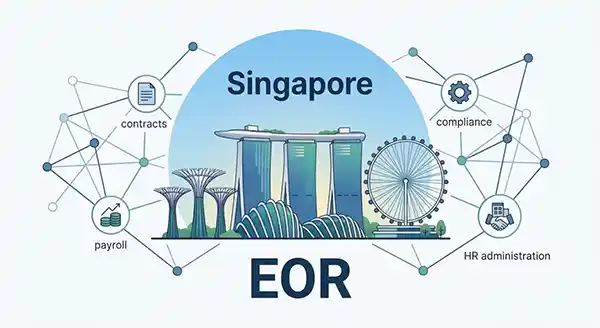
Hiring employees is not the same at every location. For instance, consider Singapore, where one doesn’t need to just look for an ideal candidate. Rather, the employer has to ensure that things are aligned with local employment laws, payroll, regular contributions, and other responsibilities.
This is where an Employer of Record (EOR) becomes critical to help employers handle tasks, allowing companies to hire in local spaces without further stress.
This guide shares the 7 best EOR providers in Singapore in 2026 to help businesses choose the right partner.
These three providers address the most typical hiring events in Singapore based on compliance depth, scale capability, and budget limits.
Singapore & APAC Native Compliance: BIPO
Multi-Country Global Evolution: Deel
Budget-Driven Mid-Market: Multiplier
Full List of Top 7 EOR Providers in Singapore
This list highlights the seven most capable platforms for placing remote staff locally in Singapore.
BIPO – Native APAC compliance and customized HR services
Deel – Multi-country scaling and automated onboarding processes
Multiplier – Flat-rate pricing for mid-market purse strings
Remote – Intellectual Property (IP) protection and equity oversight
G-P (Globalization Partners) – Enterprise security and legal help
Rippling – Unified IT hardware provisioning and HR coordination
Remofirst – Micro-team hiring at low monthly costs
Comparison Table
This table contrasts the primary services based on their minimum monthly fees, legal entity structure, and major market focus.
Provider
Starting Monthly EOR Fee (USD)
Singapore Direct Entity
Primary Operational Focus
BIPO
Custom Pricing
Yes
APAC Headquarters & Local Compliance
Deel
$599
Yes
Rapid Multi-Country Onboarding
Multiplier
$400
Yes
Mid-Market Cost Predictability
Remote
$599
Yes
IP Security & Equity Administration
G-P
Custom Pricing
Yes
Enterprise Legal Mitigation
Rippling
$599+
Yes
IT Device & Software Provisioning
Remofirst
$199
No (Partner Model)
Minimum Viable Budget Hiring
Note: Pricing reflects baseline starting tiers as of early 2026. Custom enterprise plans vary.
Detailed Reviews
After the superficial overview, this is the time to read insider facts and build a detailed understanding of the same:
1. BIPO
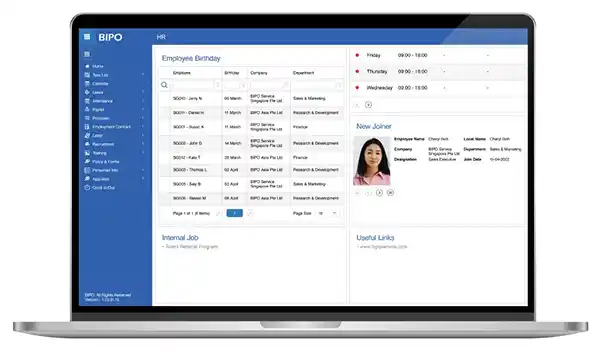
Headquartered in Singapore, BIPO functions as a direct-entity EOR with dedicated local account controllers.
Operational Model: BIPO uses a 100% owned legal entity to process statutory reimbursements under the Singapore Employment Act. This includes specific estimates for CPF, the Skills Development Levy (SDL), and the Foreign Worker Levy (FWL).
Key Differentiator: Direct-entity models limit compliance breach risks by 40% as opposed to partner-dependent models. BIPO also offers transitions to confidential Human Resource Management System (HRMS) software.
Use Case: Organizations developing an Asia-Pacific (APAC) headquarters in Singapore demanded strict local regulatory follow-up.
2. Deel
Deel largely depends on a software-driven workflow supervised by a direct Singapore entity to process multi-country hires synchronously.
Operational Model: The platform regulates Inland Revenue Authority of Singapore (IRAS) Form IR8A tax filings and statutory employer CPF withdrawals. Current MOM guidelines prescribe employer CPF payouts of up to 17% of an employee’s monthly wage.
Key Differentiator: Deel sorts through Singaporean employee onboarding documentation in 24 to 48 hours. The system administers simultaneous hiring operations across over 100 territories.
Use Case: Technology entrepreneurs managing distributed remote teams across 10 or more global jurisdictions at the same time.
Multiplier serves up a direct-entity EOR solution with flat-rate pricing uniquely structured for Small and Medium-sized Businesses (SMBs).
Operational Model: The system defines employment contracts with respect to Singapore local law. It automates statutory CPF and SDL evaluations without requiring manual client management.
Key Differentiator: Multiplier charges a simple flat monthly fee of $400 per employee. This pricing structure excludes the off-cycle processing charges and cancellation fees that are common in enterprise contracts.
Use Case: Mid-market startups need predictable monthly budgets and rapid compliance without premium administrative prices.
4. Remote
Remote utilizes a 100% owned-and-operated local entity concept focused heavily on Intellectual Property (IP) covering.
Operational Model: The platform implements IP transfer directly with Singapore jurisdiction laws through a proprietary legal architecture. Remote also acts as the withholding agent for local employment tax liabilities.
Key Differentiator: Remote automates the region-specific administration of Restricted Stock Units (RSUs) and stock options that change. This solves a specialized compliance condition cited by 65% of venture-backed tech startups.
Use Case: Deep-tech and biotechnology companies where guaranteeing proprietary source code and geographical equity distribution are primary constraints.
5. G-P (Globalization Partners)
G-P provides advisory-led employment services that use in-house legal teams for corporate risk mitigation strategies.
Operational Model: G-P works as a direct entity in Singapore and enforces stringent data residency protocols. The firm utilizes local legal counsel to fulfill multi-jurisdictional labor standards.
Key Differentiator: Enterprise organizations give priority to legal risk mitigation over software automation. G-P gives you dedicated 1-on-1 legal advisory for complex labor fights.
Use Case: Multinational Corporations (MNCs) and Fortune 500 companies with enormous compliance budgets prioritizing maximal legal risk mitigation.
6. Rippling
Rippling merges global payroll workflows with physical IT hardware management and software planning.
Operational Model: Beyond standard Singapore statutory compliance, Rippling works as an IT management system. Administrators use the software to ship physical laptops directly to Singaporean email addresses.
Key Differentiator: The software implicitly provisions and de-provisions access to cloud app stores based on employment contract status. This automation decreases onboarding administrative time by 50%.
Use Case: Software-intensive organizations demand unified control over employee authentication, local payroll, and physical hardware deployment.
7. Remofirst
Remofirst functions via a partner model to provide minimum entry pricing for early-stage corporations.
Operational Model: Rather than constituting a legal entity in Singapore, Remofirst utilizes a vetted network of local third-party consulting firms. These agencies hold the local contracts and process the compulsory CPF contributions.
Key Differentiator: Remofirst operates at a flat rate of $199 per employee per month. This represents a 66% cost reduction in contrast to the standard EOR baseline of $599.
Use Case: Early-stage founders hiring a single remote servicing agent or virtual assistant under strict budget controls.
In the end, choosing an EOR in Singapore depends on your present hiring goals, budgets, and compliance needs. For broad multi-country deployments, a software-first approach is best.
BIPO can be the best for businesses that are more focused on Singapore and the wider Asia-Pacific region. The core is to ensure that pricing, local entity arrangements, and other services are verified properly.
FAQs
Ans: An Employer of Record legally employs workers on behalf of another company and normally manages employment contracts and more.
Ans: BIPO is a major choice for businesses supporting local Singapore expertise and major Asia-Pacific operations.
Ans: Compare pricing, local employment aspects, compliance, payroll services, and other support-related things.