What actually is margin trading, and what is the main concept it functions on? It lets traders open positions by using borrowed funds, giving them greater market exposure than their available money.
This will have a lot of advantages and benefits, like more flexibility and an increase in the potential impact of gains, but it can impact losses as well. This also has risks. Before any decision, proper information is very important.
Read this blog ot learn all the details needed.
To learn modern financial markets, understanding the meaning of margin is important. Margin in trading means the minimum collateral deposit needed to open and keep an active position. When using margin in investment strategies, traders put up part of the total trade cost, while the broker provides the remaining capital.
The relationship between collateral, leverage, and position size governs how trades perform. Leverage acts as a multiplier, deciding how many times your deposit gets multiplied in the open market.
To handle this process, traders must understand some core ideas:
Think a trader wants to buy a currency pair priced at $100,000. Without taking funds, the trader would need the full $100,000 in cash. With a leverage ratio of 1:100, the calculation for the required margin is:
Margin Required = Total Position Value / Leverage Ratio
Margin Required = $100,000 / 100 = $1,000
The trader commits $1,000 as collateral to hold a $100,000 market exposure.
Before deploying capital, market participants must master core things that govern margin trading performance.
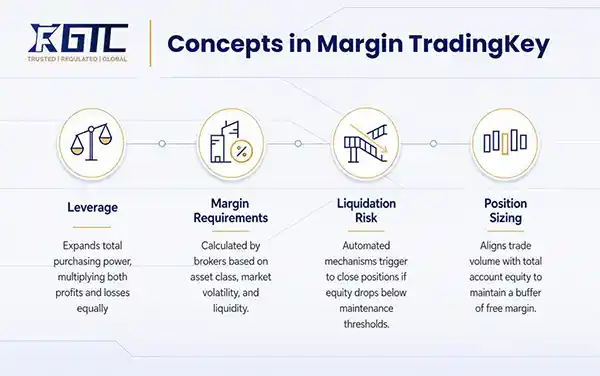
Leverage grows total purchasing power, multiplying both profits and losses equally. A 1% favorable price movement on a leveraged position has better relative returns on account equity. Conversely, a 1% move against the position generates an equal relative loss.
Brokers calculate margin needs based on asset class, market volatility, and liquidity. Highly liquid major currency pairs often need lower margin percentages compared to volatile exotics, single stocks, or commodities.
When market prices move against an open trade, account equity drops. If equity declines past the broker maintenance point, automated liquidation mechanisms trigger to stop negative equity balances, forcibly closing open positions.
Effective position sizing aligns trade volume with total account equity. Rather than utilizing maximum available margin on a single position, disciplined traders limit exposure per trade to keep a healthy buffer of free margin.
Leveraged trading gives many key structural benefits for modern investors looking for flexible market participation.
While capital leverage opens new chances, it poses risks that demand systematic management.
To protect trading capital, successful market participants enforce rigorous risk protocols:
For traders looking for a robust environment for margin trading, picking a good broker is vital. GTCFX gives access to over 27,000 instruments in forex, indices, commodities, precious metals, and equities.
GTCFX has competitive features tailored for beginner and institutional traders alike:
To start your trading journey, open a live trading account with GTCFX or look for trading strategies risk-free using a free demo account today.
Ans: Margin Trading Facility (MTF) is a service that enables you to purchase shares by paying only a portion of the total cost. The remaining amount is funded by Zerodha, and interest is charged on this amount.
Ans: As per regulations, the MTF funds statement is maintained separately and is displayed on Console. Users can click on the MTF category to view the MTF funds statement.
Ans: No. Collateral margin received from pledging shares or other securities cannot be used for MTF. Only cash in your trading account can be used to purchase stocks using MTF.